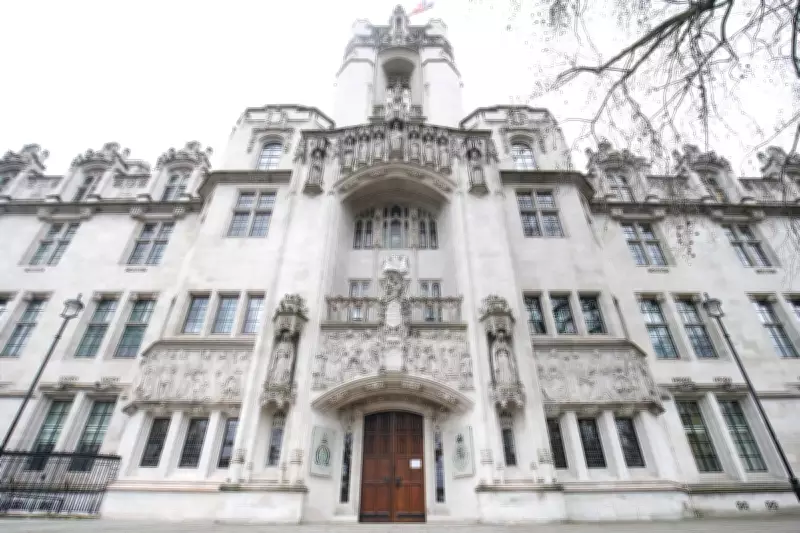
Supreme Court Overturns 40-Year Precedent, Allows Children to Claim 'Lost Years' Damages
The Supreme Court of the United Kingdom has delivered a landmark ruling that fundamentally alters the legal landscape for medical negligence claims involving children. In a decisive judgment, the court has declared that children can now claim damages for the years of life lost due to clinical negligence, overturning a legal precedent that had stood unchallenged for more than four decades.
Historic Legal Shift
On Wednesday, the UK's highest court declared that a 1981 Court of Appeal judgment, which had previously prevented children from receiving compensation for lost years while allowing it for adults and teenagers, was "incorrect" and "inconsistent with legal principle." This ruling represents a significant expansion of compensation rights for young victims of medical errors.
The decision was reached by a four-to-one majority, with Lord Reed delivering the majority opinion alongside Lords Briggs, Burrows and Stephens. The court ordered that the case be sent back to the High Court so that "lost years" damages could be properly assessed and awarded.

The Case That Changed Everything
The landmark ruling stems from a case involving an 11-year-old girl known only as CCC, who sued Sheffield Teaching Hospitals NHS Foundation Trust in 2020. CCC was diagnosed with cerebral palsy following a severe brain injury attributed to clinical negligence by the trust, leaving her requiring 24-hour care and significantly reducing her life expectancy to just 29 years.
In 2023, High Court Judge Mr Justice Ritchie ordered the trust to pay CCC approximately £6.8 million in damages, including £2.7 million already disbursed. However, the judge declined to award further damages for the years of CCC's life that would be shortened due to the negligence, citing that he was "bound" by the 1981 Court of Appeal decision.
Legal Reasoning and Dissent
In his ruling, Lord Reed addressed the fundamental legal question at stake: "One might observe that the attempt to exclude claims for the lost years where they are brought by young children invites the question where the line is to be drawn. In reality, because the distinction sought to be drawn between claims by young children and claims by older children or adults has no basis in legal principle, the court cannot draw a line."
The majority emphasized that "whatever the age of the claimant, it has to assess just compensation as best it can on the material which is reasonably available." This represents a significant departure from previous legal thinking that had excluded children from such claims based on the argument that they did not have "dependants."
In a dissenting opinion, Lady Rose expressed concern that assessing "lost years" damages for children could "push the court into uncomfortable territory" and went against the principle that "the loss to be compensated is the loss suffered." She argued that damages "should not extend to the lost years" where "there is no evidence before the court as to the claimant's earning capacity or individual characteristics."
Family and Legal Response
Following the ruling, CCC's mother expressed profound relief and gratitude: "I feel elated that my little girl has changed the law and that this will help lots of other children who have been injured through no fault of their own. To fight a case all the way to the Supreme Court has taken a huge amount of work and courage, and I want to thank our legal team from the bottom of my heart."
James Drydale, medical negligence partner at Sheffield law firm Taylor Emmet, which represented CCC, described feeling "absolutely elated" following the ruling, which he said "put right a historic injustice." He emphasized the fundamental fairness of the decision: "If your life has been significantly shortened by someone else's negligence, then I think most people would regard it as fair that amends should be made for that. Why should a child's life be any different?"
Financial Implications and Next Steps
The original claim included £823,506 in damages specifically for the "lost years" of CCC's life, with calculations based on approximately £17,000 for each year of her working life that was lost, and £8,750 for each lost year of her retirement, assuming she would have had a normal life expectancy.

While the trust admitted responsibility for the negligence in 2019, there was significant disagreement about the appropriate compensation amount. The trust's lawyers argued in June 2023 that it should pay just over £3.3 million in damages, while CCC's legal team contended she should receive around £9.2 million, including the lost years compensation.
Mr Drydale noted that the added damages would have a "major impact" on CCC and her family, stating that "they feel vindicated, they have shown great courage in doing this" and that "they are ready for the next round, hopefully the final round" as the case returns to the High Court for reassessment.
Broader Implications
This Supreme Court ruling establishes a new legal standard that will affect future medical negligence cases involving children across the United Kingdom. It recognizes that children who suffer life-shortening injuries due to clinical negligence deserve compensation for their lost years, just as adults do, removing what legal experts have described as an arbitrary and unjust distinction.
The decision underscores the court's commitment to ensuring "just compensation" for all victims of medical negligence, regardless of age, and represents a significant step forward in the protection of children's rights within the UK legal system.