Myanmar's military government has declared a record-breaking confiscation of illegal narcotics and manufacturing equipment, marking the largest such seizure in the country's history. The announcement, made via state media on Thursday, 15 January 2026, follows a major operation in the conflict-ridden north.
Unprecedented Raids on Production Hubs
The massive haul was the result of a large-scale security operation conducted between 8 and 12 January. Forces targeted suspected drug production and online scam centres in northern Shan State. According to reports in state-run newspapers like Myanma Alinn, the core action took place on 10-11 January with raids on three major drug manufacturing facilities.
Home Affairs Minister Lieutenant General Tun Tun Naung detailed the operation at a Wednesday news conference. The three sites, located just kilometres apart in Mongyai township, were sophisticated operations. Mongyai is situated approximately 200 kilometres northeast of Mandalay, Myanmar's second city.

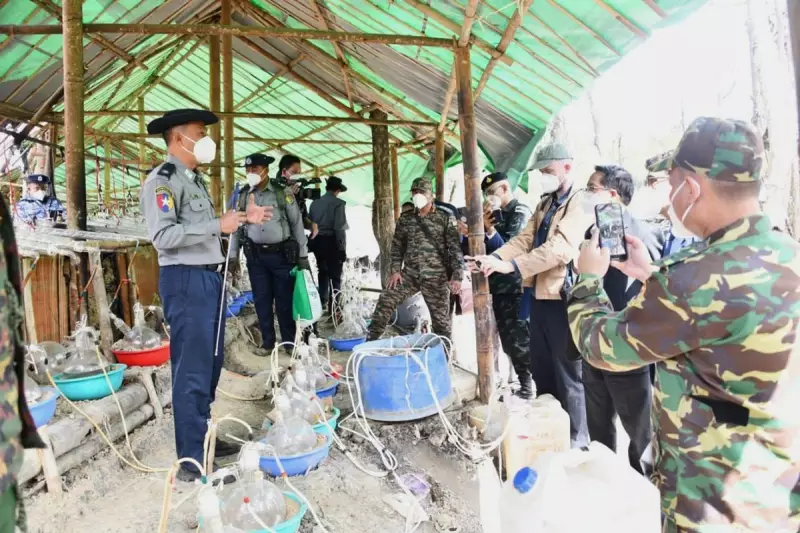
The minister confirmed the facilities were producing a cocktail of hard drugs, including heroin, methamphetamine, and crystal methamphetamine ('ice'). Official military photographs depicted extensive setups with dozens of blue barrels filled with powder, gas cylinders, large mixing vats, and complex glassware tubing systems housed in makeshift structures.
Links to Insurgency and Regional Trafficking
The military was quick to link the operations to ethnic armed groups challenging its authority. Tun Tun Naung asserted that drug sales were a major income source for insurgent groups. He stated that six individuals connected to the Shan State Progress Party (SSPP) were arrested at one site. The SSPP, engaged in long-running conflict with the army, later denied any involvement with illegal groups in the operation zones.
Major General Zaw Min Tun, the military's spokesperson, suggested the raided sites might constitute the country's primary drug-production hubs. He outlined trafficking routes running from the region to neighbouring Bangladesh, Thailand, and Malaysia, as well as through conflict zones in western, northwestern, and southeastern Myanmar.
In a subsequent development, state broadcaster MRTV reported on Thursday evening that security forces had raided a fourth narcotics production site located close to the original three.
A Deep-Rooted Problem Amid Civil War
The scale of the bust underscores Myanmar's entrenched role in the global drug trade, historically attributed to ethnic minority groups funding armed struggles for autonomy. The UN has labelled the nation the world's largest producer of methamphetamine and noted a surge in opium cultivation.
Tun Tun Naung provided staggering national figures: over the past five years, authorities have seized drugs valued at more than 5,900 billion kyats (around £2.8 billion), destroyed over 10,000 hectares of opium poppy fields, and arrested more than 43,900 people for drug-related crimes.
UN drug experts directly connect the booming trade to the country's instability. The civil war, which erupted after the 2021 military coup, has created conditions that facilitate illicit drug production and distribution on an industrial scale, destabilising the entire Asia-Pacific region.