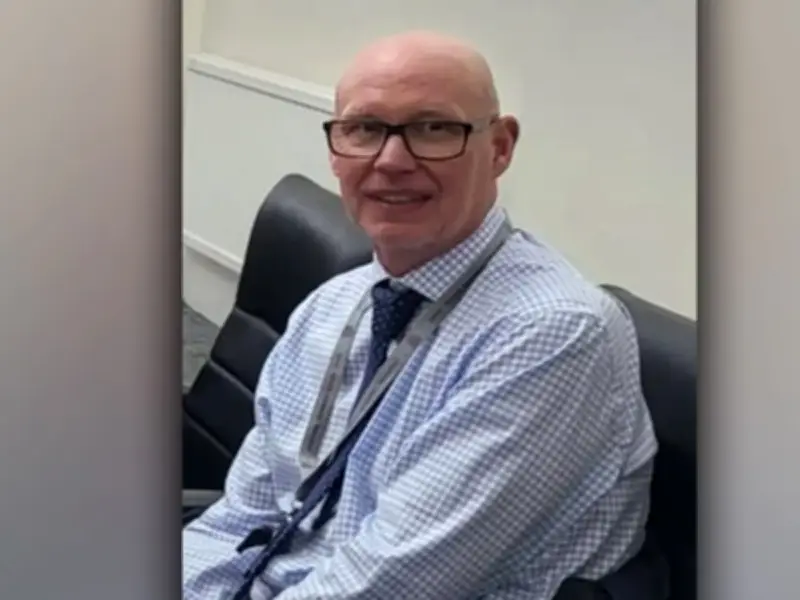
The trial of a man accused of murdering Stretford Grammar headteacher Michael Mullins has heard how the 56-year-old was dragged under a car for 1.3 miles after being struck while cycling home. Simon Richardson, 35, denies murder, manslaughter, and dangerous driving.
Richardson allegedly struck Mr Mullins with his Volvo at the junction of Dunham Road and Warburton Lane in Altrincham in April, prosecutors told Minshull Street Crown Court. Mr Mullins was making his way home to Northwich from work at the time.
The prosecution alleges that Richardson failed to properly observe the junction, 'flying straight through the give way markers', before hitting Mr Mullins. It is further alleged that Richardson 'put his foot down' as Mr Mullins was trapped under the car, while his damaged bike was left in the road.
Dragged for 1.3 miles
Mr Mullins was dragged under the wheels of the car for 1.3 miles (2.2km) before dying at the roadside on Wet Gate Lane in Lymm, the court heard. Prosecutors allege that Richardson later stopped, got out of the car, and made 'concerted physical efforts' to try and pull Mr Mullins out from underneath the vehicle.
He then carried on driving, veering 'sharply and deliberately' from side to side and mounting a grass verge. Witnesses followed a trail of blood in the road before finding Mr Mullins fatally injured. He was pronounced dead at the scene.
Richardson, of no fixed abode but formerly of Epsom Avenue, Sale, denies murder, an alternate offence of manslaughter, and dangerous driving.
Day 1 - Tuesday, October 13th
As the case opened, jurors were told the incident happened on April 20 this year. Mr Mullins finished work at the school at around 5.30pm, leaving at 5.35pm. He was described as a 'plainly fit man', regularly cycling to the school in Stretford from his home in Northwich.
The court heard his journey took him out of Stretford, through Urmston and Flixton, across the River Mersey into Carrington, through Partington towards the village of Lymm and over the border into Cheshire. The route was regularly recorded on his Apple Watch, jurors heard.
By 6.07pm he had reached Warburton Lane and was cycling south, it was said. Richardson - driving a black Volvo XC90 - was nearing the end of Dunham Road, where he was required to give way to traffic on Warburton Lane, the court heard.
"And that, of course, includes Mr Mullins, who at that moment is cycling across the front of him, in plain view," prosecutor Phil Barnes KC said. He told jurors: "What happened next was captured by a CCTV camera, but the view was obscured by trees. What you are about to hear – but not see – is the defendant completely fail to observe that junction, flying straight through the give way markers, and collide into the left-hand side of Michael Mullins on his bike."
Other motorists who witnessed the crash stopped and called 999, the court heard. Richardson, jurors were told, didn't stop. "Simon Richardson did not stop to see if the man he had just ploughed into was okay," Mr Barnes added. "Simon Richardson, knowing he was to blame for what had happened, turned his head, put his foot down and – at times travelling at double the speed limit or more – he fled the scene."
Jurors heard Mr Mullins' damaged bike was left in the road on Paddock Lane, which follows on from Warburton Lane. Mr Mullins was 'nowhere to be found', the prosecutor said. "Why?," Mr Barnes continued. "Because he was trapped beneath Simon Richardson's car... his foot entangled in the suspension and steering architecture of the front-left hand wheel."
"And as Simon Richardson fled the scene of a collision which was entirely his fault, he was dragging the stricken Michael Mullins along the ground, right beneath his feet."
The prosecution says Richardson knew Mr Mullins was 'trapped and injured, but alive' and that he knew his actions would kill him or cause him 'the gravest of injuries'.
The court heard that after the collision, Richardson was captured by an ANPR camera driving 60mph in a 30mph zone, with visible damage to the Volvo. The driver's side window was all the way down, it was said. In CCTV footage from outside restaurant La Boheme, Mr Mullins could be seen, with his foot caught in the front left wheel assembly of the Volvo, being 'dragged to his death', the court heard.
The court heard blood was left in the road as Mr Mullins was dragged along. "It would have taken no more than a glance in the rear-view mirror for the defendant to see that ghoulish line being drawn on the road behind him," Mr Barnes added.
The court heard Richardson turned onto Wet Gate Lane - with the trail of blood leaving an 'arc shape' - before stopping. Prosecutors said the car stopped for around 90 seconds. It is alleged Richardson went to the left-hand side of the car and made 'concerted physical efforts' to try and pull Mr Mullins out from underneath.
Jurors were told he then went back to the driver's seat and turned the wheel hard to the right in an effort to remove Mr Mullins from the steering assembly, before going back around to attempt to free the headteacher. The court heard he got back into the car and drove on, approaching Wet Gate Lane Farm. Prosecutors said footage showed the defendant 'veered sharply and deliberately' from side to side - then mounted a grass verge - in an attempt to cut Mr Mullins loose.
"What he did in those moments, we suggest, may speak volumes about what he knew he had done," Mr Barnes said.
The court heard those who witnessed the collision followed the trail of blood before finding Mr Mullins lying on the grass verge. Emergency services attended, but sadly he was pronounced dead at 6.50pm.
A post mortem concluded Mr Mullins died from multiple injuries. The court heard he had sustained a head injury during the collision, but it was not sufficient to cause his death. "No, Mr Mullins died not from the initial collision, but from the time he spent being dragged under this defendant's car, when this defendant knew he was there, and then ejected and crushed by its wheels," Mr Barnes said.
Jurors heard Richardson then drove to Lymm before filling up his car at a petrol station. His passenger - cousin Gabrielle Debotte - could be seen with her head in her hands, it was said. They then went to collect weight loss medication from a clinic in the village before returning to Ms Debotte's home in Altrincham, the court heard.
Jurors were told Richardson arranged to swap his Volvo with a friend before attempting to concoct a 'false alibi'. The next day Ms Debotte broke down and told work colleagues what had happened, the court heard. She was taken to a police station where she was initially arrested, it was said. She has not been charged with an offence, jurors heard.
Richardson was spotted the same day in a Ford Transit van in Failsworth, Oldham, and drove away from officers during a short pursuit in which he was said to have driven dangerously, the court heard. He was arrested and interviewed, and provided no comment, jurors heard.
Day 2 - Wednesday, October 13th
On the second day of the trial, jurors heard a number of statements from witnesses of the collision. Terry Snowdon said his wife was driving towards Partington at the time of the crash, "I said to my wife 'oh s**t, he's hit him'," he said. "There was a short sharp thug - metal on metal. The cyclist left the ground momentarily, no more than 3 to 4ft, before hitting the ground."
Kirsten Biggs, who was driving her grey BMW towards the junction of Dunham Road and Warburton Lane, said she saw the Volvo travelling 'extremely fast'. "It was absolutely tanking it... in excess of the speed limit, it kept edging out into the opposite lane in an attempt to overtake the vehicle in front," she said in a statement. "I was four or five car lengths away. It was bobbing and weaving in and out, and not travelling in straight lane."
Dog walker Peter Connell said he saw the Volvo on Mill Lane. It caught his attention because it was making an 'unusual sound, like something flapping around, like cardboard or plastic sheeting', he said in a statement. He said he looked at the Volvo as it passed and could see an object underneath that was 'all different colours, looking like clothing'.
Off-duty Police Constable Claire Bailey said she was passing the scene of the crash at 6.25pm and used her motorbike to block the road. "I could see a pedal cycle in the middle of the road," she said. "I could see a mobile phone. There were two tyre marks on the road. Further down the road I could see a water bottle. I couldn’t see a vehicle." Pc Bailey said she then called 999 'to inform them the cyclist was potentially under the vehicle as he wasn’t at the scene'.
Motorcyclist Andrew Besant-Roberts noticed the 'strange' trail after finding a 'damaged and bent' bicycle in the road surrounded by confused drivers who were looking for the rider. Besant-Roberts rode on his Kawasaki motorbike until he came across critically-injured Mr Mullins, 56, lying on a grass verge, a jury was told. "It looked suspicious," he said of the blood trail, in a statement read out in court. "It suddenly occurred to me that it was blood. As it went over a white line I could see it was red."
Mr Besant-Jones followed the trail until he saw a badly-injured and unconscious Mr Mullins lying on a grass verge at the side of the road. He called 999 and performed CPR until paramedics arrived. "His breathing became worse," he said. "There were long pauses then it stopped."
Earlier, a motorist parked at the Green Dragon pub in Mill Lane said she noticed something underneath a vehicle travelling at speed. In a witness statement, Katie Woodward said: "My first thought was that it was a body but I thought this was ridiculous and surely a body can’t be under the car. I convinced myself it must have been an animal. As the vehicle drove along the road I saw it was leaving a trail coming from the passenger side." She too decided to follow the 'thick, dark trail', the court was told, which stopped where Mr Mullins laid as he was being tended to by Mr Besant-Roberts.
Day 3 - Thursday, October 15th
On Thursday, jurors heard evidence from forensic collision investigation for Greater Manchester Police, PC Mark Noonan, who showed the jury a number of CCTV clips of the Volvo before and after the collision. Footage from a house 60 metres before the junction showed the car travelling at 55mph, the court heard. The speed limit in that area is 40mph, PC Noonan said.
The officer said he visited the scene shortly after the collision and noted the road was dry with no marks or defects which would have affected driving conditions. When he arrived at the scene, PC Noonan said he saw Mr Mullins’ damaged bike lying in the carriageway. Fragments of carbon fibre from his helmet were also in the road and 'body scuff marks' ran alongside the tyre marks, the witness said.
PC Noonan showed the jury a second piece of footage, taken from Mill Lane, after the collision site. In this clip, the Volvo was going 43.3mph, the officer calculated. At this point, it is alleged Mr Mullins was underneath the car. The final CCTV clip shown to the jury captured the Volvo pulling in towards the grass verge on Wet Gate Lane. PC Noonan said the movement of the vehicle was consistent with it running over Mr Mullins before driving away.
The jury has been shown damage to the underside of the Volvo which investigators say is consistent with a person being dragged beneath the car. Damage to the bumper was consistent with it colliding with the bike frame and dents to the bonnet suggested it had come into contact with a person, PC Noonan said. A 'bullseye' pattern of shattered glass on the windscreen was consistent with it being struck by Mr Mullins' bike helmet.
Day 4 - Friday, October 16th
On day four of the trial, jurors heard evidence from consultant forensic pathologist Dr Jamie Robinson. He confirmed he had recorded the cause of Mr Mullins' death as multiple injuries. Jurors were handed a document containing digitised images of the injuries Mr Mullins sustained. These included a large number of bruises and abrasions to his head, face, scalp, arms, legs and chest area.
Dr Robinson said that on the left side of his body there was a large wound, stretching from his shoulder to his left thigh. He said: "There are other aspects to this injury, in the left shoulder underlying muscle and bone were exposed. The most severe part of the injury is towards the left buttock region. The muscle is almost completely worn away, exposing the bone at the back of the pelvis, which is also partially worn down."
The pathologist said this was caused due to the body's contact with a 'rough surface', such as a road surface, over a prolonged period of time. He said Mr Mullins had a fracture to his sternum, and multiple extensive rib fractures, which were worse on the right side of his chest. He said: "Some may be caused by resuscitation attempts. All of the fractures could be caused by an initial impact or a crush type scenario where a car had overrun the chest."
Dr Robinson said both of Mr Mullins' lungs were bruised, and his right lung was 'torn'. "Such injuries can be caused by severe impact or a crush," he said. Asked by prosecutor Phil Barnes KC: "What part did the drag injuries play in his death?" He replied: "I think if it was those injuries alone, they would be life threatening, but they certainly sped up death, particularly to the crush type injuries in the chest." "Would it be possible that his death was caused by dragging?" he was asked. He confirmed: "Yes".
Jurors also heard evidence from forensic scientist Robert Harvey who analysed photographs of the blood staining and the 'trail' to Wet Gate Lane, in Lymm, along with the footage from the police helicopter. Of the trail, Mr Harvey said: "From the area where Mr Mullins’ bike was located and the area he was found, there is what appears to be a streak of blood on the road between those two areas. A smear or a drag mark. A smear or drag mark is a contact stain, when wet blood comes into contact with another surface whilst moving."
The court was shown an image of the blood trail in which more blood appears to have pooled in one section of the road. Mr Harvey confirmed that his view was that the car had been stationary in that location for a longer period.