
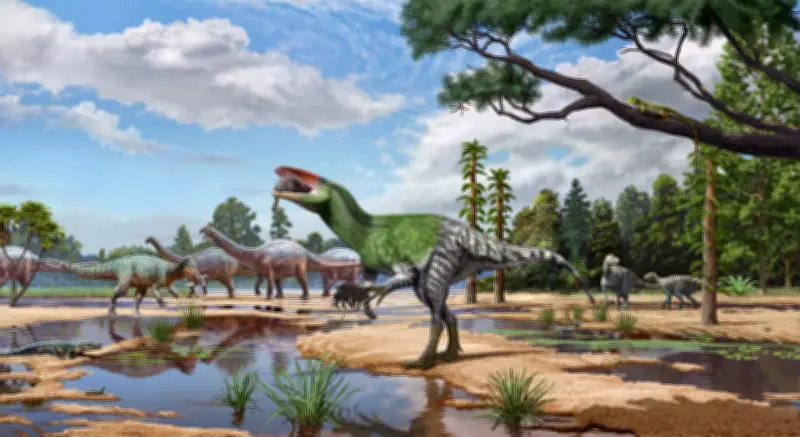
A new species of dinosaur has been discovered from a fossil found on the Isle of Wight which has been “overlooked” for study for more than a century, researchers said.
The dinosaur, a long-clawed predator the size of a large tiger, is the first of a group of two-legged carnivores called megaraptorans to be found in Europe, according to the research team led by University College London (UCL).
Fossil acquired in 1924
The fossil from which the discovery was made is a part of a skull which was acquired by the Natural History Museum in 1924.
This new species of megaraptorans, which were closely related to tyrannosaurs including Tyrannosaurus rex, lived in the UK in the early cretaceous period around 120 million years ago.
It has been named Invictibellatrix amberina, with the former meaning “unconquered female warrior”.
Researcher's comments
Dr Cassius Morrison, the lead author of the paper documenting the finding, published in the journal Royal Society Open Science, said: “It was not the apex predator of its time, but for humans this dinosaur would have been more dangerous than a T rex.
“We would have been perfectly sized prey, about a third of their body weight. They definitely would have chased us.
“A T rex would not have bothered, as we would have been too small.
“It is a real mystery that this fossil was overlooked for so long, sitting in a drawer for nearly 100 years.
“Lots of bones are found on the Isle of Wight – who knows what else is waiting to be discovered.”
Physical characteristics and history
He said Invictibellatrix would have been three to four-metres long, just over a metre and a half in height, with feathers and claws between 10 and 20cm long.
It would have eaten small dinosaurs, lizards and mammals.
The fossil was originally found at the foot of a cliff on the south-west coast of the Isle of Wight by amateur palaeontologist Reginald Walter Tooley.
Megaraptors are thought to have originated in Asia before migrating through Europe.
The research was funded by the Palaeontographical Society, the Royal Society and UK Research and Innovation.




