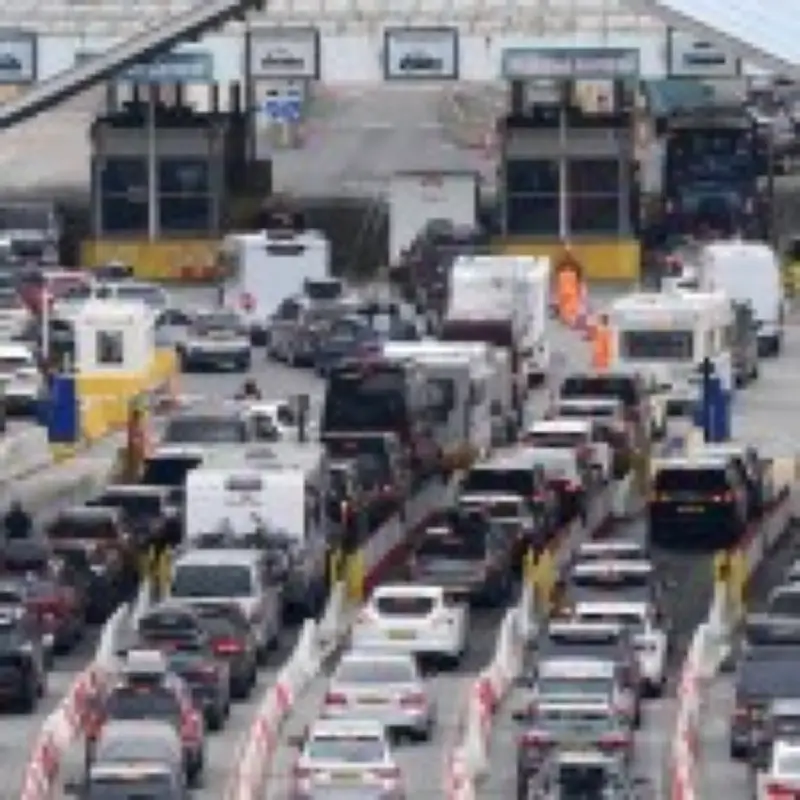
An estimated 14.1 million motorists are expected to take to UK roads between Friday and Sunday, marking the busiest summer weekend in four years. The RAC predicts Saturday will be the most congested day, with 3.8 million journeys planned, while Friday and Sunday each see 3.4 million trips. An additional 6.8 million trips are spread across the three days as drivers remain undecided on their departure day.
Second-highest traffic since 2016
This weekend's traffic volume is the second-highest since data tracking began in 2016, surpassed only by 2022's 18.8 million when COVID-19 lockdown restrictions were lifted. The surge coincides with the start of the six-week summer break for most students in England and Wales, while schools in Scotland and Northern Ireland are already on holiday.
Staycation hotspots and congestion
Staycations have grown in popularity, with the south-west and north-west of England expected to see the most leisure traffic. Transport analytics company Inrix identified several congestion hotspots, including the M1 southbound from Northampton (junction 16) to Watford (junction 6), the M25 clockwise from Junction 15 (M4) to Junction 19 (Watford), and the M25 anticlockwise from Junction 17 (Maple Cross) to Junction 12 (M3).
RAC spokesperson Harriet Hernando advised drivers to plan their journeys, setting off earlier or later in the day to avoid jams. “People should prepare for delays and getting stuck in a jam in potentially very hot weather,” Hernando said, urging travellers to carry plenty of water, sun cream, and an umbrella for shade.
Port of Dover and EU border checks
The Port of Dover reported approximately 7,500 outbound cars on Friday and 10,000 on Saturday. A statement issued Saturday afternoon said: “Traffic remains steady, with an approximate 32-minute wait time in the buffer zone. All operators currently have queues building at their check-ins, while the port approaches remain clear and traffic is flowing well. Safe travels!”
Ferry passengers were advised not to arrive earlier than two hours before departure, following wait times of up to an hour the previous day. Port of Dover chief executive Doug Bannister expressed disappointment that a new Entry/Exit System (EES) processing facility, built as part of a £40 million investment, was not being used for cars because the technology had not been activated.
During the May half-term, the port declared a critical incident when waiting times reached four-and-a-half hours, with around 8,500 outbound vehicles. The EES, fully rolled out in April, requires non-EU travellers to register fingerprints and photographs when entering the Schengen Area. The system applies to 29 European countries, including Austria, Belgium, France, Germany, Italy, Spain, and Switzerland. For most UK travellers, the process occurs at foreign airports, but it is also conducted at the Port of Dover, Eurotunnel's Folkestone terminal, and London St Pancras railway station.