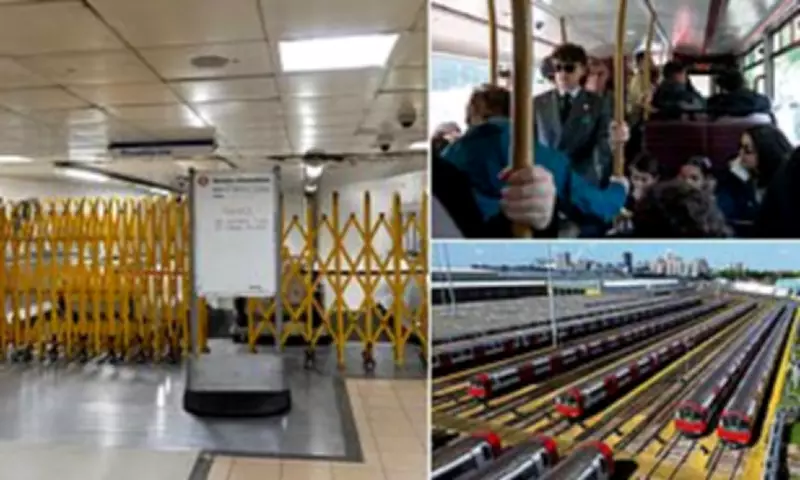
London Braces for Third Consecutive Day of Tube Strike Chaos
Londoners are facing a third day of severe travel disruption this afternoon as Underground drivers commence another 24-hour strike at midday. This latest walkout follows two previous days of industrial action, with the Rail, Maritime and Transport union (RMT) leading the protests against Transport for London's proposed four-day working week.
Widespread Service Suspensions and Economic Impact
The strike has resulted in complete suspension of the Piccadilly and Circle lines, with significant sections of the Metropolitan and Central lines also closed. Other Underground lines are operating reduced services that will end early, creating what experts estimate could be a £250 million blow to the London economy.
Hundreds of thousands of commuters have been forced to find alternative transport methods, with many choosing to walk, cycle, or rely on overcrowded buses. Some workers have opted to work from home, leading to what pub chains describe as some of their "lowest trading days to date." Hospitality businesses report bookings could fall by up to two-thirds during the strike period.

Political Divisions Over Industrial Action
The Green Party has thrown its support behind the striking drivers, with London Assembly leader Caroline Russell stating: "The drivers are raising really important issues about their working conditions that ultimately affect safety. What's important is that TfL listens and engages with the striking drivers so that their issues can be addressed through dialogue."
Conservative transport spokesman Richard Holden offered a contrasting view, telling The Standard: "We can see the chaos the Greens would bring to Britain. Strikes, disruption, and making ordinary working people pay the price for their weird far-left ideological politics." Reform UK's London mayoral candidate Laila Cunningham added that the Greens were a "danger to London" for supporting the strikers.
Specific Service Disruptions and Alternative Transport
Tube services ran normally this morning but began reducing from mid-morning, with significant disruption commencing at midday when the strike action officially started. No service is expected on the Piccadilly and Circle lines throughout the strike period. The Metropolitan line will be closed between Baker Street and Aldgate, while the Central line will have no service between White City and Liverpool Street.
Any services that do operate will be less frequent, extremely busy, and passengers may not be able to board the first available train. The strike action will continue until midday tomorrow, after which services will gradually recover through the afternoon, though disruption is expected to continue into the evening.
Other TfL services including the Elizabeth line, Docklands Light Railway, London Overground, Trams and most bus routes are expected to run normally, though they are likely to be exceptionally busy. A separate 24-hour bus strike beginning at 5am tomorrow will affect seven routes in East London: the 8, 25, 205, 425, N8, N25 and N205 services.
Business Impact and Economic Consequences
Mark Reynolds, director of the Three Cheers Pub Group, reported that Tuesday's strike had "destroyed" trade at its Trafalgar Pub in Chelsea. "We're looking at one of our lowest trading days to date," he said. "It's incredibly frustrating for businesses who are impacted negatively. There is no compensation in the form of business rates or rent reductions."
The Centre for Economics and Business Research estimates that the combined direct costs of the three Tube strikes scheduled for this week and in May and June could total between £360 million and £760 million – averaging up to £253 million for each strike day. The last five-day RMT Tube strike in September 2025 cost TfL between £20 million and £25 million in lost fares alone.
Alternative Transport Patterns Emerging
Live cycle data from Camden Council indicates more than 10,000 people cycled through Bloomsbury Way in the West End on Tuesday, representing a 75 percent increase over the daily average. Transport hire app Voi, which operates approximately 4,000 e-bikes and thousands of e-scooters in London, reported a 52 percent increase in rides taken on its vehicles, along with a 110 percent spike in new users.

Major employers have adapted to the disruption, with Amazon workers who normally travel into the City working from home on Tuesday, while JP Morgan bankers were reportedly told to negotiate with managers about remote working arrangements.
Controversy Over Driver Recruitment Practices
The strike has reignited debate about Tube driver recruitment practices, with campaigners calling for TfL to break what they describe as the RMT's "stranglehold" over the capital by opening driver positions to external candidates. Currently, these lucrative roles – with base salaries around £71,170 annually and total earnings often reaching £75,000 to £80,000 – are almost never advertised to the general public due to an agreement with the union.
William Yarwood, campaigns director at the TaxPayers' Alliance, told the Mail: "It is an insult to Londoners that these closed shop roles remain a private members' club for union buddies. By blocking external recruitment, unions kill off competition and artificially inflate wages, leaving taxpayers to bankroll a gold-plated payroll for a protected few."
A TfL source insisted there was no ban on external recruitment, but acknowledged that the agreement with unions requires vacant positions to be advertised internally first, at which point they are typically filled rapidly.
Union Positions and Working Conditions Dispute
RMT leaders are resisting TfL's introduction of a four-day working week, claiming it could increase fatigue and compromise safety. RMT boss Eddie Dempsey stated: "We have approached negotiations with TfL in good faith throughout this entire process. But despite our best efforts, TfL seem unwilling to make any concessions in a bid to avert strike action."
In contrast, Aslef, which also represents Tube drivers, has accepted the changes that would reduce the average driver's working week from 36 to 35 hours. An Aslef spokesperson expressed surprise at the RMT's strike action, noting: "It will be the first strike in the history of the trade union movement designed to stop people having a shorter working week and more time off."
Hospitality Sector Suffers Significant Losses
Hospitality AI tech company Access Hospitality predicts bookings at London businesses could fall by up to 67 percent during the strikes, with walk-in customers dropping by nearly 70 percent based on data from previous industrial action. Emma McClarkin, chief executive of the British Beer and Pub Association, highlighted that London's pubs typically generate approximately £80 million in gross value added between Tuesday and Friday alone.
"This doesn't just boost the economy but represents the jobs, high streets, and community spirit that revolve around pubs," she said. "At a time when so many locals are already operating on a knife edge because of huge costs, significant disruption to trade will be acutely felt."
TfL's Position and Future Strike Dates
Claire Mann, TfL's chief operating officer, defended the organization's proposals: "We have set out proposals to the RMT for a four-day working week. This allows us to offer train operators an additional day off, whilst at the same time bringing London Underground in line with the working patterns of other train operating companies, improving reliability and flexibility at no additional cost."
She emphasized that the changes would be voluntary, with no reduction in contractual hours, and those wishing to continue a five-day working week would be able to do so. Picket lines have been mounted outside Underground stations, and two more strikes are planned for May 19-22 and June 16-19 unless the dispute is resolved.