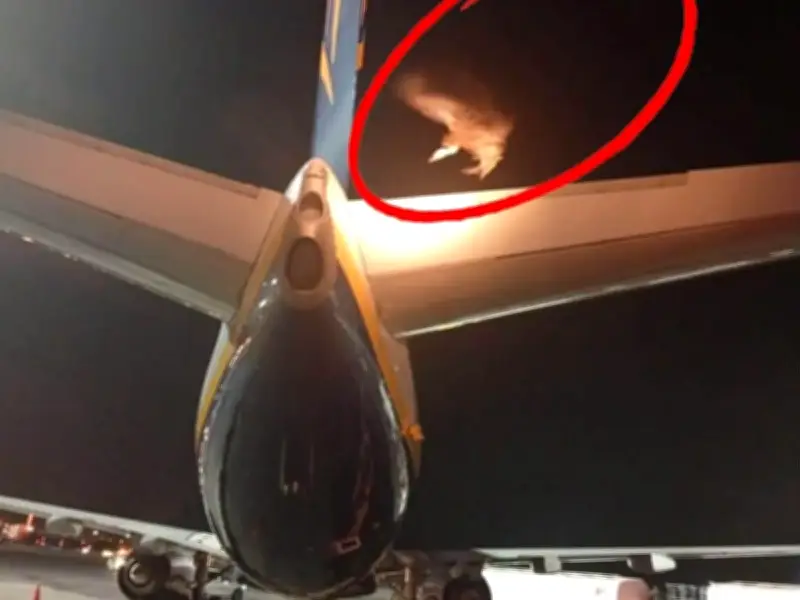
A Ryanair flight was delayed after a flesh-eating vulture perched itself on one of the wings and refused to move.
The frightening-looking griffon vulture was pictured sitting calmly on the aircraft while it sat on the tarmac at Crete's Heraklion airport, even refusing to move an inch when poked and nudged by a team of firefighters equipped with a ladder.
Pilot activated flaps to no avail
Incredibly, even the pilot activated the plane's wing flaps ahead of take-off, the massive bird remained still, leading to the scheduled flight being pushed back. Firefighter Antonis Petrakis told Greek media about the problem, calling it an "unprecedented incident", adding that the bird was "completely calm" in spite of its precarious location.
He explained: "From what I saw, it had no injury or other problems. It was probably still young and was likely just taking its first flights".
Bird moved of its own accord
Eventually, Petrakis and his team were able to move the bird after it decided to fly from the wing onto the tarmac seemingly of its own accord. Petrakis explained: "I immediately ran over with a colleague, we caught it and put a fire brigade jacket over its head so it couldn't see anything and would calm down. And that worked," he said of Sunday's incident.
The incredible occurrence was posted on Facebook, where many celebrated the fact that the bird was able to leave the plane on its own terms. One user wrote: "Bravo to you! Congratulations to everyone who saved him! Because it's an endangered species."
Endangered species in Crete
Another mused that the recent wildfires might have caused it to take up this unusual habitat, saying: "They have been eaten by hunger and thirst . . . from the fire".
Griffon vultures are native to Crete. They feed mainly on the flesh of dead animals rather than hunting live prey. Griffon vultures can have wingspans approaching nine feet and use their sharp eyesight to spot carcasses while soaring high above the landscape. They are considered "Critically Endangered" in Greece as a whole, but the specific population on Crete is classified as "Threatened" and serves as the largest and most stable refuge for the species in the country.