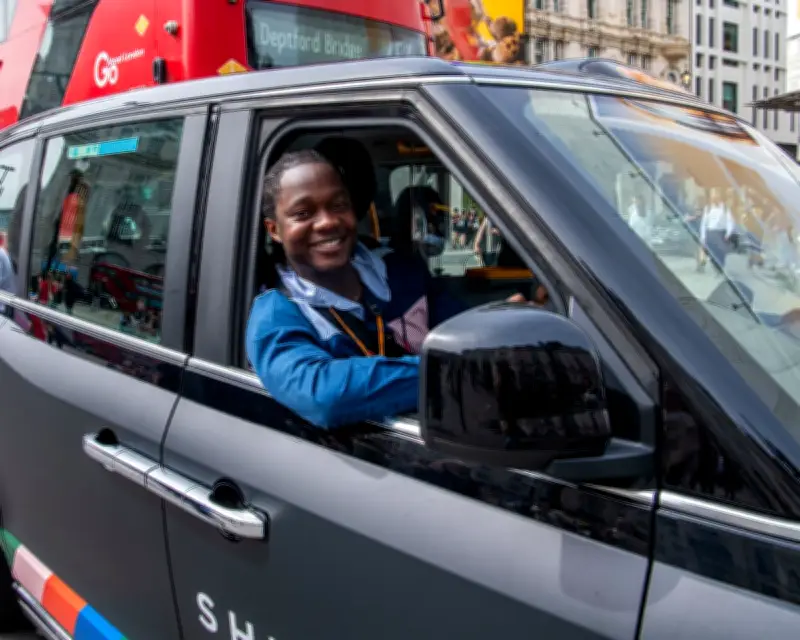
Bahrain Mujagata, at just 21 years old, has become London's youngest licensed black-cab driver after completing the notoriously demanding Knowledge test in two years and five months—a feat that typically takes most candidates three to four years, according to Transport for London. He balances taxi driving with university studies in computer science and acting classes.
A Rare Achievement in an Aging Industry
The number of licensed black-cab drivers has fallen by more than a third over the past decade, with most drivers aged 54 or older. Mujagata's achievement stands out not only for his youth but also for his speed. He began learning the Knowledge while studying for A-levels, applying to university, and adjusting to life in Britain after moving from Uganda four years ago.
His father and brother are also black-cab drivers, which provided him with a unique advantage. “The easiest part of the process was that other people had to travel to different houses for a Knowledge teacher, but I had one in my own house,” he said. His father guided him through the process, while the family adjusted schedules to support him.
Rigorous Training and Sacrifice
To qualify, candidates must memorize London's network of roughly 25,000 streets along with thousands of landmarks, stations, hotels, theatres, hospitals, and public buildings. They face oral examinations where examiners can ask for the shortest legal route between any two points, accounting for one-way systems, restrictions, and banned turns.
Mujagata's bedroom wall was covered with a large map of London. He woke at 4am to practice routes on a moped before traffic built up, revised during breaks in college, and sometimes woke in the middle of the night to study. “I didn't sleep properly for two or three years,” he said. The moped rides were draining, especially in winter, and he incurred parking and traffic fines while focusing more on memorizing routes than driving. The oral exams were particularly daunting: “The exam was very scary,” he admitted.
Public Attention and Future Outlook
Customers have given him flowers, chocolates, tips, and even Formula One tickets after discovering his age. Some people flag him down just to say hello. “Very many customers have noticed me before,” he said. “They don't even take the cab. They'll just stop me and go: ‘I know who you are.’ And I'll be disappointed and happy at the same time because I thought I got a job.”
Despite industry concerns about the future—especially with government plans to allow self-driving taxis—Mujagata remains optimistic. Companies like Wayve, Waymo, and Baidu aim to launch autonomous services in coming years. He countered: “You can replace a human, but not the humanity within them. The conversations you have – sometimes people just want to talk to someone.” He sees black cabs as part of London's identity, akin to New York's yellow cabs. “Maybe it's not going to be as profitable as it was, I can agree with that. But I definitely don't think it's going to die off just like that.”
A Model for the Next Generation
Mujagata's story offers hope for an industry worried about workforce replacement. He studies computer science at a London university and takes acting classes on the side, often driving from 4pm after lectures into the night, then returning for 9am classes. Even if acting or technology don't become long-term careers, he notes: “I am always going to have my badge. I could not work for two years and still come back and work in the third.”
At the Astral cafe in Westminster, older cabbies share stories of decades past, and Mujagata listens carefully, occasionally joining in. In a trade facing an aging workforce, London's youngest cabby has already provided one answer.