

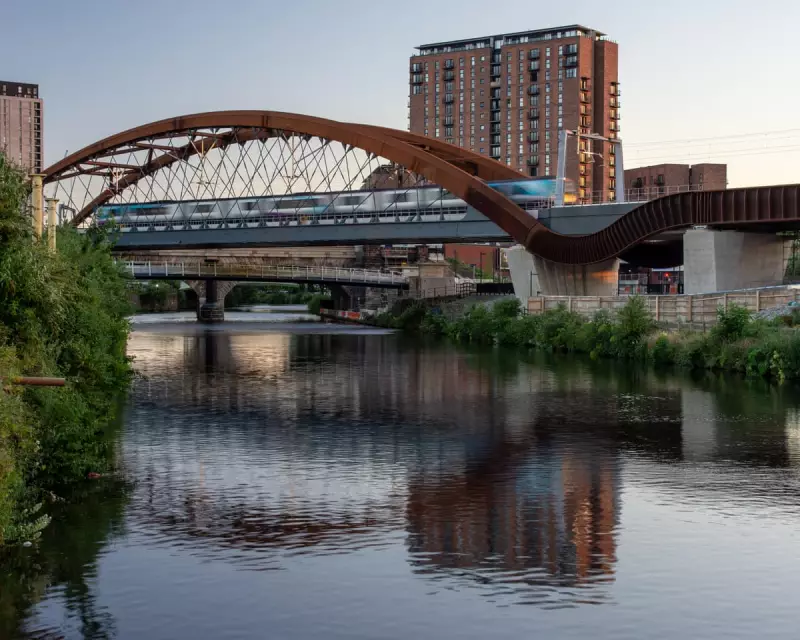
Chancellor Rachel Reeves has unveiled the Labour government's long-awaited plan to resuscitate the Northern Powerhouse Rail (NPR) project, a move welcomed as overdue in regions that have endured decades of underinvestment. The announcement commits to developing a three-stage strategy to upgrade crucial rail connections from the west coast to the north-east of England.
A Legacy of Broken Promises and Crumbling Infrastructure
The dire state of northern England's railways has been a persistent source of anger. Analysis of Treasury figures reveals a staggering £140bn shortfall in transport funding for the north compared to London. To put this in perspective, the equivalent of seven Elizabeth lines could have been constructed with the level of investment directed to the capital.
This chronic underinvestment has tangible consequences for daily life. The 35-mile journey from Liverpool to Manchester can take more than twice as long as the 42-mile trip from London to Reading. Passengers continue to rely on outdated rolling stock navigating Victorian-era infrastructure, a stark contrast to the modern networks enjoyed in the south-east.

Sir Keir Starmer acknowledged this painful history, stating northerners had "been let down by broken promises." The NPR concept, first mooted by George Osborne in 2014, has barely left the station. The HS2 project's ignominious halt at Birmingham, instead of reaching Manchester and Leeds, and the unfunded pipe dream of HS3 have fuelled deep cynicism.
The New Plan: Substance or Another Empty Gesture?
The government's headline pledge of £45bn to reverse decades of neglect is substantial. Key elements of the plan include a new station for Bradford, frequently cited as the UK's worst-connected major city. After protracted talks, Labour's northern mayors have rallied behind the proposals.
However, a discernible undercurrent of scepticism remains. The initial government allocation for developing the modernisation project is just £1.1bn. Crucially, much of the major construction work is not scheduled until the 2030s and 2040s. For instance, work on a vital new Birmingham-to-Manchester line, intended to ease congestion on the west coast mainline, is only expected to begin in two decades' time.
The lack of detailed delivery timelines raises legitimate fears that shifting political priorities in future administrations could once again leave the north stranded, with local authorities forced to pick up the pieces.
The Unarguable Case for Investment
Despite the scepticism, the economic imperative for upgrading northern transport is undeniable. Future productivity gains from improved mobility between northern cities could eventually dwarf the upgrade costs. Beyond economics, in a nation fractured by deepening regional inequality, providing a respectable, modern rail network for northern England is a vital step towards healing a polarised country.
The government's direction of travel is correct, but the timelines are far from fast-tracked. Echoing a British Rail slogan from the 1980s, it might be said they are "getting there," but at a glacial pace. For long-suffering passengers and commuters, who have heard grand visions before, the proof will be in the delivery. This time, the journey must be completed, not aborted en route.






