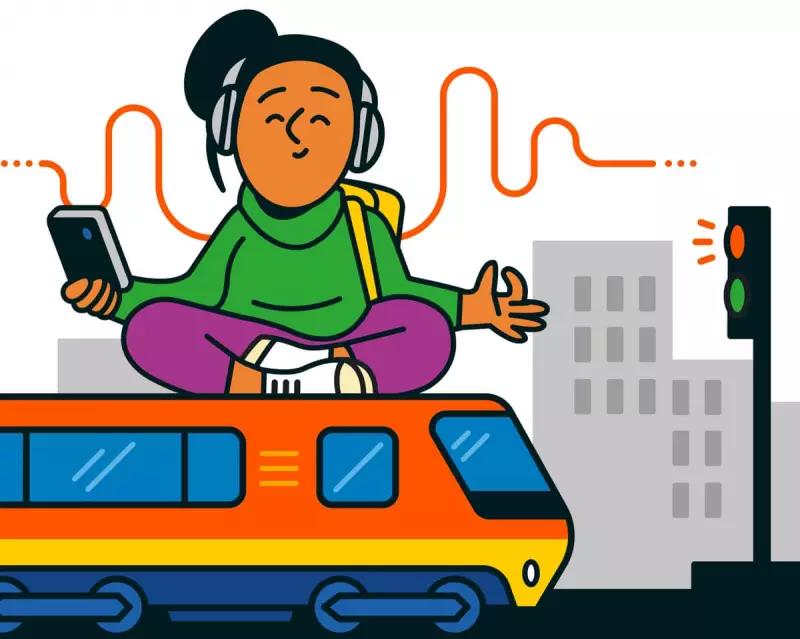
For countless workers across the UK, the daily journey to and from the office is a source of dread, often involving packed trains or congested roads. This daily grind is more than just an inconvenience; it can significantly heighten stress levels, cut into valuable exercise time, and lead to unhealthy snacking. However, experts argue that with a shift in perspective and some clever planning, this 'lost' time can be reclaimed for personal betterment.
Conduct a Commute Audit and Reclaim Your Time
The first step towards a better commute is understanding its true cost, advises Kelly Nolan, a time management coach and former lawyer. She recommends performing a 'commute audit' by visually blocking out the time on your calendar. "Creating a visual representation of how much commuting takes out of your day gives an accurate picture," Nolan explains. "It's not just about free time; it's about seeing how it affects other life activities." The goal isn't to despair but to identify a substantial window for positive change.
With the average UK commute standing at 27 minutes (rising to 38 minutes in London), those travelling five days a week have roughly five hours of potential 'me time' at their disposal each week.

The Power of Habit Stacking on the Move
One of the most effective strategies is habit stacking—attaching a new, desirable activity to your existing commute routine. Since you're already making the journey, piggybacking another task makes it far more likely to stick. This could be physical, such as:
- Cycling all or part of the way.
- Walking a longer distance to the station.
- Running home from work.
Alternatively, it could be mental or administrative:
- Learning a language via an app.
- Meditating with headphones.
- Catching up on personal admin.
- Brainstorming ideas for a project.
Nolan highlights the commute's unique benefit as a structured, regular window for deep focus, referencing Cal Newport's concept of 'Deep Work'. "If you're stuck on a bus, rather than scrolling, you could use the time to brainstorm a specific idea," she says, noting that quiet, still moments are when creativity often sparks.
Managing Frustration and Creating Boundaries
Of course, theory meets reality when faced with delays or overcrowding. Gordon McCrorie, a life coach based in Glasgow, advocates for the concept of acceptance to reduce emotional friction. "Ask yourself: 'What is within my control? What is out of my control?'" he suggests. His advice is to "think data, not drama"—reframing a "nightmare" journey as a "15-minute delay" you can't change, thus freeing you to enjoy an extended podcast session.
For the journey home, establishing a clear ritual is key to signalling to your brain that work is over. Nolan recommends fun audiobooks or comedy podcasts, while McCrorie emphasises movement. "A post-work walk can help reduce stress. Even simple stretching can regulate the nervous system," he notes.
What About the 'Faux Commute' for Homeworkers?
For hybrid or remote workers, the dilemma is whether to invent a pretend commute. McCrorie, who bookends his home-working days with dog walks, stresses the importance of a buffer. "If you don't create one, stagnant stiffness lingers. Movement reduces anxiety." He argues that dedicating time before work means a smaller percentage of your waking day is dominated by it, lessening its overall impact.
However, not everyone needs an elaborate routine. Nolan points out that some people establish strong boundaries with simple rituals, like changing into a special pair of "work slippers" or physically closing a home office door. The principle remains: consciously marking the transition protects your personal time and mental space, whether you're travelling across London or just from your bedroom to your desk.