
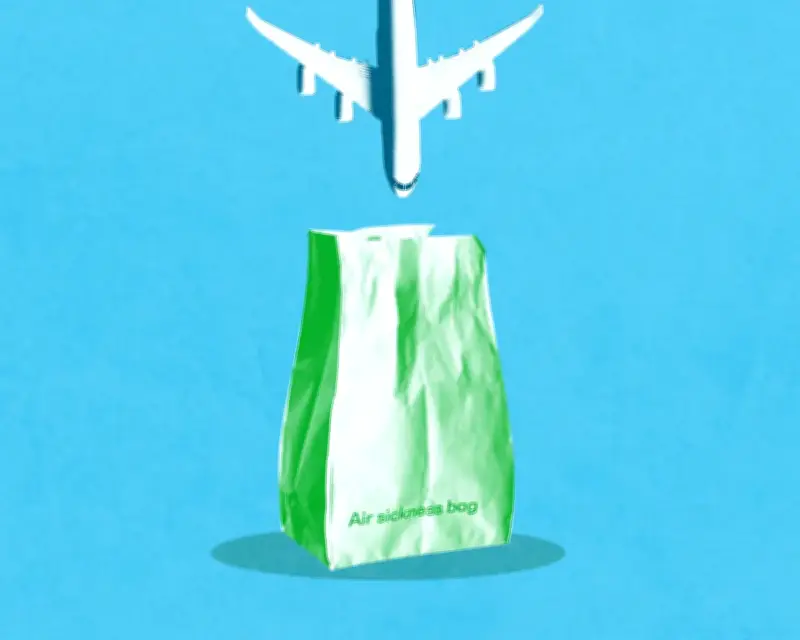
A stomach bug that had troubled Kate Carson's family during a holiday re-emerged on an Air New Zealand flight, turning their "cuddle class" skycouch into a "nightmare" scene. Her three-year-old daughter began vomiting in her sleep, and the mess spread into the seat and its cracks. The child continued vomiting until an hour before landing in Los Angeles.
Carson's husband spent ten straight hours catching vomit in a barf bag while Carson cleaned the plane bathroom. She later realised the crew had provided only deodorising spray, not a cleaning product. The family abandoned a planned Disneyland surprise and booked a hotel to do laundry. Ground crew removed and replaced the family's row of seats after landing. Air New Zealand declined to comment when contacted.
Biological Hazards Are a Recurring Problem
Other incidents have left passengers with visible reminders of previous flights. A Delta passenger sat in faeces left by a service animal, an Air France passenger found blood and faeces from a prior hemorrhage, and Air Canada passengers were threatened with a no-fly list for refusing to sit in vomit-soaked seats. Delta said safety and security protocols are "top customer priorities"; Air Canada said it follows health authority standards for deep cleaning; Air France did not respond to requests for comment.
Such incidents can cause major delays. In 2023, a trail of diarrhoea forced a Delta flight from Atlanta to Barcelona to turn back. A 2008 flight diverted after several passengers from a New England tour group were struck with norovirus, a case studied by the US Centers for Disease Control and Prevention.
How Airlines Respond to Contamination
Travel is a major risk factor for gastrointestinal illnesses, with travellers' diarrhoea affecting between 30% and 70% of travellers during a two-week period. Turbulence can increase nausea, and logistical barriers may prevent passengers from reaching lavatories on time, making air travel a biological hazard.
Justin Brownjohn, a former operations manager for Singapore Airlines, Qatar Airways and Virgin Australia, now at RMIT's Aviation Academy, says flights are delayed due to biological hazards "more regularly than you would think" – roughly once a week per airline. The extent of the delay depends on the substance, its severity, location, and the airport's capabilities.
Cabin crew use onboard biohazard kits with absorbent powder to contain liquids, then sanitise the area. Severe contamination may require ground crew to deep clean or remove carpet sections. Flight attendants can swap seat covers, block off rows, or close bathrooms, says Seth Heiple, a flight attendant and safety representative for the Association of Flight Attendants.
Specialist Cleanup and the Risk of Cancellation
Ground crew services like Çelebi Aviation, which contracts for Lufthansa, Emirates and Air China, handle routine cleanups, but "something beyond that, they don't have to touch it," says managing director Osman Yılmaz. For blood or extreme cases, specialist cleaning companies are called in. In smaller airports without such support, airlines may cordon off areas or cancel the flight.
The captain has final authority on whether to accept an aircraft, Heiple says. Delays are becoming more common with low-cost carriers that turn planes around quickly. "The system is not designed to accommodate last-minute problems like this," says William McGee, a former airline operations manager now at the American Economic Liberties Project.
McGee advises passengers to "take the first flight of the day because chances are that's the cleanest that plane is going to be all day." Heiple notes that between flights, passengers might not realise tray tables have been contaminated. "Anything that can come out of the human body has and does on the aircraft unfortunately."




