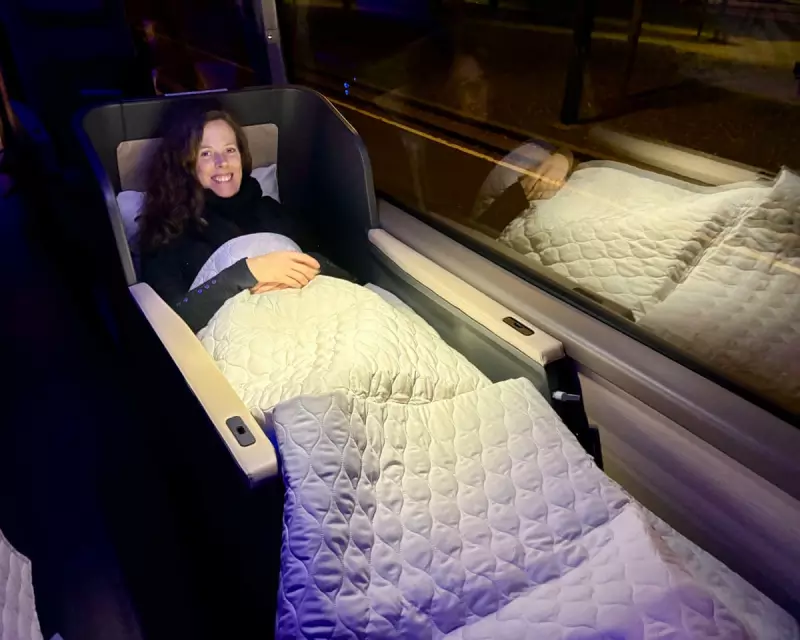
Imagine stretching out on a plush mattress, wrapped in a quilted blanket, as the landscape of Europe whisks by outside your window. This isn't a first-class train cabin or a private jet; it's the revolutionary experience offered by Europe's first 'business class' sleeper bus, which has just launched on a key route between the Netherlands and Switzerland.
A New Dawn for Sustainable Overnight Travel
Last month, the Swiss startup Twiliner launched its fleet of futuristic sleeper buses, aiming to provide a comfortable and green alternative to short-haul flights. The service currently runs three times weekly on a 12-hour journey from Amsterdam to Zurich, passing through Rotterdam, Brussels, Luxembourg, and Basel. A second route from Zurich to Barcelona, via Berne and Girona, is set to begin on 4 December.
"Flying is one of the main drivers of climate change. We wanted to design an alternative that people would actually want to use," explained the company's co-founder and CEO, Luca Bortolani. Their solution centres on a custom-designed seat that transforms into a genuinely comfortable flat bed, manufactured by Greater Manchester-based Airline Services Interiors.

The environmental credentials are a major selling point. The buses primarily run on hydrotreated vegetable oil (HVO) fuel, a highly sustainable renewable diesel. Twiliner claims this results in less than 10% of the CO2 emissions of a comparable flight. Even when forced to use conventional diesel, the company states its service is as sustainable per passenger kilometre as a sleeper train.
Onboard the Violet-Coloured 'Cruise Liner'
The journey begins at Amsterdam's outdoor Sloterdijk bus station, a short train ride from Centraal. The distinctive violet-accented bus arrives, its size likened to a cruise liner docking. Upon boarding via softly glowing purple steps, passengers find a surprisingly well-appointed interior.
The lower deck houses a spacious toilet, a changing room, and self-service shelves selling snacks and travel essentials. Free ear plugs, coffee, and wifi are provided. The upper deck contains 18 flat-bed seats, each with USB ports and lofty views. A notable no-children-under-five policy and guidelines on noise contribute to a calm atmosphere conducive to sleep.
The unique bedtime routine involves securing one's lower legs in a mesh bag clipped to seatbelt-style buckles—a necessary safety measure for a bed travelling at 50mph. Once settled, the magic of falling asleep in one country and waking in another takes over.
The Future of European Road Travel
While flatbed buses are common in Asia and South America, they have struggled to gain traction in Europe. Twiliner is betting that its blend of comfort, sustainability, and efficiency will change that. The company currently operates three buses and has ambitious plans to expand to 25 routes across Europe by 2028, with a potential UK service in the future.
"Our niche will be routes where lots of people travel and you don't have a night train, or good connections," said Bortolani. For UK travellers, the recent addition of a fifth direct weekday Eurostar service to Amsterdam makes the Dutch capital a convenient connecting hub for longer European journeys via Twiliner.
Arriving in Zurich on a frosty morning, the verdict from passengers like Adrien, a student from St Gallen university, was positive: "It's not quicker. It's not cheaper. But it's another option, and it's a good one. I slept. I feel rested." After a journey where a significant portion can be spent asleep, travellers can step off the bus feeling genuinely refreshed, ready to explore a new city from the moment they arrive.
Twiliner tickets between Amsterdam and Zurich start from 150 Swiss francs (approximately £141). The service represents a significant step forward in making slow, sustainable travel not just a responsible choice, but a genuinely desirable and comfortable one.