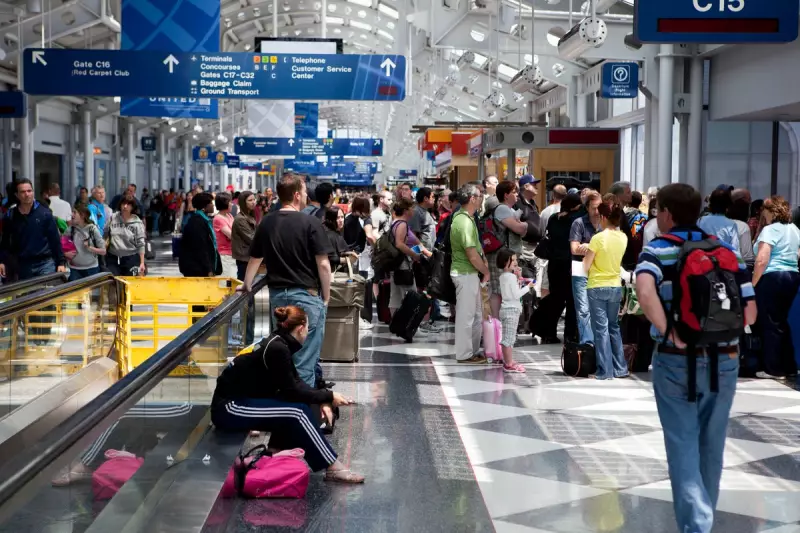
Chicago O'Hare International Airport appears to be on an unstoppable trajectory towards claiming the title of the world's busiest airport by scheduled flight numbers, according to the latest aviation data analysis. The figures reveal a significant shift in global aviation patterns that could see the long-standing dominance of Atlanta's Hartsfield-Jackson International Airport challenged in a fundamental way.
Statistical Surge Points to Historic Shift
Recent statistics from aviation data firm Cirium indicate that Chicago O'Hare has experienced a remarkable 13 percent year-over-year increase in scheduled flights. The data shows that for the first half of 2026, Chicago has 437,191 scheduled flights planned, compared to Atlanta's 389,663 during the same period.
This represents a substantial jump from the same period in 2025, when Chicago recorded 386,326 flights. The consistent growth pattern suggests that Chicago is not merely experiencing a temporary spike but rather establishing a new operational baseline that could redefine global airport rankings.

Understanding the Capacity Versus Flight Numbers Distinction
Traditionally, the title of world's busiest airport has been awarded to the hub with the highest seat capacity. By this established metric, Atlanta remains firmly in first place, with 63.1 million seats in 2025 and a forecast of 31,134,246 for the first half of 2026. Chicago, by comparison, is projected to have 26,694,997 seats during the same period.
However, the emerging story is about scheduled flight numbers rather than passenger capacity. Atlanta has historically led in both categories, recording approximately 387,000 flights last year compared to Chicago's 386,000. The narrowing of this gap and subsequent overtaking represents a significant shift in aviation operations.
Aircraft Composition Explains the Statistical Divergence
The apparent discrepancy between Chicago's scheduled flight statistics and its seat capacity can be explained by examining the types of aircraft operating at each hub. Chicago O'Hare sees a larger proportion of smaller regional jets in its flight schedule, while Atlanta handles more mainline aircraft with greater seating capacity.
This operational difference means that while Chicago may schedule more individual flights, those flights collectively carry fewer passengers than Atlanta's fewer but larger aircraft. This distinction highlights how different measurement criteria can produce different leaders in the competitive world of airport rankings.
Airline Expansion Drives Chicago's Growth
The substantial growth at O'Hare is being driven primarily by expansion from two major carriers. American Airlines has increased its operations from Chicago O'Hare by approximately 22.1 percent in the first half of 2026 compared to the same period in 2025, according to Cirium data.
United Airlines has similarly expanded its presence, with flight numbers rising around 12 percent year on year. This dual expansion from major carriers creates a powerful growth engine that shows no signs of slowing, particularly as both airlines continue to develop their Chicago operations as key strategic hubs.
Peak Operations and Seasonal Patterns
The busiest month for Chicago O'Hare in the first half of 2026 is scheduled to be May, with over 81,000 flights planned. This peak period demonstrates the airport's capacity to handle exceptionally high volumes of air traffic while maintaining operational efficiency.
The seasonal concentration of flights in May suggests that Chicago's growth is not evenly distributed throughout the year but rather follows traditional travel patterns with particular intensity during spring months. This concentration could have implications for airport staffing, security operations, and passenger experience during peak periods.
The aviation industry will be watching closely as these projections become reality throughout 2026. Whether measured by scheduled flights or passenger capacity, the competition between Chicago and Atlanta represents more than just statistical rivalry—it reflects evolving patterns in global air travel, airline strategy, and regional economic development.