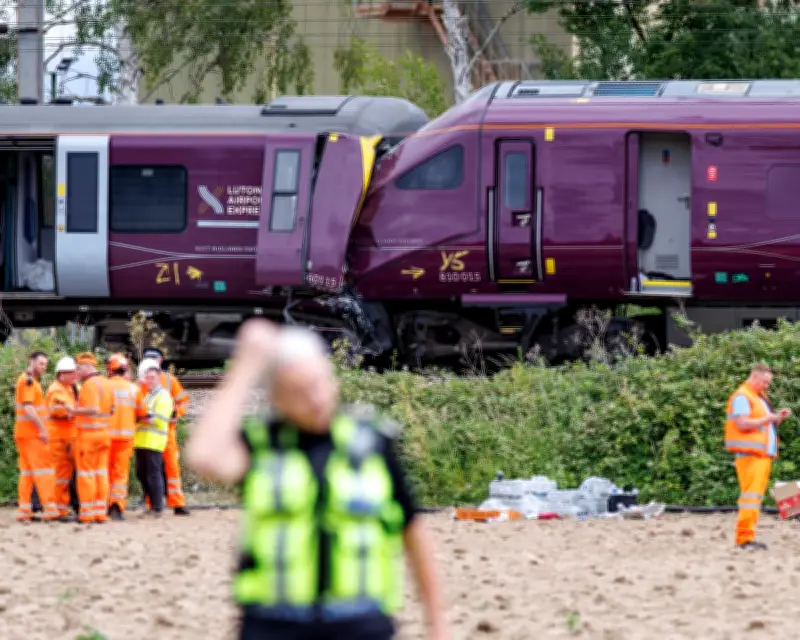
The collision between two East Midlands Railway trains near Bedford on Friday has stunned experts not only for the high number of casualties but also for its unusual nature, occurring on an upgraded main line with new trains, modern signalling, and no apparent external factors like extreme weather or leaf fall that have contributed to recent notable accidents.
Investigation Underway
Specialist investigators from the Rail Accident Investigation Branch and British Transport Police have released no details yet and have cautioned against speculation. Network Rail stated that “current indications are that this was a tragic, isolated incident,” though it remains unclear whether a specific factor has emerged or if the statement simply reflects the rarity of such an event.
Investigators will focus on what could have allowed the collision given the multiple failsafes in modern signalling and trains.
Why Did the First Train Stop?
The southbound East Midlands Railway (EMR) train from Nottingham to London St Pancras came to a halt on the track just south of Bedford. According to unverified reports in the Telegraph, the driver may have stopped to report a fault with the automatic warning system linking the train to the signalling. The train was a brand-new Aurora class 810 model built by Hitachi, brought into service within the last six months on EMR.
Why Did the Second Train Fail to Stop?
The EMR Luton airport express from Corby had stopped at Bedford and switched to the fast track, colliding with the Nottingham-London train a couple of miles south of the station at Elstow. A functioning signalling system would normally display a red signal when a train is stopped ahead. If a driver fails to spot the red light—a signal passed at danger—automatic train protection systems should apply the brakes. Images from the crash suggest the second train was not travelling at anywhere near full speed at the time of impact.
Context of the Crash
This section of the UK’s rail network is heavily used, with Thameslink commuter trains running on the main line alongside EMR services. Years of work have taken place across the Midland main line to upgrade and electrify the track for more capacity and faster services between St Pancras and the East Midlands. Only last year did Network Rail complete work to allow the new Hitachi bimode trains to run at a higher top speed of 125mph south of Bedford to London.
Temperatures last Friday were hot but well below the mark where Network Rail limits train speeds in case direct sun causes rails to buckle, although such restrictions could follow in the later phases of the heatwave forecast for this week.
Wider Safety Questions
The last crash in Britain where a passenger train hit the back of another service on the same line occurred in Clapham in 1988, killing 35 people. In the darkest times from then through the years immediately after privatisation, when Railtrack was in charge of failing infrastructure, the railway’s culture appeared to be a petri dish for disaster.
Renewed investment and a laser focus on health and safety helped Britain maintain a pre-eminent safety record in Europe: after 2007, no passenger died in a UK train accident for more than a decade. However, in the last six years there have been four particularly serious accidents: in Stonehaven in Scotland, where three people died after a landslide sent a ScotRail train over an embankment; collisions between passenger trains in service at Salisbury in 2021, and in Talerddig, Powys, in 2024 where one person died; and now the Bedford crash.
Disruption from the crash is expected to continue for at least a week.