

New American import taxes have cast a stark light on the nation's reliance on overseas manufacturing for festive staples, with artificial Christmas tree prices rising sharply this season. A leading trade body reports that tariffs have pushed costs up by 10% to 15%, forcing retailers to cut orders and increase prices for consumers.
Why US Production Remains a Distant Dream
Despite the price hikes and trade tensions, industry leaders confirm there is little prospect of bringing large-scale artificial tree manufacturing back to the United States. The production process, which shifted to Asia decades ago, is intensely labour-dependent and relies on components like holiday lights that are no longer made domestically.
Chris Butler, CEO of the National Tree Company, which sells over a million trees annually, explained the market reality. American shoppers are highly sensitive to price when buying seasonal decorations. "Putting a 'Made in the U.S.A.' sticker on the box won't do any good if it's twice as expensive," Butler stated. "If it's 20% more expensive, it won't sell."

Mac Harman, founder of Balsam Brands, highlighted the practical hurdles. His company explored making trees in Ohio during the first Trump administration but found a model currently retailing for $800 would cost $3,000 if produced in the US. The challenge extends to minor components; Balsam Brands couldn't even find a domestic supplier for the simple pair of gloves included in each box for fluffing branches.
Overwhelming Consumer Preference for Artificial Trees
The demand for artificial trees remains robust. According to the American Christmas Tree Association, roughly 80% of US households displaying a tree this year planned to use an artificial one, a statistic stable for at least fifteen years.
Drivers for this preference include convenience and practicality. Many Americans erect trees around Thanksgiving and keep them up for weeks, which would desiccate a real tree. Others have allergies to mould spores on natural firs. A significant 80% of artificial trees sold come pre-strung with lights, eliminating a tedious chore for consumers.
This desire for pre-lit trees is a key reason production migrated abroad. "Where are we going to get 15,000 people in America who want to string lights on Christmas trees?" Harman questioned, noting the work is time-consuming and tedious.
Global Supply Chains and Tariff Impacts
Approximately 90% of the world's artificial trees are made in China, where workers are paid between $1.50 and $2 per hour. The intricate process of making a tree—moulding needles, assembling branches, attaching lights—takes one to two hours per unit.
In response to the new tariff landscape, some companies are diversifying. National Tree Co. moved some manufacturing to Cambodia in 2024 and could source all trees from outside China by next year. However, this hasn't provided full insulation, as the US also threatened tariffs against Cambodian products in April 2025, initially set at 49% before being reduced to 19%.
Tariffs on Chinese-made trees now average around 20%. Companies have absorbed the shock in various ways. National Tree Co. raised prices by 10% and used much of the revenue to fund customer discounts amid weak economic demand. Balsam Brands implemented a 10% price increase, cut its workforce by 10%, froze pay rises, and curtailed office perks like weekly lunches.
The tariffs appear to be dampening US demand. Harman reported Balsam Brands' US sales are down 5-10% this year, while sales in Germany, Australia, Canada, and France are up by 10% or more. "If a merry Christmas is measured in how many decorations people put up, by that measure it's going to be a slightly less merry Christmas," he remarked.
The Exception: A Niche US Manufacturer
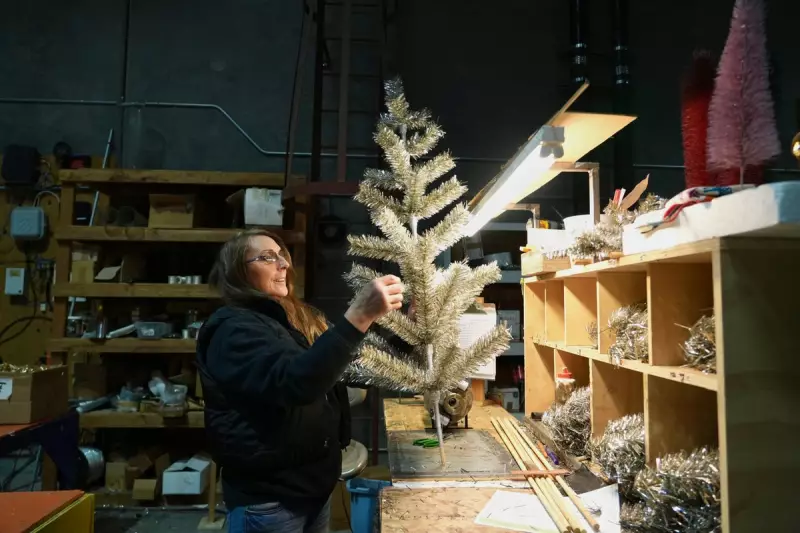
One rare holdout in domestic production is Lee Display, a Fairfield, California-based company founded in 1902. Now run by CEO Mark Latino, the great-grandson of the founder, it produces about 10,000 custom artificial trees annually using a nearly century-old machine.

Half its business involves creating displays for major retailers like Macy's, with the other half direct consumer sales. Latino values the control and speed of local production. "I like to think that everything here is either my fault or my mistake or my careful planning and skill," he said.
Even Lee Display felt the tariff's ripple effects. The company avoided importing lights from China this year, depleting its existing stock. James Latino, head of business development, confirmed they will have to pay higher costs to import lights next year.
Reporting contributions from Terry Chea in Fairfield, California.





