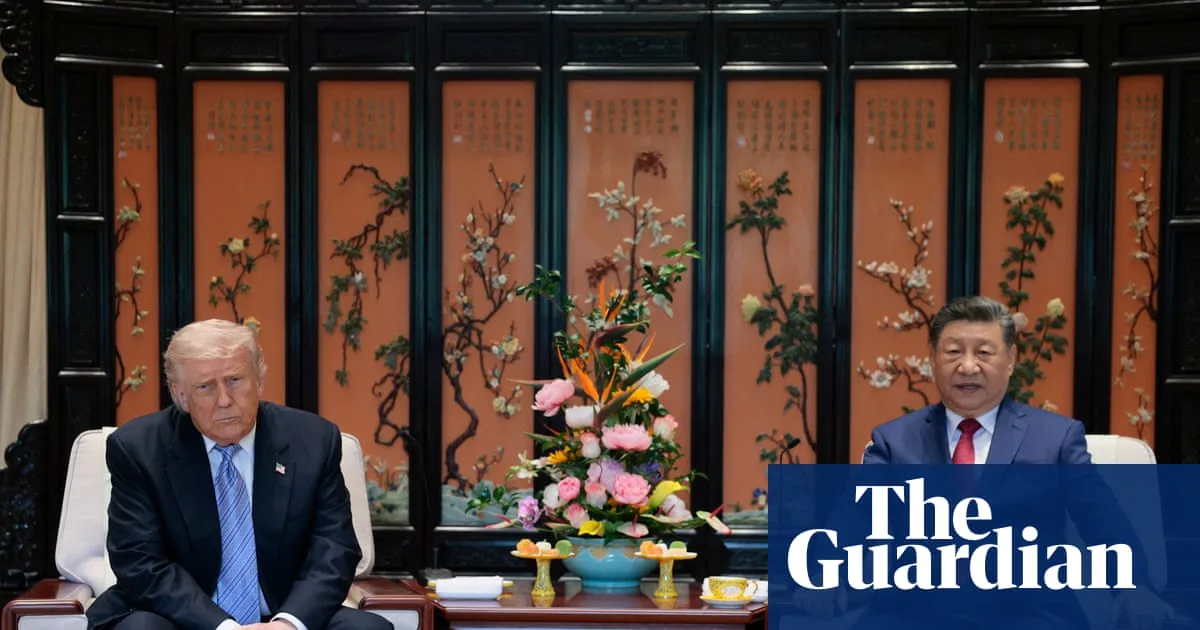
U.S. President Donald Trump wrapped up his visit to Beijing on Friday with a private meeting at Chinese leader Xi Jinping's official residence before departing for Washington. The two leaders discussed divisive issues such as the Iran war, trade, technology, and Taiwan during a series of meetings and events on Thursday.
Trump said Xi told him China wants to help negotiate an end to the war and a reopening of the Strait of Hormuz. China is the largest buyer of Iranian oil, and Trump hopes Xi will use that leverage to prod Iran into a deal on U.S. terms. Trump also said Xi assured him that China would not provide Iran with military equipment.
Trump has taken a decidedly rosy outlook on the U.S.-China relationship during this trip, but that has collided with some difficult truths about the thorniest issues between the two superpowers, including Taiwan, the Iran war, and trade.
In a summit marked by fanfare and flattery, Xi warned Trump that differences over Taiwan, a self-governed island claimed by Beijing as its own territory, could bring the U.S. and China into clashes or conflict. Trump authorized an $11 billion arms package for Taiwan in December but has not moved forward with delivery. Secretary of State Marco Rubio warned later on Thursday it would be “a terrible mistake” for China to take Taiwan by force.
Trump also focused on trade and deals for China to buy more agricultural products and passenger planes, setting up a board to address their differences and avoid a repeat of the trade war ignited last year after Trump's tariff hikes.
Lunch and Garden Tour
Trump and Xi dined on a menu including minced codfish in seafood soup, crispy and stir-fried lobster balls, pan-seared beef fillet stuffed with morel mushrooms, kung pao chicken and scallops, braised seasonal greens, bamboo shoots, mushrooms, and beans, as well as stewed beef in a bun and steamed pork and shrimp dumplings. Dessert was chocolate brownies, fruits, and ice cream. Coffee and tea were also served.
Before their closed-door lunch, Xi gave Trump a tour of Zhongnanhai, the former imperial gardens and now the seat of power. “Zhongnanhai is where the CPC Central Committee and the State Council work, and it is also where I work and live,” Xi said. “After the founding of New China, Chinese leaders including Mao Zedong, Zhou Enlai, and others all lived here.”
In the highly manicured garden, the two men walked with their interpreters as they admired the greenery. “All these trees are 200 to 300 years old. There's a big one that's about 400 years old,” Xi said as he pointed out specific trees to Trump, who expressed his admiration. “There's even one that's 1,000 years old. It's somewhere else,” Xi said. Xi said he invited Trump to the quarters in response to the hospitality Trump showed by inviting him to Mar-A-Lago in 2017.
McDonald's for Staff
While Trump ate lunch inside Xi's residence, the folks outside chowed down on McDonald's. The fast-food restaurant with the golden arches is one of Trump's favorites. His White House chief of staff, Susie Wiles, recently said he eats McDonald's every day. Trump did a stint working out of a McDonald's drive-thru window during his 2024 reelection campaign and more recently had a McDonald's order delivered to the door of the Oval Office during an event contrived to highlight the elimination of taxes on tips to service industry workers.
Outside Xi's residence, U.S. Embassy and White House staff ate their McDonald's lunches in the parking lot. Bags of McDonald's food also were delivered to members of the White House press pool as they waited in vans for Trump to depart for the airport and the long trip back to Washington.
Trump's Silence with Media
The U.S. president did something highly unusual for him over days of meetings with Xi: he held his tongue in front of the media. Trump relishes taking reporters' questions, often doing so nearly every day back home. But Xi, like most members of senior Chinese leadership, refrains from press conferences. In what might have been deference to Xi, Trump didn't answer questions when reporters asked them while the pair toured the Temple of Heaven on Thursday. And he didn't do so again on Friday while walking with Xi at Zhongnanhai. Trump's relative silence even extended to posting on his social media site, where he was not as active as usual during his three-day Beijing swing.
Trade Deals and Iran Discussions
The White House so far hasn't released details of any deals struck during Trump's summit with Xi in Beijing. Trump told Fox News about soybeans, airplanes, and oil in an interview that followed his two-hour sit-down with Xi on Thursday. Meeting with Xi again on Friday, Trump praised the visit as “incredible.” He said “a lot of good has come of it,” including “some fantastic trade deals” that are “great for both countries.”
Trump said he and Xi discussed Iran. “We feel very similar about (how) we want it to end,” the president said of the U.S. and Israel's war in Iran. “We don't want them to have a nuclear weapon.” Trump added of both sides and the Strait of Hormuz, which Iran has effectively closed, “We want the straits open.” He said of the conflict in Iran, “We want them to get it ended because it's a crazy thing there. A little bit crazy. And it's no good, it can't happen.”
Rose Seeds and Garden Walk
Trump and Xi spent about 10 minutes walking Zhongnanhai's gardens. “These are the most beautiful roses anyone has ever seen,” Trump remarked while walking past green columns and archways. Trump said the pair had struck “fantastic trade deals” without providing details. Xi said he would send rose seeds to Trump. Trump tore up the lawn around the White House Rose Garden last year to make room for a patio space reminiscent of his Mar-a-Lago club in Florida. Trump also has said he would like more roses there, recently complaining that the White House's garden “didn't have too many roses.”
Meeting Participants
The White House shared the list of participants for the meetings. Trump was joined by David Purdue, the U.S. ambassador to China; Secretary of State Marco Rubio; Treasury Secretary Scott Bessent; Defense Secretary Pete Hegseth; and U.S. Trade Representative Jamieson Greer. Xi was joined by Xie Feng, China's ambassador to the United States; Cai Qi, a director of the Central Committee of the Communist Party of China; Foreign Affairs Minister Wang Yi; Deputy Foreign Affairs Minister Ma Zhaoxu; and He Lifeng, vice premier of the State Council.
China Calls for Reopening Strait of Hormuz
China reiterated a call to reopen the Strait of Hormuz in a bilateral meeting with the U.S. and called for a diplomatic solution to the Iran war. “Now that the door for dialogue has been opened, then it shouldn't be shut again,” China's Ministry of Foreign Affairs said in a statement Friday, adding that the solution should “take into account the concerns of all parties on the Iran nuclear issue.” “Shipping routes should be reopened as soon as possible,” the ministry said. Trump has demanded a rollback of Iran's nuclear program as a condition to end the war. The ministry did not say if China would help negotiate an end to the war, as Trump told Sean Hannity of Fox News in an interview. Instead, the ministry promoted a four-point peace proposal from Xi, which is light on specifics but mentions upholding national sovereignty and international law.
Deepened Trust, China Says
A Chinese Foreign Ministry spokesperson said Trump's meetings with Xi during his visit have promoted mutual understanding, deepened trust, advanced cooperation, and injected “stability” into the world, according to Chinese state media. “The two heads of state also reached important consensus on properly handling each other's concerns and agreed to strengthen communication and coordination on international and regional issues,” the spokesperson said. Xi and Trump agreed on a new framework of “constructive, strategic stability” for their countries, the spokesperson added, referring to a diplomatic framework described previously as focused on managing differences and limiting competition with an eye toward maintaining stability and peace.
Potential US Oil Sales to China
Trump suggested there could be a deal for China to buy oil from the United States after talks in Beijing. Xi “said he likes the idea,” Trump said in an interview with Sean Hannity on Fox News. “I think it will happen.” “They've agreed they want to buy oil from the United States. They're going to go to Texas. We're going to start sending Chinese ships to Texas and to Louisiana and to Alaska,” Trump said. There were no immediate details of the deals. Beijing limited U.S. energy imports to a “bare minimum” after Trump imposed significant trade tariffs in 2025, and U.S. crude exports to China effectively halted more than a year ago, according to trade data and analytics platform Kpler. Despite the global energy shock from the Iran war, China's ample oil stockpile has so far been able to cushion it from bigger economic impacts. Russia has been a major source for crude imports for China. China was the biggest buyer of Iranian oil before the Iran war began.
Other Topics: Chinese Students, Credit Cards, Jimmy Lai
Trump said it would be “very insulting” for the U.S. to turn away Chinese students. The Trump administration announced last year it would start revoking the visas of some Chinese students, including those with ties to the Communist Party or studying in critical fields. Asked about the issue during the Fox News interview, Trump said, “I frankly think that it's good that people come from other countries and they learn our culture, and many of them want to stay here.” Nearly a quarter of all foreign students in U.S. colleges and universities in the 2023-2024 school year, about 270,000, were from China. Trump cited a figure of 500,000 Chinese students in the interview and said, “if you want to see a university system die, take a half a million people out of it.” “It's something I'm always looking at. But it's a very insulting thing to tell a country, we don't want your people in our schools,” he said.
Trump, whose delegation for the trip included the CEOs of Mastercard and Visa, said he also raised with Xi expanding access to the China market for U.S.-based credit card companies. “I said, 'What about using Visa in China?'” Trump said in his Fox News interview. “For some reason they were blackballed and maybe that'll come off.” China allows foreign cards to be linked to instant pay apps such as Alipay and WeChat Pay. But physical card usage is limited mainly to international hotels, high-end shopping malls, and some upscale restaurants. Visa and Mastercard have been long pushing for inroads to Chinese consumers and businesses in the world's second largest economy.
Trump asked about the release of Jimmy Lai, the 78-year-old former newspaper publisher and pro-democracy activist who is serving a 20-year sentence in Hong Kong, in his meeting with Xi, Secretary of State Marco Rubio said in an interview with NBC News Thursday. “We would like to see him released. We would be open to any arrangement that would work for them, as long as he's given his freedom,” said Rubio. Lai was the publisher of Apple Daily, a tabloid that was critical of Chinese and Hong Kong government authorities.
Trump Describes Xi as 'Warm' but All Business
Trump described Xi as “warm” but not prone to small talk. “He's all business,” Trump told Sean Hannity of Fox News in a taped interview that followed Thursday's meeting with the Chinese leader. “There's no games. There's no talking about how nice the weather is.” Trump said Xi is a “very smart person” and that they have a “good relationship.” “He's all about China,” Trump said.
Nuclear Dust and Iran Negotiations
Trump suggested during the Fox News interview that Iranian officials at first “said very strongly” that the U.S. could send it teams to collect hundreds of pounds of enriched uranium believed to be buried under nuclear sites badly damaged by U.S. military strikes last year. But then, he said, Iran reneged. “They agreed to it. They take it back. They agree, you know it's back and forth,” he said. Whether Iran would be willing to relinquish enriched uranium is a key point in negotiations to end the war. Trump has long insisted Tehran is willing to do so, but Iran has largely rejected such assertions. Trump added during the interview that Iran says only the U.S. and China had sufficient technology to remove the enriched uranium, given that it's buried deep underground.
US Farmers Hope for More Soybean Purchases
Secretary of State Marco Rubio told NBC that “there's going to be some agricultural purchases” made as a result of this trip. U.S. soybean farmers were hit especially hard by Trump's trade war with China and have urged him to persuade Beijing to buy more of their crop. China is on track to fulfill its commitment to buy 12 million metric tons (13.2 million tons) of U.S. soybeans this year, although that is well below the 25 million to 30 million metric tons (27.5 million to 33 million tons) purchased in past years. China, the biggest foreign buyer of U.S. soybeans, stopped buying them altogether last year after Trump hiked tariffs on all Chinese goods. After Trump met with Xi in October, the White House said China agreed to purchase 12 million metric tons. The American Soybean Association hopes Trump can secure a deal for an additional 8 million metric tons (8.8 million tons) by Aug. 31.






