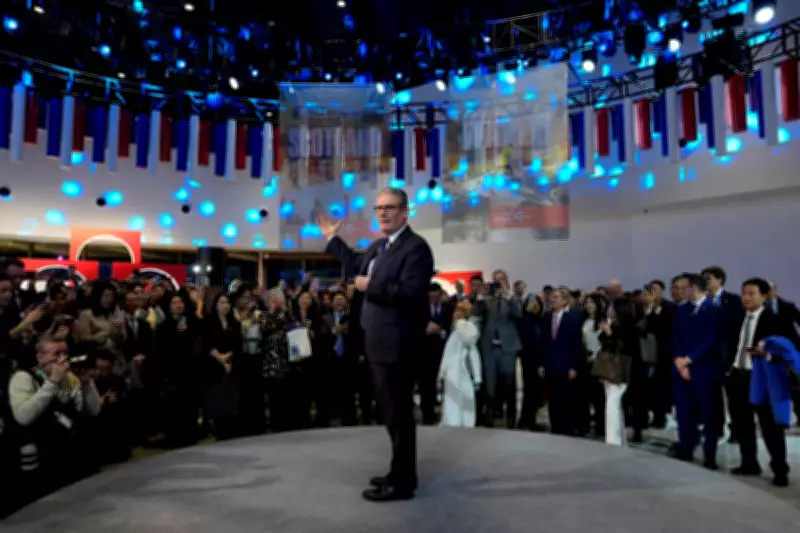
Britain must become more adept at promoting its strengths and fostering a culture of optimism, Prime Minister Sir Keir Starmer declared upon his return from a significant trade delegation to China. The Labour leader emphasised this need for national self-confidence following his four-day diplomatic mission to Beijing and Shanghai, which marked the first visit by a British prime minister to the country since 2018.
A Mission to Reset Relations
Sir Keir's journey was fundamentally trade-oriented, representing a concerted effort by the Labour government to 'reset' and enhance relations with Beijing. He was accompanied by a substantial 54-strong business delegation, which the Prime Minister praised for its proactive and opportunistic mindset.
"They're real glass half-full people and they see the opportunity," Sir Keir told reporters aboard his flight from Shanghai. "That's why we want to take all these delegations because they see opportunity in what we're doing and we need a bit more of that."

Injecting Optimism at Home
When questioned about how to project this sense of possibility within the United Kingdom itself, the Prime Minister outlined a collective responsibility. "I think we've all got a responsibility to inject that optimism and make sure that we talk up what we're good at as a country, and we're not always as good at that as we should be," he stated, advocating for a more positive national narrative.
Tangible Outcomes from the Visit
The diplomatic mission yielded several concrete agreements aimed at boosting economic ties. Key successes included securing a reduction in tariffs on British whisky exports to China and establishing visa-free travel arrangements for UK citizens visiting the country. Furthermore, commitments were made to engage in more detailed discussions concerning a potential trade in services deal.
In a notable political achievement, Sir Keir's meeting with Chinese President Xi Jinping resulted in an agreement to lift sanctions that had been imposed on British parliamentarians back in 2021. The Prime Minister also expressed hope that President Xi would visit Britain in 2027, coinciding with the UK's hosting of the G20 summit.
Observations on Pace and Technology
Reflecting on China's rapid development, Sir Keir highlighted the impressive speed at which the nation executes infrastructure projects and adopts new technologies. He pointed to widespread systems like the Alipay app, which integrates payments and service ordering, as examples of this swift technological integration.
"On technology and on things like infrastructure, the speed at which they're acting is really important," Sir Keir observed. "I feel that on things like infrastructure, we're too slow in the United Kingdom."
However, when asked if China's approach could serve as a model for his own flagship digital ID programme, the Prime Minister was clear about maintaining British autonomy. "We'll do it our own way, with a UK perspective," he affirmed, distancing the policy from direct Chinese inspiration.
Cultural and Educational Dimensions
The delegation was not solely comprised of business leaders; it also included representatives from prominent cultural institutions such as the National Theatre and the Science Museum. In Shanghai, Sir Keir engaged with this cultural aspect, meeting design students and participating in a National Theatre workshop alongside actor Rosamund Pike.
Ms Pike, during the visit, remarked that she considered Mandarin "the language of the future," noting that her own children speak it. While Sir Keir did not advocate for making Mandarin compulsory in schools, he suggested that enhanced UK-China relations would likely increase business demand for the language. He pointed to existing frameworks like university exchanges and the British Council's Mandarin excellence programme as suitable avenues for this learning.
The Prime Minister's trip underscores a strategic pivot towards strengthening economic and diplomatic channels with China, while simultaneously calling for a renewed sense of ambition and self-promotion within Britain itself.