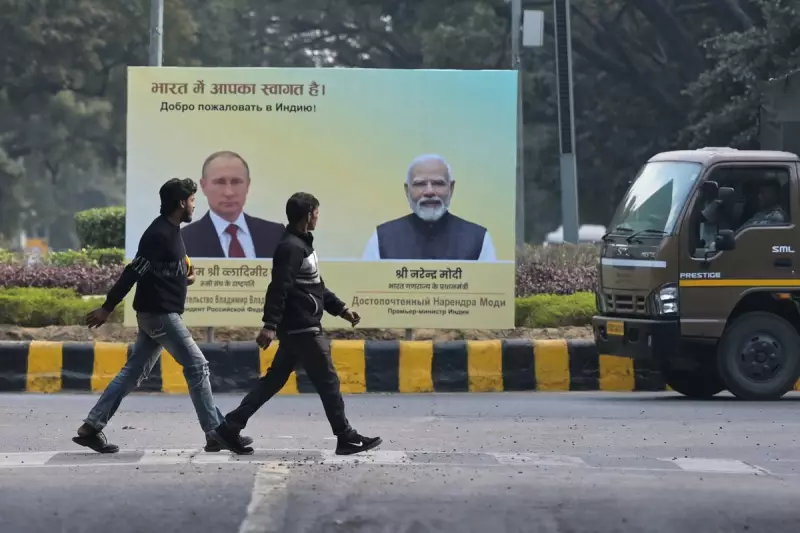
Russian President Vladimir Putin touched down in New Delhi on Thursday for a high-stakes state visit, aiming to reinforce the long-standing strategic partnership between Moscow and New Delhi. The trip, his first to India since 2021, comes at a geopolitically sensitive juncture, testing India's delicate balancing act between its historic ally and Western partners.
A Warm Welcome Amid Global Tensions
Indian Prime Minister Narendra Modi personally welcomed President Putin at the airport, greeting him with a characteristic bear hug and a firm handshake that underscored their personal rapport. Mr Modi is set to host the Russian leader for a private dinner at his official residence, setting the stage for formal talks on Friday as part of the 23rd India-Russia Annual Summit.
The summit's agenda is densely packed, with a core focus on deepening economic collaboration in critical sectors. Key discussion points will include defence, energy, and the mobility of skilled labour. This visit occurs against the backdrop of renewed US-led efforts to broker an end to the Russia-Ukraine war, now in its fourth year, placing New Delhi's diplomatic dexterity under intense scrutiny.

Trade Imbalances and Strategic Partnerships
Bilateral trade presents a complex picture. According to the latest Indian government data, total trade for the fiscal year ending March 2025 reached $68.7 billion. However, this figure is heavily skewed, with India importing $63.84 billion worth of goods—primarily discounted Russian crude oil—while exporting a mere $4.88 billion. Both nations have set an ambitious target of boosting trade to $100 billion by 2030.
Indian officials confirmed that bridging this significant trade deficit is a priority. They are working on plans to increase Indian exports across several sectors, including pharmaceuticals, agricultural products, automobiles, and marine goods. A series of agreements expected to be signed on Friday in areas such as shipping, healthcare, and connectivity are designed to give fresh impetus to the economic relationship.
Defence: The Bedrock of the Relationship
Despite India's efforts to diversify its arms suppliers in recent years, Russia remains its largest provider of military hardware. Defence cooperation is poised to be the centrepiece of the leaders' discussions. Hours before Putin's arrival, Russian Defence Minister Andrei Belousov co-chaired a high-level commission on military-technical cooperation with his Indian counterpart, Rajnath Singh.
New Delhi is anticipated to press Moscow for expedited delivery of two remaining S-400 surface-to-air missile systems under a 2018 deal worth approximately $5.4 billion, with delays attributed to war-related supply chain issues. Indian authorities are also reportedly exploring the potential acquisition of additional S-400 units or an upgraded variant, though no immediate contract is expected.
Further talks will cover the modernisation of India's Russian-made Su-30MKI fighter jet fleet, faster delivery of other critical defence hardware, and enhanced coordination in joint exercises and disaster relief. While Moscow is keen to market its advanced Su-57 stealth fighter to India, New Delhi is keeping its options open with other international suppliers.
Navigating the Shadow of US Sanctions
The visit unfolds under the cloud of sustained Western pressure, particularly from the United States. Washington has repeatedly criticised India's purchase of discounted Russian oil, arguing it helps fund Moscow's war effort. In a significant escalation, US President Donald Trump imposed additional 25% tariffs on Indian imports in August 2025, bringing total duties to 50% in what was seen as retaliation for the oil trade.
Indian officials maintain that their energy imports are essential for meeting the needs of its 1.4 billion citizens and that New Delhi has always adhered to international sanctions. They indicate a willingness to source from entities not currently under sanction restrictions. Analysts suggest the summit allows both nations to reaffirm their ties in the face of this pressure.

Praveen Donthi, a senior analyst for India at the International Crisis Group, noted that while US pressure has succeeded in reducing India's crude imports from Russia, New Delhi will continue to uphold its crucial defence partnership with Moscow, especially given regional tensions with China and Pakistan.
Before his departure, President Putin gave an interview to India Today, later reported by Russia's Tass agency, where he framed the partnership as one between equals. "India is a great power, not a British colony. And everyone will have to accept that," he stated, emphasising planned cooperation in cutting-edge technology, space, and nuclear energy.