
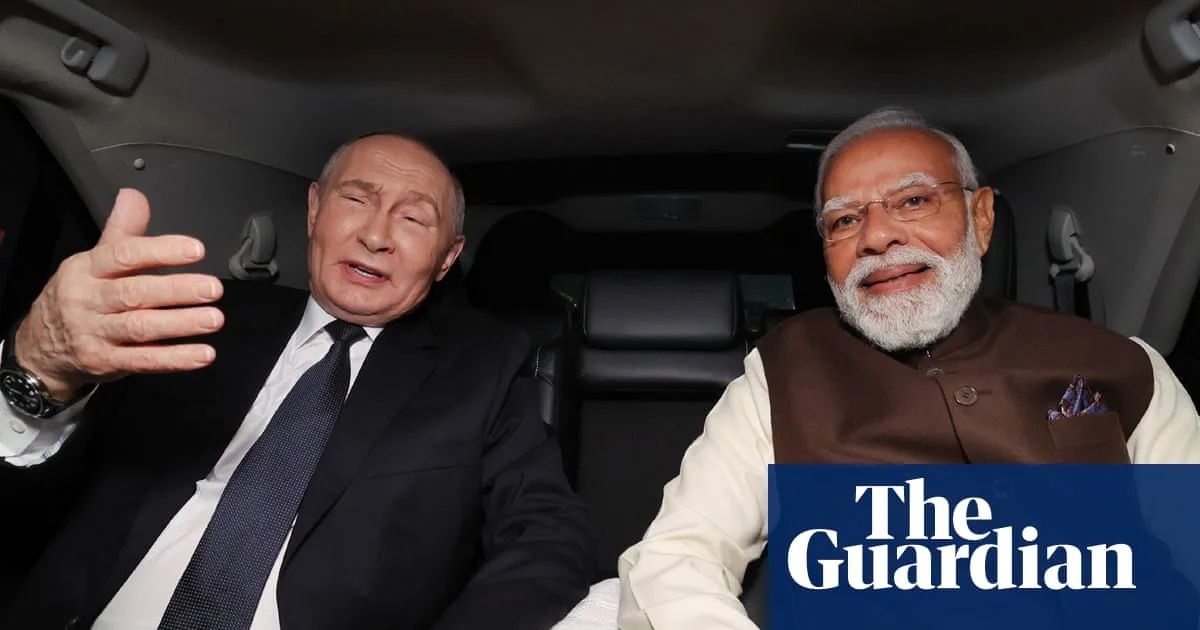
Vladimir Putin has arrived in New Delhi for talks with Narendra Modi, the Indian prime minister, at a time when both leaders are navigating significant geopolitical pressures. The Russian president's last visit to India was almost exactly four years ago, a five-hour trip during the Covid pandemic, when the two sides reaffirmed their defence and economic partnership.
That relationship was upended three months later by Russia's full-scale invasion of Ukraine, which turned Putin into a global pariah and restricted his international travel. More recently, Donald Trump's re-election has strained US-India ties, with Washington imposing punishing import tariffs and accusing Delhi of bankrolling Russia's war effort through its purchases of cheap Russian oil.
Analysts say the summit carries particular weight for Russia, which has been isolated for years. Petr Topychkanov, a senior researcher at the Stockholm International Peace Research Institute, said the visit's importance lies in the fact that it is happening at all. "It will signal that Russia is returning to something resembling normal international relations," he said, adding that Moscow is no longer anxious about political isolation.
For India, the stakes are arguably higher. Aparna Pande, director of the India and south Asia initiative at the Hudson Institute, described the current climate as the most unfavourable in years, citing a semi-isolationist America, a weaker Russia and a very powerful China. She said India is returning to its default mode of "hedging" in its alliances, signalling to Washington that it has options. India's relationship with Russia dates to the cold war, and Moscow remains New Delhi's largest defence supplier.
Tensions with Western powers were visible on the eve of the visit, when the French ambassador, German high commissioner and UK high commissioner co-wrote an opinion piece in the Times of India titled "Russia doesn't seem serious about peace". India's foreign ministry responded sharply, calling it "not an acceptable diplomatic practice to give public advice on India's relations with a third country". At their last meeting three months ago, Putin, Modi and China's Xi Jinping were pictured holding hands, a display that angered Trump. For India, analysts note, the deeper concern is China, which remains its greatest long-term threat.




