

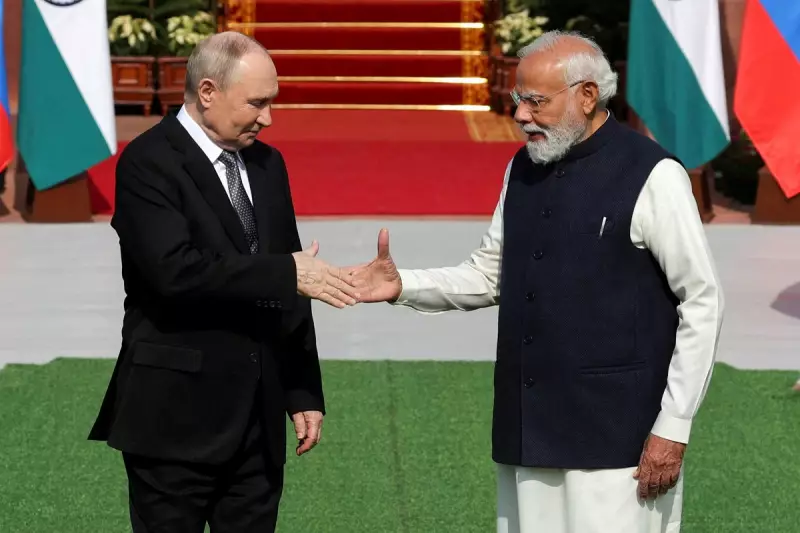
Russian President Vladimir Putin's visit to New Delhi has culminated in a significant pact to deepen economic cooperation with India, a move that directly challenges pressure from the United States and risks reigniting a trade dispute with the Trump administration.
A "Resilient" Partnership Defies Western Pressure
During the 23rd Russia-India Summit, held on Thursday, the two leaders signed an agreement to fortify their economic alliance. This comes as Moscow seeks to bolster its wartime economy against Western sanctions. Both Putin and Indian Prime Minister Narendra Modi emphasised that their relationship was "resilient to external pressure".
Modi, describing the long-standing partnership as "a guiding star", stated that ties built on mutual respect have consistently endured. This stance persists despite concerted efforts from Washington. The Trump administration has urged New Delhi to distance itself from Moscow, arguing that Indian purchases of Russian crude oil are effectively funding Putin's military campaign in Ukraine.

The US has already imposed a 25 per cent tariff on India over its Russian energy imports, and in August, former President Donald Trump raised tariffs on Indian goods to 50 per cent, citing the country's status as the world's second-largest buyer of Russian oil after China.
Details of the New Economic Programme
The newly finalised economic cooperation programme is set to run until 2030. Its central aim is to diversify business links with a target of boosting annual bilateral trade to $100 billion within the next five years. A key component remains the strengthening of energy ties, with Putin promising "uninterrupted shipments" of fuel to India.
This commitment follows October's US sanctions on two of Russia's major oil producers, designed to compel nations like India to reduce imports. Indian Foreign Secretary Vikram Misri confirmed that these recent sanctions were discussed during the talks. Indian officials maintain that New Delhi always adheres to international sanctions and would continue to do so regarding Russian oil.
Wider Diplomatic Repercussions and Security Incidents
Critics have warned that Putin's high-profile visit could strain India's relations with Western allies and potentially jeopardise negotiations for other major trade agreements. The summit also highlighted the complex diplomatic landscape surrounding the Ukraine war.
While the US attempts to isolate Russia, Kremlin aide Yuri Ushakov noted that peace talks between Moscow and Washington had progressed. He referenced a 28-point deal proposed by US officials in mid-November, which was agreed with Moscow but rejected by Kyiv as a capitulation.
In a separate but contemporaneous security incident, reports emerged that an Irish naval vessel detected up to five drones operating near the flight path of Ukrainian President Volodymyr Zelensky's aircraft as he arrived in Ireland on Monday. The sighting triggered a major security alert over fears of interference, though sources stated the aircraft, which landed early, was never in danger. Zelensky's European tour aims to drum up support as Ukraine faces its fourth winter of conflict.
Ultimately, the Delhi summit underscores India's determined pursuit of strategic autonomy, prioritising its energy needs and historic ties with Russia even as it navigates escalating pressure from its Western partners.






