

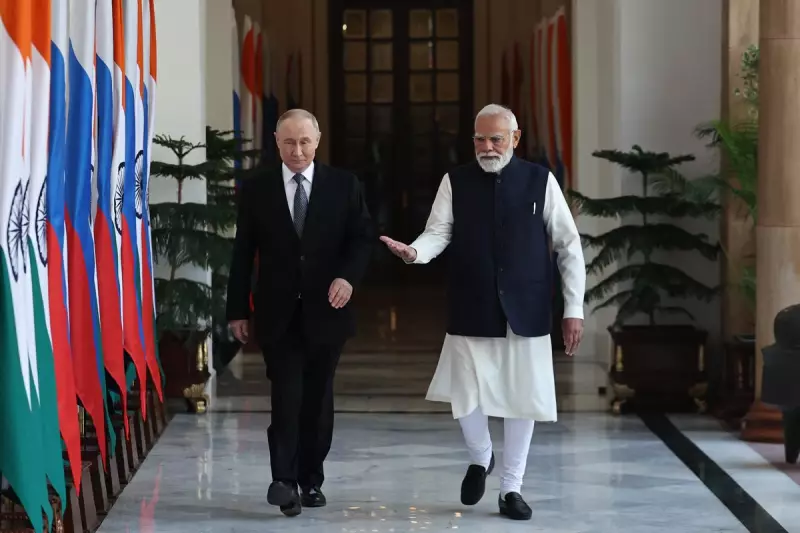
Prime Minister Narendra Modi broke protocol with a warm airport greeting for President Vladimir Putin on Thursday, setting the stage for a 30-hour summit in New Delhi that underscored India's delicate diplomatic balancing act. The visit, concluding on Friday, 5 December 2025, was rich in symbolic gestures but yielded limited concrete agreements on pivotal defence purchases, despite ambitious plans to dramatically boost bilateral trade.
Symbolism and Strategic Autonomy on Display
Mr Modi's decision to personally welcome Mr Putin at the Palam Air Base, complete with a bear hug, was a powerful visual statement. The leaders then shared a car to the prime minister's residence for a private dinner. This display of bonhomie was widely interpreted as a signal of India's commitment to its long-standing partnership with Moscow, asserting its "strategic autonomy" amid intense Western pressure to isolate Russia over the Ukraine war.
During the compact visit, the Russian president engaged in formal talks, attended state and private dinners, and participated in a business forum. Notably, he also announced the launch of a dedicated India service for the Kremlin-funded broadcaster RT (Russia Today).

Economic Ambitions and the Energy Lifeline
The most substantive outcome was the finalisation of a bilateral economic cooperation programme extending to 2030. The central goal is to diversify trade and increase its annual value to $100 billion. This is a significant jump from the robust $68.7 billion recorded in the last fiscal year, a figure heavily skewed by Indian imports of discounted Russian oil and other commodities.
President Putin explicitly addressed energy security, stating, "Russia is a reliable supplier... We are ready to continue ensuring the uninterrupted supply of fuel for the rapidly growing Indian economy." This pledge comes as the United States increases pressure, having recently sanctioned major Russian oil producers to dissuade third-party buyers like India. Indian officials confirmed the sanctions were discussed but gave no further details.
Both nations are also progressing on an agreement to establish a free trade zone between India and the Moscow-led Eurasian Economic Union, which could further facilitate commerce.
Defence Cooperation: Promises Without Major New Deals
Despite earlier expectations, the summit produced no landmark announcements on defence. India had hoped to secure faster delivery of two additional S-400 surface-to-air missile systems, supplementing the three already received under a 2018 deal worth approximately $5.4 billion. Discussions also touched on upgrading India's Russian-made Su-30MKI fighter jets and accelerating other hardware deliveries.
Instead of new contracts, the leaders endorsed a joint plan to encourage the joint manufacturing in India of spare parts for Russian-origin military equipment. This would be achieved through technology transfers and joint ventures, aiming to address long-standing maintenance and supply chain issues.
A pre-visit pact on broader military cooperation, covering exercises and logistics, was ratified by Russia's State Duma ahead of the trip.
Geopolitical Tightrope and Other Agreements
The summit's outcomes highlight the complex geopolitical tightrope India navigates. While securing continued energy supplies and fostering defence industrial collaboration, it risks straining relations with Western partners. Former US President Donald Trump had previously cited India's Russian oil purchases as a reason for imposing punitive tariffs.
In other developments, Prime Minister Modi announced that India would soon begin issuing free electronic visas for Russian tourist groups. The two sides are also working to finalise an agreement on the safety and regulation of skilled Indian migrant workers in Russia.
Ultimately, while the 2030 trade roadmap and energy assurances provide a framework for future engagement, the lack of breakthrough defence deals suggests the partnership, though resilient, is navigating a new and more complicated international landscape.






