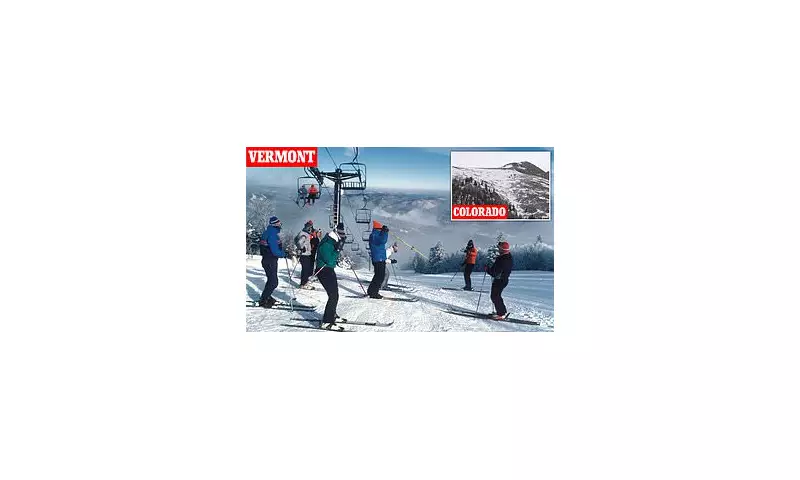
Unseasonably warm temperatures across the western United States have triggered a severe snow shortage, crippling ski resorts and devastating local tourism during the crucial winter season. While iconic destinations from Lake Tahoe to Colorado sit nearly barren, a contrasting deluge of record snowfall in the Midwest and Northeast is drawing skiers eastwards in a dramatic seasonal shift.
Western Desperation: Lifts Closed and Sleighs Shelved
The heart of America's ski industry is facing an existential crisis this December. Resorts around Lake Tahoe, straddling California and Nevada, have managed to open only a tiny fraction of their ski lifts due to significantly above-average temperatures and a critical lack of snow. Kevin Cooper, president of the Kirkwood Ski Education Foundation, summed up the plight, telling the Associated Press that "Mother Nature has been dealing a really hard deck."
The economic pain extends beyond the slopes. In Colorado, businesses that rely on a white winter are adapting however they can. Nicole Godley, owner of Bearcat Stables near Vail, explained that her company's three large sleighs have been swapped for wagons due to the sparse snowfall. "December is when we make most of our money," Godley said, highlighting the precarious situation for seasonal enterprises. The warm spell has been intense; areas in Utah, Oregon, Idaho, and western Colorado have experienced their warmest Novembers on record, with temperatures soaring 6 to 10 degrees Fahrenheit above normal.

Eastern Elation: Record Snowfall Creates a Ski Boom
In a stark reversal of fortune, skiers are flocking to the Midwest and Northeast, regions peppered by exceptional snow this month. Unseasonably cold conditions have meant precipitation falling as snow rather than rain, creating ideal early-season skiing. Vermont's Killington Resort and Pico Mountain, for instance, had roughly 100 trails open.
Josh Reed, a resort spokesman with a decade of experience in Killington, called it "by far the best conditions I have ever seen for this time of year." Local skier Elena Veatch echoed the sentiment, noting she had cross-country skied more this autumn than in the previous two years, adding, "I don't take a good New England winter for granted with our warming climate."
A Climate-Driven Precipitation Problem
Experts clarify that the issue is not necessarily a lack of moisture, but its form. Jason Gerlich, a drought information coordinator at the National Oceanic and Atmospheric Administration (NOAA), stated that while precipitation has been near normal for much of the West, warmer temperatures are causing it to fall as rain instead of snow. This shift has dire consequences beyond tourism, affecting vital snowpack that acts as a natural water reservoir for farmers, ranchers, and communities across the region.
Gerlich warned that the lack of snow is already "manifesting itself" through events like the recent flooding in the Pacific Northwest, where a levee failure south of Seattle threatened thousands. He noted, however, that a single powerful storm could still "turn things around rather quickly" for western ski areas. Meanwhile, California braces for an incoming atmospheric river, which may bring heavy rain, floods, and landslides, alongside some crucial high-elevation snow for the Sierra Nevada.
The contrasting scenes across the United States this winter underscore a volatile and shifting climate pattern, where traditional seasonal expectations are being upended, leaving some businesses in crisis while offering a temporary boom to others.