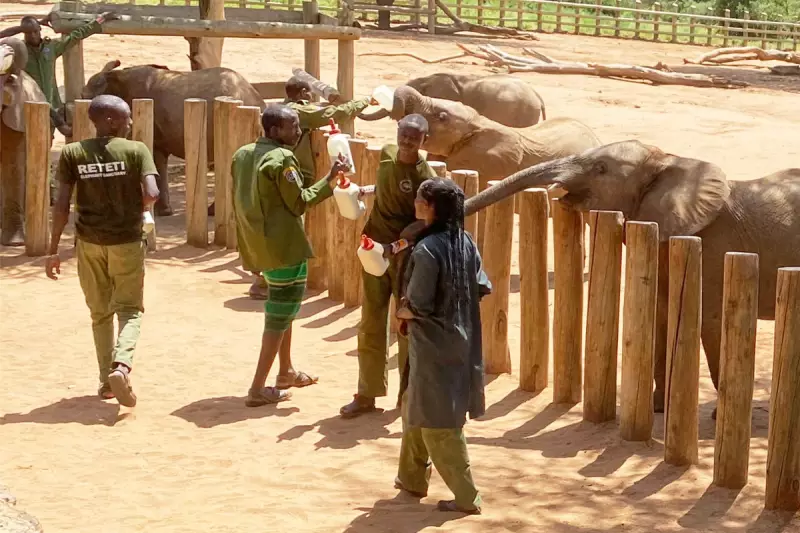
Beneath the relentless equatorial sun, a dusty corral comes alive. Its perimeter, marked by posts as stout as telephone poles, becomes the stage for a daily ritual of hope. Perched on some posts are plastic jugs filled with goat's milk, each fitted with a red teat. The approaching rumble is not thunder, but the joyful, jostling stampede of orphaned elephant calves, each weighing up to 2,000 pounds, hurrying towards their lunch.
A Sanctuary Run by the Samburu
This is the Reteti Elephant Sanctuary in northern Kenya, and the scene forms a compelling chapter in a new form of sustainable tourism. The sanctuary addresses a critical issue: how to nourish young elephants rescued after becoming separated from their herds. The solution was both local and ingenious. Expensive, manufactured formula proved unsuitable, but the omnipresent goat herds of rural Kenya provided the answer. Caretakers discovered that goat's milk serves as a viable substitute for elephant's milk.
What makes Reteti truly groundbreaking is its governance. It is the only elephant sanctuary in Africa entirely operated by Indigenous people, specifically the Samburu tribe. The project creates a circular economy of conservation. More than 1,200 Samburu women now sell nearly 700 litres (185 gallons) of milk daily from their goats to the sanctuary. This income allows them to purchase better food and clothing and grants them a degree of financial independence from their husbands, marking a significant shift in traditional roles.

"We can say that elephants are the keystone of the entire economy," explained Dorothy Lowakutuk, a Samburu elephant keeper and sanctuary spokesperson. Reteti also employs around 100 local people, proving that protecting wildlife can directly support communities.
Beyond the Safari Vehicle: Conservation in Action
This insight came during a two-week trip organised by Uplift Travel, a fledgling non-profit that dedicates a share of its revenue to Kenyan community development. Founded by Michigan travel writer Kim Schneider and philanthropy partner Tanja Wittrock, the group aims to marry exploration with tangible aid. "I set out with a heart for travel and a heart for helping people, and this has married the two," Schneider said.
The journey redefined the classic safari. While game drives in places like Amboseli National Park delivered spectacular sightings of the "big five," the deeper narrative was found in human encounters. Travellers met the all-female Team Lioness, the first Maasai women in their community to work as anti-poaching rangers. At the famed Sheldrick Wildlife Trust orphanage in Nairobi, they learned how keepers sleep alongside each baby elephant, each on their own mattress.
A profound moment occurred at the Ol Pejeta Conservancy, where one visitor fed a carrot to Najin, a 36-year-old northern white rhino. She is one of only two left on Earth. The conservancy, which hasn't lost a rhino to poachers since 2017, now pins its hopes on an international scientific effort to use stored sperm and surrogate southern white rhinos to save the subspecies.
Bees, Steers, and Sustainable Stays
The trip also highlighted the complex challenges of wildlife conservation. Edwin Lusichi, head keeper at Sheldrick, noted that conflicts with communities, where elephants trample crops or lions kill livestock, often test local patience with conservation. Innovative solutions are emerging. In the Maasai village of Japan B, the chief showed off a ring of 33 beehives whose buzzing inhabitants effectively deter elephants and lions from encroaching.
Accommodations, largely run by Serena Hotels, blended comfort with context. The most memorable was Kileleoni Mara Gateway House, a welcoming homestead where proceeds sponsor a refuge village for women escaping abuse and young widows. The trip's ethos culminated when the group pooled $240 to buy a steer for the women of that village, a direct and personal investment in the community's wellbeing.

For those inspired to embark on a similar journey, Uplift Travel offers customisable safaris. A typical 14-day itinerary costs approximately $9,000 per person, covering hotels, meals, ground transport, and guides. As demonstrated, the true value extends far beyond the price, funding a model where tourism, wildlife, and people thrive together.