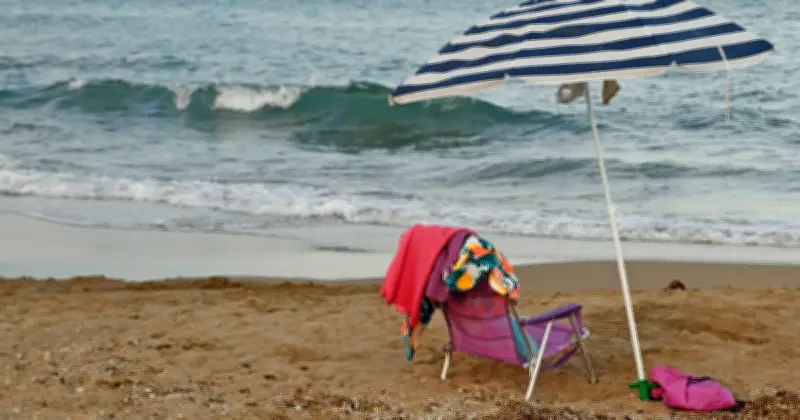
British tourists in Italy are being warned that the common practice of reserving a beach spot by leaving a towel, chair, or parasol overnight can lead to fines of up to £425 (€500), with additional costs if seized items need replacing. The custom is explicitly forbidden in Italy, and authorities have intensified enforcement against the so-called furbetti dell'ombrellone, or "umbrella cheats"—people who try to occupy areas of free public beaches while absent.
Recent crackdowns and confiscations
In a recent early-morning operation at Laghetto beach in Torre del Greco, near Naples, Coast Guard personnel and local officers cleared roughly 40 abandoned items, including parasols, chairs, and tables. Some of the equipment had allegedly stayed on the beach for over two days, according to the Liverpool Echo.
Those accountable face fines of up to £425 (€500), while retrieving confiscated belongings may entail a protracted administrative procedure. Similar operations have taken place across Italy, including in Castellabate, Campania, where approximately 200 parasols, chairs, loungers, and other items were seized during overnight checks in July, returning more than 3,000 square metres of beach to public use. Hundreds more unattended parasols, loungers, and beach towels were removed from Micenci beach at Donnalucata in Sicily during another dawn operation, and a further operation in Campomarino reportedly removed around 170 items and freed more than 10,000 square metres of public beach.
Why the rules exist
Free beaches hold particular significance in Italy, as many popular coastal areas are run by private lidos, where holidaymakers must pay to rent loungers and parasols. Graziano Gagliardi, travel expert at Private Italy Tour, explained: "Brits may recognise this as the beach equivalent of leaving a towel on a hotel sunlounger. The difference is that a free Italian beach is public land, so leaving equipment overnight can be treated as an unauthorised occupation rather than simply inconsiderate behaviour."
Gagliardi added: "These fines are not being imposed simply because authorities dislike unattended towels. The rules exist to preserve access to publicly owned coastline and stop people informally claiming the best parts of the beach for days at a time." He also noted that abandoned equipment can obstruct beach cleaning, emergency access, and early-morning safety inspections, and that unsecured parasols could become dangerous if the weather changes overnight.
What tourists should know
The clampdown primarily targets equipment deliberately abandoned overnight or for extended periods. It does not mean that a tourist will automatically face a fine for briefly stepping away to take a dip or grab a drink. Gagliardi warned: "The intention matters, but travellers should not rely on assumptions. If you are still using the beach and briefly enter the sea, that is very different from packing up everything except a chair and returning to your hotel until the next morning."
He advised: "The simplest rule is that if you are leaving the beach for the day, every item you brought should leave with you." Britons seeking a guaranteed spot are urged to book a sun lounger through a licensed lido or utilise the beach's official reservation system where available. Gagliardi recommended asking hotels or hosts about local ordinances, closing times, or formal reservations, and checking information boards at beach entrances. He concluded: "Leaving a cheap chair overnight is not a free reservation system, and losing the chair may be the least expensive consequence. Public beaches belong to everyone. The safest approach is straightforward: when you go back to your accommodation, take your towel, chair, table and parasol with you."