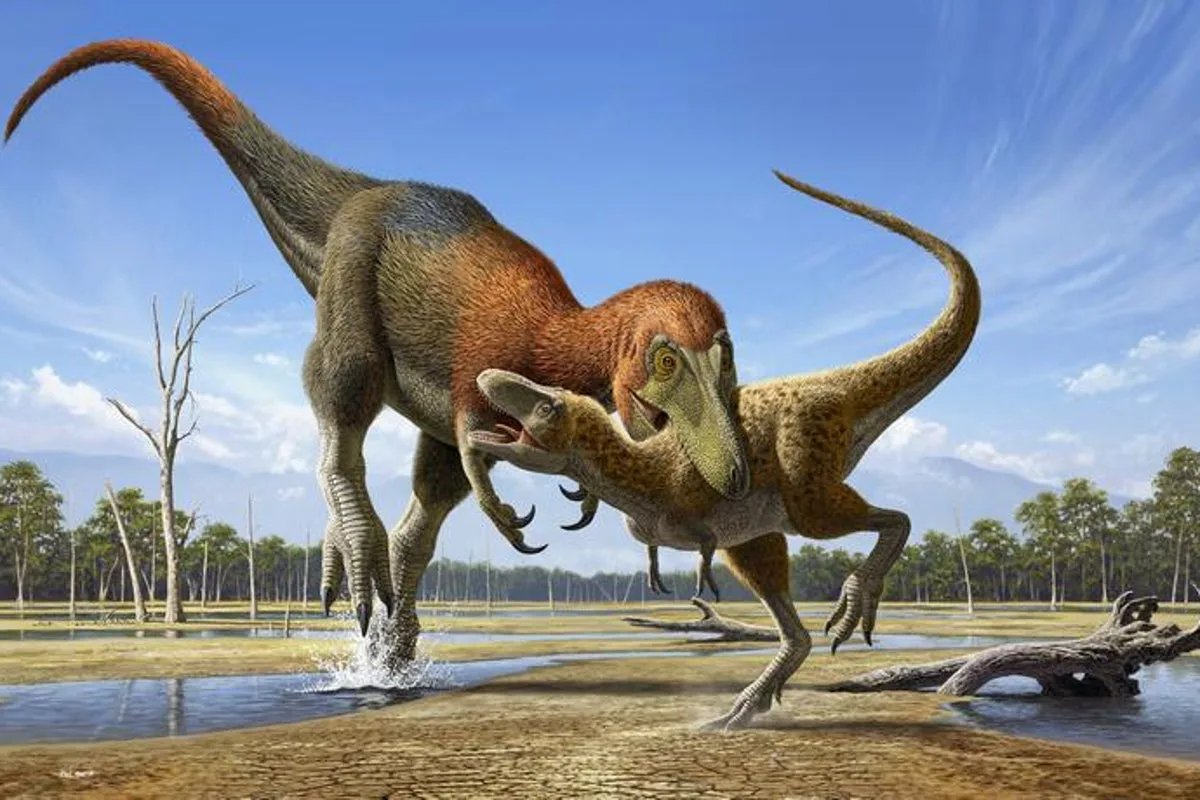
A new study suggests that Tyrannosaurus rex and other large meat-eating dinosaurs evolved tiny arms because their heads became the primary weapon for hunting. The research, published in the journal Proceedings of the Royal Society B Biological Sciences, indicates that as these dinosaurs developed powerful skulls and jaws, their forelimbs became redundant and shrank over time.
Scientists have long puzzled over why T rex, which grew up to 40 feet long and 20 feet tall, had arms only about three feet in length. The study, led by Charlie Roger Scherer, a PhD candidate at University College London, found a strong link between short arms and robust skulls across five groups of dinosaurs with reduced forelimbs.
“The head took over from the arms as the method of attack. It’s a case of ‘use it or lose it’,” Scherer said. The shift likely occurred in response to the increasing size of prey, such as giant sauropods, where grabbing with claws became less effective than biting and holding with jaws.
The researchers quantified skull robustness by measuring dimensions, bone connectivity, and bite force. T rex scored highest, followed by the similarly massive Tyrannotitan from Argentina. They found that arm length reduction was more closely tied to skull robustness than to overall body size.
The study concludes that forelimb reduction resulted from their redundancy in prey capture. Future research will explore how the small forelimbs may have contributed to the evolution of feathers and flight.