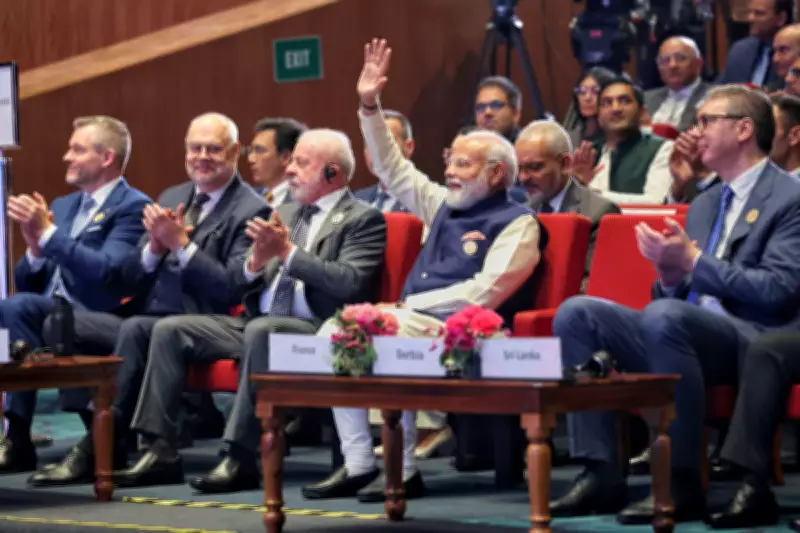
Prime Minister Narendra Modi has positioned India as a future global epicentre for artificial intelligence, declaring the nation's intent to design and develop technology domestically for worldwide application. Speaking at the India AI Impact Summit in New Delhi on Thursday, Modi addressed an assembly of international leaders, tech executives, and policymakers, emphasising a vision of "Design and develop in India. Deliver to the world. Deliver to humanity."
India's Strategic Ambition in the AI Landscape
This bold declaration aligns with India's strategy to capitalise on its status as one of the planet's fastest-expanding digital markets. The nation aims to utilise its extensive experience in constructing large-scale digital public infrastructure, such as its digital ID and online payments systems, to present itself as a cost-effective nexus for AI innovation. Modi stressed the necessity to "democratise AI," transforming it into an instrument for inclusion and empowerment, particularly for nations in the Global South.
International Endorsements and Calls for Equity
The summit garnered significant international attention, featuring addresses from French President Emmanuel Macron and Google CEO Sundar Pichai. United Nations Secretary-General António Guterres utilised the platform to advocate for the establishment of a substantial $3 billion fund. This initiative is designed to assist less affluent countries in developing fundamental AI capabilities, encompassing skills training, data accessibility, and affordable computing resources.

Guterres issued a stark warning, stating, "The future of AI cannot be decided by a handful of countries, or left to the whims of a few billionaires." He insisted that artificial intelligence must fundamentally "belong to everyone," echoing the summit's broader theme of equitable technological advancement.
Substantial Investment and Market Potential
India's nearly 1 billion internet users solidify its position as a critical market for global technology corporations expanding their AI operations. This potential has triggered a wave of colossal financial commitments. In December, Microsoft announced a monumental $17.5 billion investment over a four-year period to enhance its cloud and AI infrastructure within the country.
This commitment followed Google's earlier pledge of $15 billion across five years, which includes plans to establish its inaugural AI hub in India. Furthermore, Amazon has vowed to invest $35 billion by 2030, specifically targeting AI-driven digitisation projects. Collectively, India is actively seeking up to $200 billion in data centre investments in the coming years to support this technological surge.
Challenges and Domestic Hurdles
Despite these ambitious goals and incoming capital, India confronts significant obstacles in its quest for AI sovereignty. The country currently lags in developing its own large-scale, foundational AI model comparable to U.S.-based OpenAI or China's DeepSeek. Key challenges include restricted access to advanced semiconductor chips, a need for more extensive data centre networks, and the complexity of training AI on hundreds of diverse local languages.
Organisational Setbacks at the Summit
The high-profile event, which commenced on Monday, was not without its difficulties. Attendees and exhibitors reported considerable organisational glitches, including extensive queues, delays, and complaints on social media regarding stolen personal belongings and display items. Organisers later confirmed the recovery of these items.
Further issues emerged on Wednesday when a private Indian university was expelled from the summit. This action followed an incident where a staff member presented a commercially available, Chinese-manufactured robotic dog as the institution's own innovation. The troubles persisted into Thursday with the unexpected withdrawal of Microsoft co-founder Bill Gates from a scheduled keynote address.
While no specific reason was provided for Gates' cancellation, the Gates Foundation stated the decision was made "to ensure the focus remains on the AI Summit's key priorities." This move occurs amidst ongoing public scrutiny regarding Gates' past associations with the late financier and convicted sex offender, Jeffrey Epstein.