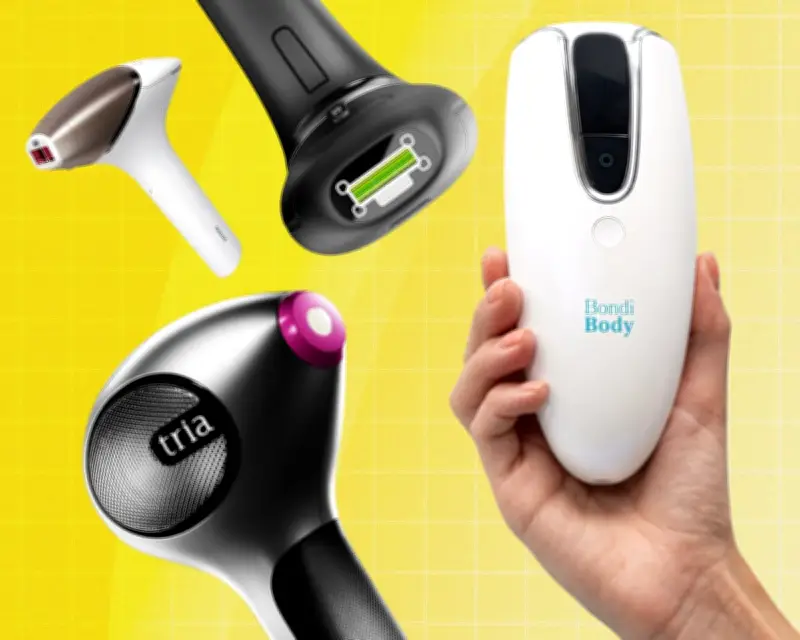
After testing 13 IPL and laser hair removal devices for home use, the Philips Lumea 9900 emerged as the best overall for its foolproof smart attachments and versatility across face and body. The Bondi Body v2 Laser @home offers the best value for budget-conscious buyers, while the Silk'n 7 is the only device that works on a wide range of skin and hair colours. The Tria 4X is the sole true laser device, delivering salon-like results in fewer sessions.
How the Devices Were Tested
Each device was used for three full sessions on the same body area. The tester recorded treatment time, comfort, and visible regrowth after each session. A control area was left untreated for comparison. Devices were assessed on weight, dimensions, ease of handling, flash rate, and total lifetime flashes. All products not returned to manufacturers were donated to the homelessness charity Crisis.
Best IPL Device Overall: Philips Lumea 9900
The Philips Lumea 9900 (£570 at Amazon) is the most versatile IPL device tested. It comes with four smart attachments for face, underarms, bikini, and body, which automatically select the appropriate light intensity. The device can be used corded or cordless, though the flash rate is faster when plugged in (two seconds per flash). An optional app provides treatment schedules and settings recommendations. However, the design is top-heavy and slower than some competitors—treating a half leg takes about 10 minutes versus five minutes with faster devices. It is not suitable for dark skin or light hair. Lifetime flashes: 450,000.
Best Budget IPL: Bondi Body v2 Laser @home
The Bondi Body v2 (£134.50 at Bondi Body) is compact and intuitive, with eight intensity settings and no extra attachments. It fits easily in the hand and is ideal for beginners. Regrowth on legs was noticeably reduced over the testing period. However, its three-second flash rate is slow, making full-leg treatments time-consuming. It is not suitable for dark skin or light hair. Lifetime flashes: 400,000.
Best for All Skin and Hair Types: Silk'n 7
The Silk'n 7 (£399.20 at Debenhams) features a skin colour sensor that calibrates treatment for a wider range of skin and hair colours than other devices. It successfully treated light blond arm hairs, which are usually unsuitable for IPL. The device has a rotating swivel head for hard-to-reach areas, three attachments (face, body, underarm/bikini), and an optional app. It is one of the more expensive options but is worth it for those with challenging skin and hair combinations. Flash rate: two per second. Lifetime flashes: 600,000.
Best Laser Device: Tria 4X Hair Removal Laser
The Tria 4X (£549.99 at Tria) uses an 810nm diode laser, similar to salon lasers, instead of IPL. It emits a warm red light and beeps with each successful pulse. The built-in skin sensor only unlocks the device if the skin tone is treatable. With five power levels, it produced smooth patches after just three treatments, though the small treatment window requires careful tracking. It is cordless but heavy. Not suitable for dark skin or light hair. The device is best for smaller areas like face and bikini.
Other Notable Devices
The Ulike Air 10 (£269.98 at Amazon) has a fast flash rate (four per second) and a built-in cooling system, but it is not cordless. The Foreo Peach 2 (£289 at Amazon) has a soft silicone casing and a useful app, but results were slower than other devices. The Braun Silk Expert Pro 5 (£600 at Amazon) offers continuous skin tone adjustment and good results, but is expensive and less versatile than the Philips Lumea 9900.
What Is IPL?
IPL stands for intense pulsed light. It uses flashes of light to heat hair follicles, causing hair to enter a resting phase and fall out. Regrowth becomes finer and slower over time. IPL is not permanent but significantly reduces hair growth with repeated use.
IPL vs Laser Hair Removal
Salon lasers use focused, high-energy light for faster results, while at-home IPL devices use broad-spectrum light and are designed for safety. Some at-home devices, like the Tria 4X, use a lower-energy laser that can produce faster and longer-lasting results than IPL.
How to Use Home IPL Devices
Hair must be removed from the target area before treatment so light reaches the follicle directly. Use on dry skin without lotions. Start with a test area, select power level, and flash each spot. Some devices have a glide mode for continuous pulses. Flash rate affects treatment speed.
How Many Sessions Are Needed?
Results vary by device, power setting, and hair growth rate. Treatments are recommended one to three times per week initially. Finer regrowth may appear within two to three weeks, with noticeable reduction after six to eight weeks. Most manufacturers advise weekly sessions for 10 to 12 weeks, then monthly maintenance.
Who Can Use IPL?
IPL works best on light skin with dark hair. Very light or grey hair may not respond, and dark skin may be at risk of burns. The Silk'n 7 is designed for a wider range. IPL is not suitable for male facial hair. Avoid use on broken skin or sensitive areas.
Drawbacks and Longevity
The main drawback is upfront cost, but it can be cost-effective compared to salon waxing over time. IPL devices last between 400,000 and 900,000 flashes, which translates to 20 to 30 years of monthly maintenance use. Devices can be recycled under the Weee directive or traded in through manufacturer programmes.