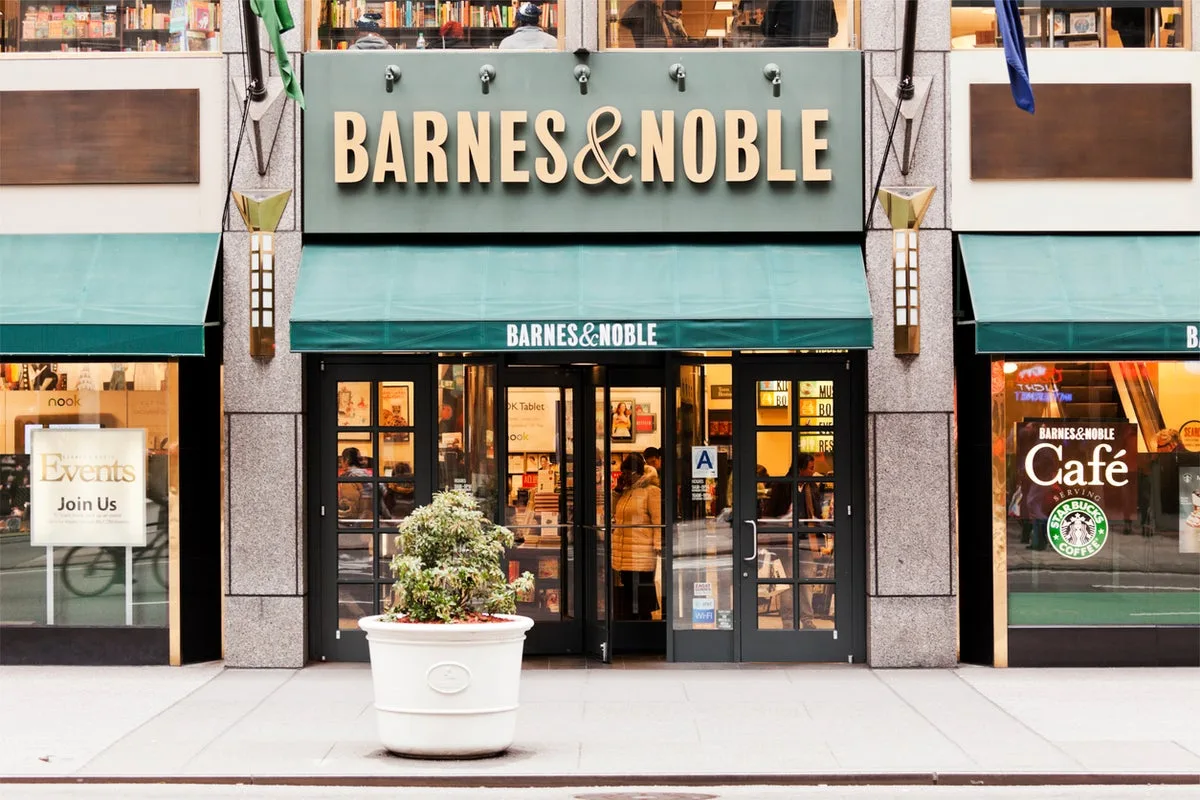
James Daunt, the chief executive of Barnes & Noble, has stated that he has no objections to the sale of artificial intelligence-generated books within the retailer's outlets. In a recent interview on NBC News' "Business in America" series, Today host Jenna Bush Hager asked Daunt how AI is influencing the book publishing sector. This query arises amid growing anxiety within creative fields about AI-generated content displacing genuine human artistry, with many artists witnessing paid assignments vanish as their literary works are utilised to train AI models.
"You have said that if the rise of AI books becomes a thing, you would be willing to sell them within your stores," Bush Hager noted. "Yes, I have actually no problem selling any book, as long as it doesn’t masquerade or pretend to be something that it isn’t," the British businessman responded. "And that it has an essential quality to it, and that the customer, the reader, wants it." He added: "So as long as an AI-written book says it’s an AI-written book and doesn’t pretend to be something else and isn’t ripping off somebody else, as long as that’s clearly stated and the customer wants to buy it, then we will stock them."
Daunt, who assumed leadership of Barnes & Noble in 2019, further remarked: "We have 300,000 titles across all of our stores. Do we think that some of those may be AI? The chances are that they are, but we’re not really conscious of them." He also argued that at present, AI-generated books appear unlikely to achieve substantial commercial success. "So I think it’s something that one should treat with common sense and acceptance, but not allow anything to masquerade," he explained. He emphasised that clarity regarding the author's identity and whether they are a real person is paramount.
His comments follow a period in which numerous authors have seen their careers affected by AI. A 2025 study conducted by Cambridge University revealed that 59 percent of UK novelists reported their work had been used to train large language models without permission or compensation. Furthermore, more than a third of those authors stated that their income had declined due to generative AI, often through the loss of supplementary work that supports their novel writing.
Daunt, who also serves as Managing Director of Waterstones, the largest independent bookshop chain in the UK, has previously expressed his acceptance of AI-generated books. In a December appearance on the BBC's Big Boss Interview podcast, he said: "If people want to read that book, AI-generated or not, we will be selling it - as long as it doesn't pretend to be something that it isn't. We as booksellers would certainly naturally and instinctively disdain it."
In 2019, Barnes & Noble was acquired by the hedge fund Elliott Advisors for $683 million, after having been a publicly traded company on the New York Stock Exchange for 26 years. Although hundreds of Barnes & Noble stores closed in the US during the 2010s, the chain is currently experiencing a resurgence. In December, the retailer announced plans to open 60 new stores across the country this year, with locations in Ohio, Texas, Florida, Illinois, Colorado, Washington state, California, Virginia, Georgia, and Washington, DC. "Barnes & Noble is enjoying a period of tremendous growth as the strategy to hand control of each bookstore to its local booksellers has proven so successful," the company stated to USA Today at the time. "In 2024, Barnes & Noble opened more new bookstores in a single year than it had in the whole decade from 2009 to 2019."