

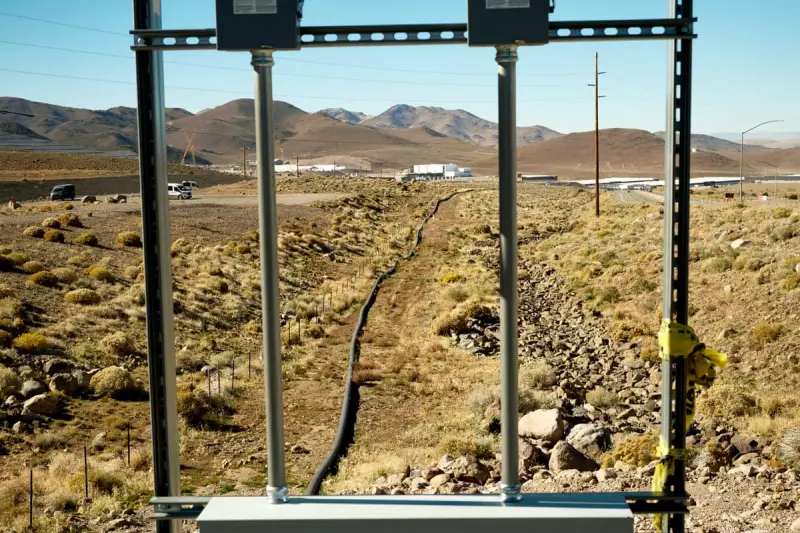
Hidden behind the sagebrush-covered hills of Nevada's high desert, a monumental construction project is unfolding. What was once a landscape traversed by gold prospectors is now the site of a frenzied, multi-trillion dollar buildout: the artificial intelligence data centres powering the world's biggest tech companies.
From Gold Rush to GPU Rush: The Desert's Radical Transformation
The epicentre of this new industrial revolution is the Tahoe-Reno Industrial Centre (TRIC), a business park in Storey county covering more than 100,000 acres – a landmass greater than the city of Denver. This area, once dubbed "The Richest Place on Earth" for its gold and silver deposits, is now one of Nevada's fastest-growing economies, driven not by precious metals, but by computing power.
"When I first came up here, there was nothing but desert dirt trails, coyotes, and rabbitbrush," said Kris Thompson of Gilman Commercial Real Estate Service, the park's exclusive broker. "Nothing else was here. No roads, no water wells, no businesses." Today, the view from the 18-mile USA Parkway highway reveals a starkly different scene: a constant stream of semi-trucks, forests of yellow cranes, and miles of new concrete buildings housing millions of servers.

The park is home to the largest data centre in the United States, built by Switch, and hosts vast facilities owned by Google, Microsoft, and Apple. Tesla's gigafactory, producing electric vehicle batteries, is also a resident. The scale of investment is staggering. Tract, a company similar to Switch, purchased 11,000 acres and pledged $100 billion into its data centre project. Consulting firm McKinsey and Company estimates global spending on AI data centres will reach nearly $7 trillion by 2030.
The Insatiable Thirst: Water and Power in a Parched Landscape
This unprecedented growth comes at a profound environmental cost, particularly in a state averaging just 11 inches of rainfall per year. AI data centres are notoriously resource-intensive, requiring far more energy and water than standard internet infrastructure. A single ChatGPT query uses nearly ten times the electricity of a traditional web search, and the supercomputers need intensive water-cooling systems to prevent overheating.
"Everyone cannot keep moving to a space that has no resources. Nevada is completely over-allocated on its ground water resources. It's the driest state in the union," said Steven Wadsworth, Chairman of the Pyramid Lake Paiute Tribe. The tribe's reservation surrounds Pyramid Lake, which is fed by the Truckee River – the same river that supplies water to the industrial park.
Wadsworth points to the dry, white bed of the former Lake Winnemucca as a dire warning. That lake dried up completely after the Truckee River was dammed in the early 1900s. "We know what happens when we don't fight for the water," he said. The tribe has fought for decades to protect Pyramid Lake and its native fish, purchasing water rights and filing lawsuits to safeguard the river's flow.
A Department of Energy report notes US data centre water use has tripled in a decade to over 17 billion gallons annually, a figure largely attributed to AI servers and expected to near 80 billion gallons by 2028. In response, the industrial park built a $100 million reclaimed water reservoir, pumping effluent from a wastewater treatment plant via a 21-mile pipeline. While seen as an alternative to direct river use, Wadsworth notes this water would previously have been returned to the Truckee, underscoring the complex trade-offs.
Powering the Future, Straining the Grid
The demand for electricity is equally colossal. The International Energy Agency estimates worldwide data centre electricity consumption could double by 2026, equalling the annual usage of Japan. In the US, where about 60% of electricity comes from fossil fuels, this surge is driving a new buildout of natural gas power plants and delaying the decommissioning of coal facilities.

NV Energy, the utility serving the area – owned by Warren Buffett's Berkshire Hathaway – has gained approval for at least four new natural gas units. Tech companies are investing heavily in renewable energy to offset their footprints; Google claims a 12% reduction in data centre energy emissions in 2024, and Apple says its local centres run entirely on solar. However, overall carbon emissions for Google and Microsoft have risen 51% and 23% respectively since 2019.
On the Pyramid Lake reservation, Wadsworth says rolling brownouts are already common in summer. "We just don't have the power capacity to keep running all of these things," he warned, concerned the data centre boom will exacerbate the problem.
As the race for artificial general intelligence accelerates, fuelled by hundreds of billions in venture capital, the Nevada desert finds itself on the frontline of a new kind of frontier. The 'miracle in the desert', as Thompson calls it, promises immense economic reward but forces a critical reckoning with the limits of our most precious resources in an era of climate crisis. The wild horses that still roam the park's preserved hills may symbolise the independent spirit of the tech pioneers, but their future, and that of the region's water and power, hinges on a fragile balance.





