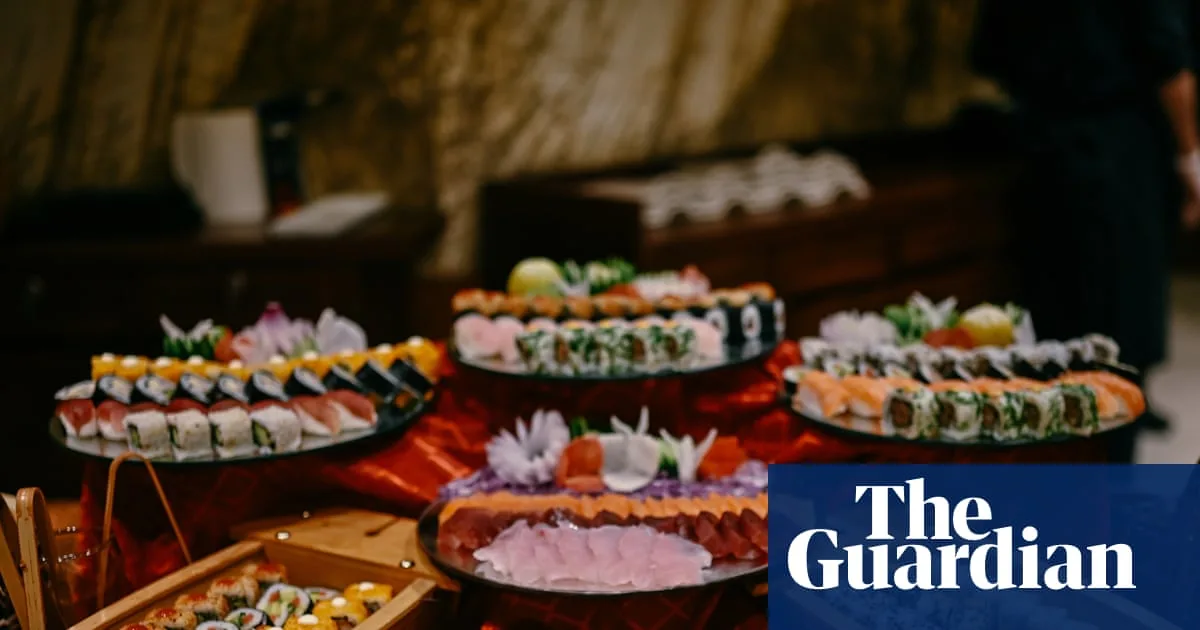
Once upon a time, Pakistanis scorned raw fish. Now sushi is everywhere from Ramadan meals to wedding buffets – and it all started with one man and a dream. When the 17-storey Avari Towers opened in Karachi in April 1985, it was the tallest hotel in the city. “It felt otherworldly,” said one chef who worked there as a teenager. “It was there that I saw a swimming pool for the first time,” he remembered, “and swimsuits.” By December 1986, this $32m building had another novelty to offer – Fujiyama, a Japanese restaurant at its summit. There had been no advertisements for Fujiyama, and for its first six weeks, the only way to get in was with an invitation; these began to land in the homes and offices of the city’s bankers, businessmen, doctors and other members of Karachi’s elite. By the new year, the restaurant was so busy it had waiting lists. There were now two kinds of people in the city of 6 million: those who had tried sushi and those who had not.
In the late 80s, a Japanese restaurant like Fujiyama was an expensive proposition: foreign chefs had to be hired, staff trained, and ingredients, from wasabi to rice, constantly imported. Sushi – raw fish – in a country where daal roti is a staple and vegetables are often cooked down until they lose their crunch: who would take such a risk? And yet, somehow, it paid off. Fujiyama was the first place to serve Japanese cuisine in Pakistan, and it was where many Pakistanis encountered sushi for the first time.
Today, you can finish your day of fasting during Ramadan at a sushi buffet or host a wedding reception for a small (by Pakistani standards) gathering of 100 or more at a Japanese restaurant. When restaurants closed during the pandemic, waiters zipped across the city on motorbikes to deliver sushi. In May 2022, the cash-strapped government attempted to impose a ban on the import of “luxury items” to Pakistan – including Norwegian salmon and nori from Dubai – but the finance minister later had to admit that “even though we had the ban … you could still find salmon and sushi in restaurants”.
While much of it may not be good – with gummy rice or chalky, bland wasabi – it’s clear today that Pakistanis want sushi. It is on the menus of fine dining restaurants in hotels, and in the many pan-Asian restaurants that have mushroomed across Lahore, Karachi and Islamabad. By the time I encountered “chapli sushi” (a chapli kebab and cucumber maki roll) at a restaurant in Lahore, I wondered: how did we get here?
To understand the risks associated with bringing an expensive novelty like sushi to Pakistan, you have to understand the men of the Avari family. They were entrepreneurs – hustlers, really – of a kind we rarely see in present-day Pakistan. Byram Avari – “Baba” to employees of the Avari hotel chain and Fujiyama – lived by the same simple edicts as his father, Dinshaw. A Zoroastrian migrant from Bombay, Dinshaw moved to Karachi as an insurance agent in 1929. “Rules are made for fools, and donkeys and mules, and children in schools,” Dinshaw liked to say. Who makes the rules? You and I. Who can amend the rules? You and I.