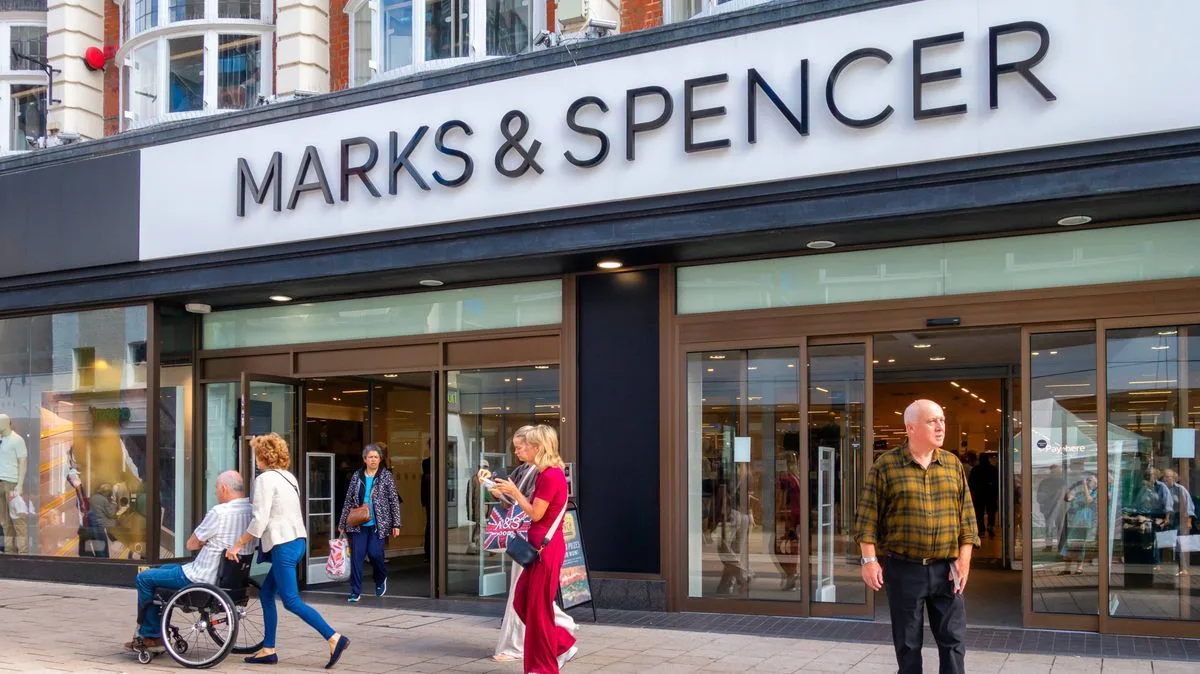
Marks & Spencer (M&S) is making a bold push to capture the British weekly shop, and the retail giant is approaching a critical update on its venture into the fiercely competitive grocery sector. M&S Food now accounts for over half (54 per cent) of the retailer's revenues, and recent warehouse expansions signal the FTSE 100 company's ambition to secure a larger slice of the UK's supermarket market. The firm will unveil its full-year results on Wednesday, hoping its food expansion will help shift focus away from last year's devastating cyber attack that disrupted operations.
Warehouse Investments Signal Ambition
On Monday, M&S spent £66 million on a 437,000 square foot warehouse from online retailer Asos. Later in the week, it announced the start of construction on a new £340 million food distribution centre in Northamptonshire. This new warehouse, the largest investment ever in M&S's food division, was described by food logistics chief Kevin Bennett as a "major step in transforming [it] into a true destination for the weekly shop," as reported by City AM.
Record Grocery Market Share
The retailer has been investing in store renovations, which it says are attracting more customers. Sales in the food business surged 5.6 per cent year-on-year, according to M&S's Christmas trading update, as the company celebrated its highest-ever grocery market share, rising to 4 per cent in November. This puts M&S Food in a position to challenge upmarket rival Waitrose, which holds a 4.6 per cent share, though it still trails far behind giants Tesco and Sainsbury's.
Britain's supermarkets are locked in a fierce battle to keep prices down amid rising food inflation triggered by the Iran war, which a leading industry body warns could hit double digits this year. Tesco and Sainsbury's have declined to specify likely price increases to avoid alarming shoppers, but have urged the government to reduce grocers' energy bills.
Recovering from the Cyber Attack
M&S will be hoping its thriving food division emerges relatively unscathed from the devastating cyber attack that struck in April last year. The attack exposed vulnerabilities in the company's supply chains, leaving some shelves bare and forcing its website into a 12-week shutdown. Chairman Archie Norman described it as "not an overstatement to describe [the attack] as traumatic," telling MPs it felt like hackers were "trying to destroy" his business.
M&S recovered only a third of its £300 million in lost sales through insurance, and the blow to trading profit soared to £324 million in the first half of that year alone. However, chief executive Stuart Machin has since deployed a forthright, hands-on approach to recovery, a strategy he calls "positive dissatisfaction."
Retail Director's Demands on Shoplifting
In recent months, M&S retail director Thinus Keeve has spearheaded demands for the government and the Mayor of London to tackle violent shoplifting, calling it a "systemic issue."
Investor Outlook
Richard Hunter, head analyst at Interactive Investor, said: "M&S will be glad to see the end of a year where the cyber disruption was the unfortunate highlight. Even so, the group's healthy financial position helped it to weather the storm, and indeed M&S continued to make investments in the business despite the cyber-related costs elsewhere."
The retailer's share price has been turbulent, climbing to a peak just before the Iran war erupted, then tumbling back towards its cyber attack lows. The stock has dropped by around three per cent in recent days to 317p, sitting 11 per cent below where it stood a year ago. To win over investors, M&S will need to match consensus forecasts of £16.4 billion in total sales and £603 million in pre-tax profit.