

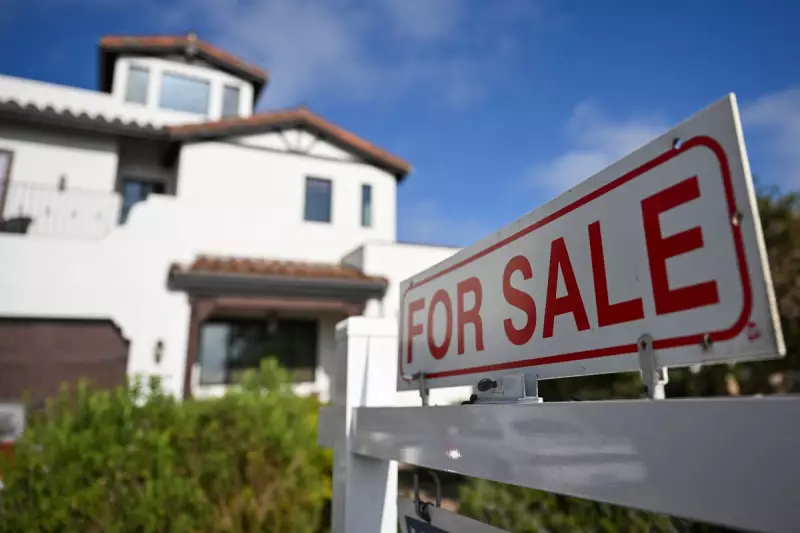
US Housing Market Shifts as Price Cuts Become the Norm
The red-hot US property market has cooled significantly, forcing a majority of sellers to reduce their asking prices to secure a sale. According to a report, more than half of the homes sold in 2025 had at least one price cut before being purchased, a stark contrast to the frenzied pandemic market.
From Seller's Paradise to Buyer's Market
During the early 2020s, the Covid-19 pandemic triggered a mass migration from dense cities to less populated areas. This created a seller's market where properties frequently sold in days, often for more than the asking price. Now, the dynamic has reversed. With mortgage rates hovering around 6 percent—double the pandemic lows of approximately 3 percent—buyers are becoming more cautious with their finances.
Many sellers are entering the market with price expectations based on the previous boom, failing to account for today's higher borrowing costs. Data from the National Association of Realtors (NAR) reveals that just over 20 percent of active listings in October had a price cut, which is double the rate seen during the pandemic.

The Consequences of Overpricing
Setting an initial price too high has tangible consequences. NAR data indicates that listings which sold after a price reduction generally spent five times as many days on the market compared to those priced correctly from the start. Homes priced accurately from day one not only sell faster but also achieve close to 100 percent of their original asking price.
A report from real-estate brokerage Redfin confirms this is the strongest buyer's market the firm has ever tracked, with 36.8 percent more sellers than buyers nationwide. This translates to over 528,000 homeowners struggling to find a buyer.
Regional Variations and a Divided Market
The market is not uniform across the United States. Analysis by Resi Club, published in Fast Company, shows that every state saw an increase in active housing inventory compared to 2024. States with the most significant jumps include:
- Maryland and North Carolina (both 34% increase)
- Virginia and Nevada (both 27% increase)
- Arizona (23% increase)
- Washington (25% increase)
- South Dakota (23% increase)
In regions where active listings now exceed pre-pandemic 2019 levels—such as Texas, Arizona, Colorado, and Florida—prices are softening or falling. However, a different story unfolds in the Northeast and Midwest, where a shortage of available homes compared to 2019 is keeping prices stubbornly high.
Despite the overall buyer's market, national home prices have not collapsed. Data shows home prices in 2025 were up 2.3 percent year-over-year, with October recording the largest monthly price increase in seven months. The challenge lies in affordability; first-time buyers made up only 34 percent of purchases in October, well below the typical 40 percent, as elevated prices and mortgage rates continue to lock many out of the market.






