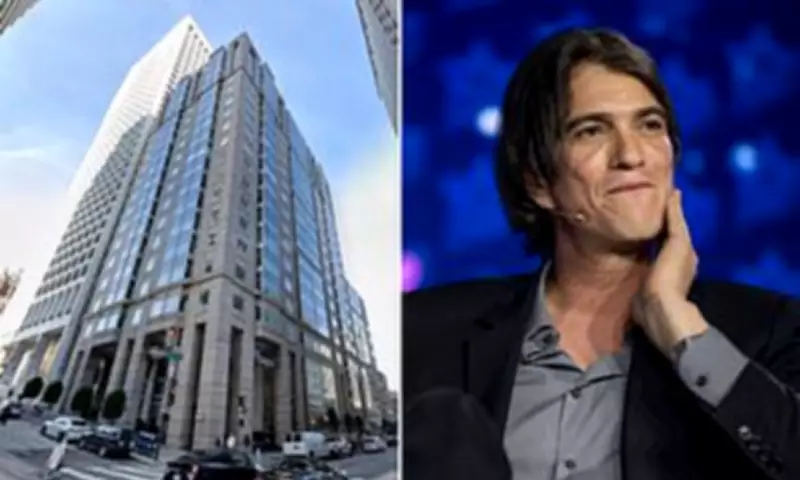
A premium office building in San Francisco's financial district failed to attract any bids when it went up for auction last week, directly contradicting claims that the city's commercial real estate market has recovered from the pandemic's devastating impact.
Stark Valuation Decline
The 20-story, 360,000 square foot Class A tower at 600 California Street was valued at an impressive $320 million in 2019, but by 2024, its appraisal had plummeted to just $109 million. This represents a staggering 66 percent drop in value over just five years, highlighting the severe challenges facing urban office markets.
WeWork's Collapse and Financial Fallout
Three years ago, the building's anchor tenant, WeWork, ceased paying rent, triggering a chain of financial difficulties. The building's owners, WeWork's investment arm WeCap and Rhone Group, found themselves unable to maintain payments on a substantial $240 million loan originally issued by Goldman Sachs.

In January, private equity group Lone Star Funds intervened by purchasing the building's debt from Goldman Sachs for $130 million. Through a strategic foreclosure process, Lone Star Funds then took ownership of 600 California Street by placing a $216 million credit bid on the property.
The Auction That Never Was
The recent auction presented a final opportunity for other parties to purchase the building by outbidding Lone Star Funds. However, the office tower's alarmingly low occupancy rate made the purchase excessively risky for prospective buyers, as it became impossible to guarantee repayment of the substantial loan.
As a result, Lone Star Funds officially assumed control of 600 California Street for an estimated $361 per square foot. This stands in stark contrast to WeCap's 2019 purchase price of approximately $900 per square foot, illustrating the dramatic market shift.
WeWork's Ambitious Expansion and Sudden Collapse
WeCap was originally established as WeWork's in-house investment vehicle, designed to enable the company to transition beyond merely leasing office space to actually owning premium properties. During its peak, WeWork had been molded into the country's most valuable startup, achieving a remarkable private valuation that peaked at $47 billion.
The company's innovative business model involved signing long-term leases of ten to fifteen years, transforming traditional offices into flexible coworking spaces, and then subleasing them at premium rates. This approach proved enormously successful until the pandemic fundamentally altered workplace dynamics.
Pandemic's Devastating Impact
When office occupancy rates plummeted during the pandemic, WeWork found itself trapped in a precarious position. The company no longer maintained a steady income stream while remaining locked into extended lease agreements that required continued rent payments.
WeCap simultaneously struggled to pay off mortgages on properties it had purchased, as rent payments from increasingly vacant offices slowed to a mere trickle. At 600 California Street specifically, the company faced a dual crisis, unable to pay both its own rent and mortgage loan payments simultaneously.
As the building's anchor tenant occupying over 200,000 square feet—more than half the total space—WeWork's financial difficulties meant revenue from the property had essentially evaporated.
Legal Proceedings and Market Implications
Goldman Sachs initiated legal action against WeCap and Rhone Group in 2023 after the partner companies fell behind on mortgage payments. WeWork subsequently filed for bankruptcy shortly after these proceedings began.
San Francisco commercial broker Charlie McCabe told the San Francisco Chronicle that WeWork's "2023 bankruptcy implosion continues to echo in San Francisco." He emphasized that the building's recent foreclosure sale "dispels the perception that the local commercial property market has completely bounced back."
McCabe further noted that five additional troubled commercial properties exceeding 250,000 square feet in size have changed ownership in San Francisco just this year, indicating broader market challenges beyond this single property.
The Daily Mail has reached out to both WeWork and Lone Star Funds for comment regarding these developments and their implications for San Francisco's commercial real estate landscape.