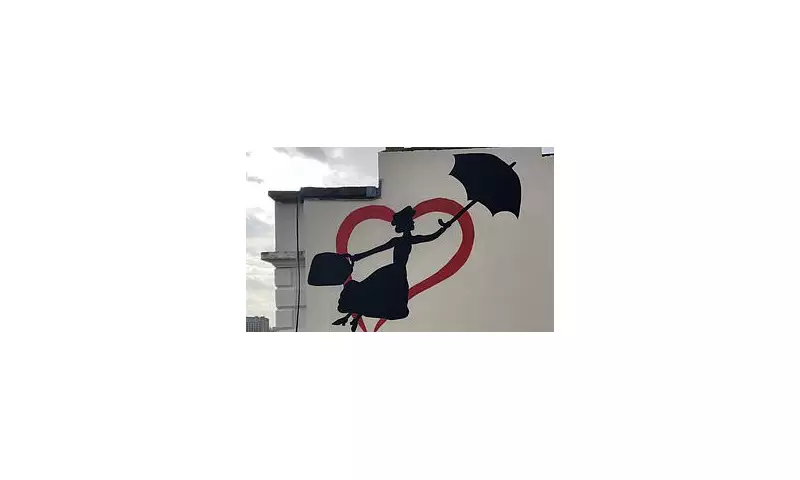
Mary Poppins Mural Triumphs Over Council Removal Demands in Kensington
A striking mural depicting Mary Poppins flying across a Kensington townhouse has been dramatically spared from removal after an independent planning inspector overruled furious local councillors. The artwork, which shows the famous nanny silhouetted against a red heart while clutching her iconic umbrella and carpet bag, was painted on the side of a property in Earls Court Square as a heartfelt 'message of hope' in response to devastating natural disasters in Africa.
Planning Saga Ends with Victory for Artwork
Patrick Spens, a 56-year-old retired consultant, commissioned the artwork on the roof of his upmarket West London home in October 2023. However, Kensington and Chelsea council swiftly informed him that the mural breached strict conservation area rules. Town hall officials launched enforcement action after councillors voted it through, despite their own planning officers initially advising against taking any action.
Now, after a 14-month planning saga, the independent Planning Inspectorate has ruled that the giant mural can remain. Inspector Grahame Kean concluded in his decision that the artwork causes 'no harm' to the historic square and 'if anything enhances it slightly'.

Symbol of Hope Versus Council Enforcement
At the height of the controversy, Mr Spens hit back at what he called attempts to 'whitewash a symbol of hope', pointing to the stark contrast with crowds flocking to see a Banksy mural that appeared overnight in Finsbury Park. 'There’s a new Banksy out today,' he remarked at the time. 'I bet the council won’t demand its removal!'
Mr Spens previously explained how the idea emerged during a low moment at home with his daughter following catastrophic floods in Libya and the Al Haouz earthquake in Morocco, both of which claimed thousands of lives. 'I was in a really bad place. I was sitting on the roof saying, ‘God, the world’s in a terrible place at the moment. I want to paint something as a symbol of hope,’ and she said, ‘just get on with it.’'
He commissioned artist Saffina Tarbuck, granddaughter of comedian Jimmy Tarbuck, to paint the mural in the dark to avoid immediate complaints. Despite gathering signatures from neighbours and receiving widespread online support, councillors voted in December 2024 to pursue enforcement action, describing the mural to Mr Spens as 'harmful graffiti'.
Council Opposition and Conservation Concerns
Local councillor Hamish Adourian insisted at a town hall meeting that the streets and buildings of Kensington and Chelsea were 'not a canvas'. He added: 'I do like Mary Poppins. I do enjoy the film, but, committee, not here.'
Meanwhile, Earl’s Court Square Residents’ Association chair Chrissie Courtney stated that the association had been calling for the mural’s removal since February 2024. She argued that allowing it to remain would set an 'unmanageable precedent'.
Earls Court Square lies within a tightly controlled conservation area where even painting an exterior wall normally requires permission. Terraces must be traditionally painted a specific shade of magnolia with white woodwork, and house numbers are recommended in black Garamond font at a specific seven inches tall.
Inspector's Poetic Ruling Favours Artwork
In his ruling, Mr Kean noted: 'Cherry Tree Lane in London does not exist in real life. However, Earls Court Square does. In the council’s view, the appeal site is no place for the unauthorised development the subject of the enforcement notice.' But after visiting the site, the inspector took a very different view.
He observed that the mural is visible only from limited angles and is barely noticed by passers-by, writing that during his inspection he watched people walk through the square and 'not one looked up to anywhere near the mural'.
In an unusually poetic ruling, Mr Kean even referenced supercalifragilisticexpialidocious, breaking the Mary Poppins word down into its parts and comparing the rhythm of the exclusive postcode's Victorian terraces to musical metre, with repeating windows, doors and rooflines acting like stressed and unstressed syllables.

He stated that the mural did not disrupt this visual rhythm, instead acting as a slight 'embellishment' to a natural break in the buildings’ height, adding that it merely 'punctuates' the roofline rather than harming it. Mr Kean also dismissed council claims that neighbours were affected by the artwork.
With this decision, planning permission was formally granted and the enforcement notice quashed, allowing the Mary Poppins mural to continue serving as a symbol of hope in the heart of Kensington.