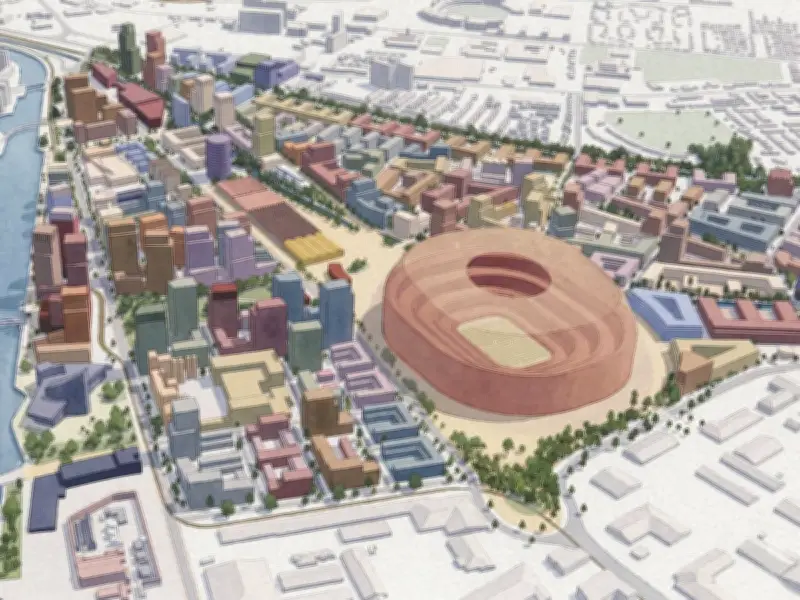
Manchester United are firmly convinced that a new 100,000-seater stadium will generate sufficient revenue to fund a winning football team, even if it means placing further debt onto a club that already carries borrowings of £1.3 billion. The Red Devils edged closer to making their ambitious new ground a reality on Thursday, when it was confirmed that the stadium will be constructed on a site 350 metres from the existing arena, as part of a sweeping regeneration of the surrounding area.
Yet serious questions linger over how a project initially pencilled in at £2bn will be financed, with some form of borrowing now widely regarded as inevitable. Collette Roche, CEO of the new stadium development at United, urged supporters not to become 'over-obsessed' with debt, insisting the stadium would ultimately pay for itself.
Stadium Revenue to Fund Team Success
'What you've got to remember is through building a stadium of 100,000 seats, where it's football first, and we deliver all our matches, but then in and around the matches, we do other stuff. People come, they stay for longer, we'll have other facilities, other experiences. That's going to generate a lot more revenue,' said Roche. 'The revenue that's going to be generated, where does that go? That'll go back into the club, that goes back into the team, that goes back into growing our football.'
'So as far as I'm concerned, whilst we can get over-obsessed with debt and borrowing, there's no stadium, I don't think, where you would not have some form of borrowing. We just need to make sure it's sensible and that it generates income and obviously money for the future of the club and doesn't distract from what we're here for, which is winning competitions, winning trophies, winning matches,' she added.
All Funding Options on the Table
United maintain that 'all funding options' remain on the table, including debt, equity, opening the project up to investors and selling shares. Roche revealed there had been 'a lot of approaches' from parties eager to get involved in the project. The final price tag remains uncertain, with United reluctant to commit to the £2bn figure put forward by chief executive Omar Berrada last March, particularly given the current turbulence gripping the global economy.
'That is the £2billion question, isn't it really?' said Roche. 'We don't know, is the answer, because obviously different stadiums have been built, we can look at what other stadiums have cost. You look at Everton, we can look at some of the ones further afield. But we're going to be building a very different stadium. It's going to be bigger than any other. It's 100,000 seats, nobody's done that. It's going to be done a bit further in the future, it's going to be done with these guys.'
'So there's not a price, I can't go and get a quote on this right now. We've been really clear from the onset this needs to be a sanity project, not a vanity project. And I think you've seen from the way we now run the club, having control of our costs is really important to us, focusing on putting our money where it matters is really important to us.'
No Public Funding for Stadium Construction
One financing route that has been firmly ruled out is public funding. While United and Trafford Council, who unveiled the Wharfside Strategic Masterplan on Thursday, are working in tandem to secure funds for surrounding infrastructure, Roche confirmed that taxpayers' money would play no part in bankrolling the stadium's construction.
'That's not something that we ever really wanted to or thought about doing,' she said. 'I think we as a football club need to stand on our own two feet and we need to pay for our stadium for a whole host of reasons. However, what you've seen today is massive; it's a lot more and a lot bigger than a stadium. So what we can't do is to pay for a new train station or new infrastructure because we won't have the funds for that, our funds will go on the stadium.'
Naming Rights Under Consideration
Selling naming rights is one potential avenue for raising funds, which Roche confirmed remains very much under consideration. 'I really don't know what the stadium will be called,' she said. 'What I will say is, and we've been really vocal, we are going to potentially look at naming rights for the stadium. It's an important revenue stream, it's something we've discussed with our Fans' Advisory Board and I think everybody realises affordable, accessible ticket prices are really important, and in order to do that, we do need to generate revenue streams in other places as well to build the stadium that everyone's said is going to be really expensive.'
Consultation and Timeline
United are set to launch a consultation with supporters before the design is finalised towards the end of the year and costs are established, but it appears increasingly evident that a new stadium is now a matter of when, rather than if. 'We've gone so far, part of it is around the masterplan,' said Roche. 'So now we've worked with the local council to say we are going to build a new stadium, so we're really committed to doing it. I think all of the other things are important, but we've got to make this work, right? We can't just abandon it. We're looking at making sure it happens, not will it happen or should it happen. The train's left the station and we just need to make it happen now.'