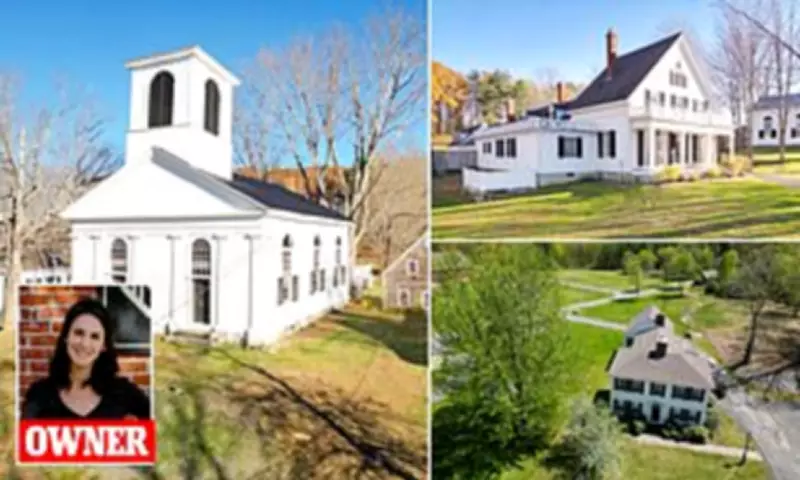
In the heart of central Maine, a sprawling 36-acre village known as Tut Hill has once again hit the market, marking its fifth listing as owners grapple with the challenge of offloading this one-of-a-kind property. Owner and real estate agent Anna Boucher has spent years attempting to sell the antique-laden estate, valued at $6 million, but has encountered limited interest from buyers despite the region's post-pandemic real estate boom.
A Property with Unmatched Character
Tut Hill, located just 12 miles outside of Augusta, boasts an impressive array of 21 buildings spread across 14,000 square feet. The landscape features a meticulously restored 1825 church, seven residential units, several barns, stables, and multi-bay garages. According to Boucher, the compound includes a total of 20 bedrooms and 16 bathrooms distributed across multiple homes and apartments, making it a unique but challenging sell.
'It's a white elephant type of property in the middle of central Maine,' Boucher told the Bangor Daily News. 'There aren't a lot of buyers for a property like this. We've gotten a lot of interest, but nothing has really come together.' She first listed the property five years ago, during a period when Maine's real estate market was thriving, yet buyers showed little appetite for such a multi-building compound, often balking at the hefty price tag.

The Legacy of Ken Tuttle
The village's origins trace back to Boucher's late father-in-law, Ken Tuttle, an antiques dealer with a passion for historic structures. In the 1960s, Tuttle purchased the main house, a Greek-revival style home spanning 3,800 square feet, which sat adjacent to a century-old church. He later acquired the church and repurposed it as the storefront for his antiques business.
Throughout the 1980s, Tuttle embarked on a mission to rescue worn-down Federal-style houses from central Maine, relocating them to the property piece by piece. 'Ken didn't set out specifically to do this venture. It sort of just fell into his lap,' Boucher explained to Realtor.com. 'His first gig was actually hanging wallpaper and painting, and then he saw these antique buildings and just gravitated toward them.' Most of the buildings have been restored to their former glory, preserving their historic charm.
Struggles in a Competitive Market
After Tuttle's passing in 2002, the village was inherited by the family. Boucher and her husband, Nathan Tuttle, have since managed the property, renting out the seven residences but now seeking to relinquish the landlord lifestyle. In 2021, they initially listed Tut Hill for $5.5 million, but after multiple relistings at the same price, they finally increased it to $6 million in October 2025.
Boucher attributes the price hike to significant investments in renovations and upkeep over the past five to eight years, covering buildings, roads, and landscapes. 'My husband has basically been using the majority of the property for his personal use, but there's a lot of potential for somebody to make an income from all that additional space,' she noted. The property includes vast lawns and appealing foliage, ideal for horses or other agricultural uses.
Envisioning a Future for Tut Hill
Potential buyers will need not only deep pockets but also creativity to transform the estate. Boucher suggests that Tut Hill could serve as a wedding venue, event center, gathering place, or even a bed and breakfast setup. 'The property would make a great wedding venue, event center, gathering place, or even a setup for a bed and breakfast,' she said. 'The buyer will definitely be someone who has a vision.'
Despite the challenges, Boucher remains hopeful that the right individual will see the potential in this historic village. The Daily Mail has reached out to Boucher for further comment, underscoring the ongoing interest in this unique real estate saga.