
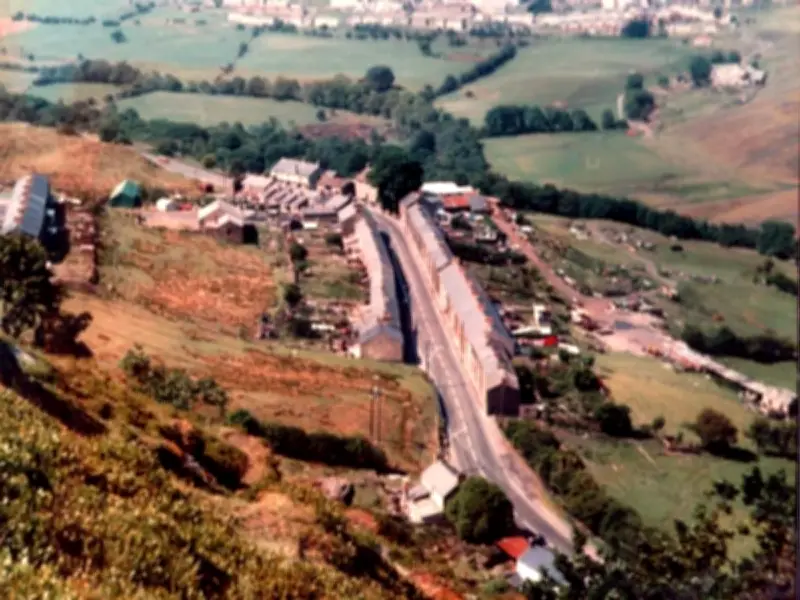
Demolition of Troedrhiwfuwch
In the mid-1980s, the entire Welsh village of Troedrhiwfuwch, known locally as Troedy, was systematically dismantled and bulldozed into history. Once a thriving community of 600 residents living in 94 houses across three streets, the village fell victim to its precarious location at the foot of the Cefn Brithdir mountain. Growing fears of a catastrophic landslide, reminiscent of the 1966 Aberfan disaster, prompted authorities to take drastic action.
Geological Instability and Landslide Threat
Elgar Lewis, former chairman of planning and vice chairman of Rhymni Valley District Council, explained: "No coal tips involved. A complex series of faults, allied to the pitch of the pennant sandstone, meant there was a danger that a major landslide might occur." Erratic loose boulders from the ice sheet and weathered rock posed constant danger, with evidence of slippage and subsidence from mine workings below. The mountain had been moving for decades, causing cracks in buildings, roads, and bridges.
As early as 1906, the Birmingham Mail reported a "gaping fissure in the mountain above the village" and a bridge at nearby Sebastopol was so affected that a man was stationed day and night to measure headroom and signal trains. Water supply disruptions occurred frequently, with Gelligaer Council waiving water bills for residents after a 1906 incident. In 1925, movement caused a "big breakage to the main water pipes," and in 1926, a horse fell into a crack on the mountain and had to be rescued with difficulty.
Scientific Confirmation and Decision to Demolish
Multiple inspections and reports documented the instability, culminating in 1975 research by Professor Geddes concluding that the village was "inherently unstable." The compulsory purchase order was issued, and by 1985, the village was flattened. Only two buildings survived: the post office, which remained a home until 2018 and was later renovated, and a second house that sold at auction for £49,050.
Community Life and Memories
Local historian Carys-Ann Neads, whose family lived in Troedy for generations, said: "It was the kind of old community where you lived there, you stayed there, you died there." Her mother Wendy recalled: "Growing up in the village was wonderful. We could go to anyone's house and be welcome." The village had two pubs, a church, chapel, library, school, shop, and post office. The primary school had only two classrooms and two teachers. The Troedrhiwfuwch Arms pub hosted Saturday night darts and singalongs.
Former resident Linda Davies summed up: "They say it takes a village to bring a child up, and it's true... We were just one big happy family."
War Memorial and Legacy
Research by Carys and Vince Davies, the last military person from the village, revealed that 110 men from 84 households (average age 22) left to fight in World War I. Sixteen were killed, with five dying on May 8, 1915, during the Second Battle of Ypres. Only four graves have been located. A war memorial garden, funded by Caerphilly RDP and the WG LEADER Fund, now stands on the site of St Teilo's Church, featuring a mural by Welsh graffiti artist tee2sugars.
Preserving the Memory
Today, the site is grass and trees, with only faint outlines of streets visible from the air. The village lives on through a website packed with information, photographs, press cuttings, and videos by Gareth Griffiths and ITV Cymru Wales, supported by funding from the Welsh Government Rural Communities Programme and Swansea University. Carys-Ann Neads concluded: "It's important to keep a community like this alive in people's memories."




