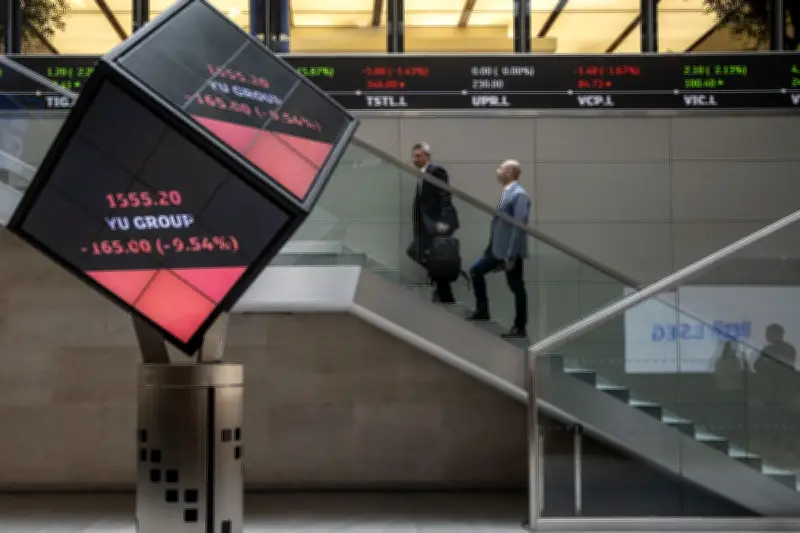
The FTSE 100 closed lower on Thursday as a tech sell-off and surging oil prices weighed on equities, with the index ending down 27.85 points, or 0.3%, at 10,725.03.
Global Markets Retreat
The FTSE 250 fell 228.07 points, 0.9%, to 24,211.71, while the AIM all-share shed 12.19 points, 1.6%, to 750.93. In Europe, the CAC 40 in Paris dropped 1.4% and the DAX 40 in Frankfurt declined 1.1%.
On Wall Street, the Dow Jones Industrial Average was down 0.3% at the London close, the S&P 500 fell 1.1%, and the Nasdaq Composite slid 2.0%.
AJ Bell investment director Russ Mould commented: “Concerns about the sustainability of AI spending hurt… markets and rising oil prices stoked concerns about the threat posed by inflation.”
Tech and Oil Pressures
Meta Platforms slid 5.6% despite better-than-expected third-quarter revenue, as chief financial officer Susan Li said its AI agent Muse’s computing intensity means expanding its user base will require significant investment, with total serving costs expected to rise. IBM fell 1.1%, Lam Research dropped 10%, and Tesla declined 0.9% after earnings.
Trade Nation analyst David Morrison described a “worrying reversal in investor sentiment” after Wednesday’s tech-led gains, adding that the market reaction to updates and the effect on the chip sector was “concerning”. He said: “Not only does it show that upside momentum has waned significantly, but that intermediate support levels are creaking dangerously.”
Morrison noted: “The common denominator appears to be revived concerns over AI infrastructure spending plans. The future commitments are enormous. Yet there’s little clarity over when, or even if, there will be a return on planned expenditure.” Nvidia chief executive Jensen Huang told CNBC that demand for neoclouds is “off the charts”, but capital is scarce and impeding growth.
Oil prices also climbed, with Brent quoted at 111.18 dollars a barrel at the London close, up from 109.14 dollars on Wednesday. The rise followed a New York Times report citing sources that the US and Israel have plans for renewed strikes against Iran after next month’s midterm US elections. President Donald Trump told reporters late Wednesday that Washington is not negotiating with Tehran and that something will happen “fairly soon”. Saudi Aramco told remaining staff to evacuate its headquarters on Thursday, two sources briefed on the matter told AFP, as disruption deepens following weeks of Houthi attacks. A late-night attack on Dammam airport killed two people and injured eight others.
Currency and Bond Moves
The euro eased to 1.1201 dollars from 1.1225 dollars, while the dollar traded at 157.20 yen, down from 158.13 yen. The pound was quoted at 1.3365 dollars, down from 1.3389 dollars, and edged up to 1.1933 euros from 1.1930 euros. The yield on the US 10-year Treasury narrowed to 5.02% from 5.11%, and the 30-year yield fell to 5.33% from 5.41%.
London Blue-Chip Movers
Rentokil Initial gained 8.6% after backing expectations and announcing a 200 million dollar (£149 million) share buyback. RBC Capital Markets analyst Andrew Brooke said: “The Q3 update was better than the market feared and further highlighted stability in the US business, as improvement initiatives start to take hold.”
London Stock Exchange Group rose 7.7% as it lifted annual guidance and confirmed a deal to acquire Octus for 3.54 billion dollars (£2.72 billion), “creating a leading proposition” in credit and private market data. Founded in 2013, New York-based Octus provides credit solutions across intelligence, data and analytics, serving customers across private, illiquid and distressed credit.
Mining stocks weighed on the FTSE 100 as metal prices fell. Antofagasta, Anglo American, Fresnillo and Endeavour Mining were down 6.2%, 5.6%, 6.5% and 3.9% respectively. Gold was quoted at 4,054.71 dollars an ounce, down from 4,139.04 dollars, silver fell 4.6%, and copper declined 2.7%.
J Sainsbury ended 2.2% lower as it reported slowing sales growth amid a competitive UK grocery scene, with like-for-like sales excluding fuel climbing 1.2% in its second quarter, shy of company-compiled market consensus of 1.9%. AJ Bell analyst Russ Mould said there were signs of “stuttering momentum” in the second quarter, adding: “Sainsbury’s is having to work hard to maintain its profitability and the contrast with Tesco, where margins are improving, will do nothing to dampen speculation about Sainsbury’s pursuing a merger in the sector.” Sky News earlier reported that Sainsbury’s held discussions on a potential merger with Morrisons earlier this year.
On the FTSE 250, Rathbones and Renishaw rose 4.4% and 0.2% respectively, but Inchcape plunged 9.3% after lowering its earnings and margin guidance for 2026 to reflect a “challenging situation in Australia”. The automobile distributor now expects a group operating margin for 2026 of around 5.5%, down from 6.0% previously guided, with adjusted earnings per share growth of around 10%. Ceres Power fell a further 11%, down 39% in the last month.
The biggest risers on the FTSE 100 were Rentokil Initial, London Stock Exchange Group, Smith & Nephew, IG Group Holdings, and Experian. The biggest fallers were Fresnillo, Antofagasta, Computacenter, Anglo American, and Rolls Royce Holdings.
Thursday’s local corporate calendar has a trading statement from betting operator Evoke, while the global economic calendar includes inflation figures from Japan, composite PMI readings including the UK at 9.30am, UK retail sales figures, and the US Michigan consumer sentiment index.