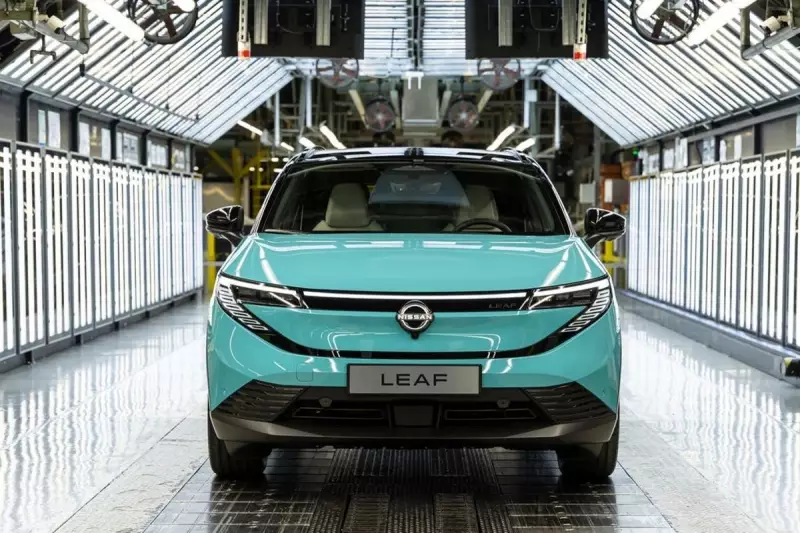
In a major boost for British industry, Nissan has announced it will manufacture the next-generation, all-electric Nissan Leaf at its massive Sunderland plant, safeguarding thousands of jobs and marking a huge investment in the UK's automotive future.
A New Chapter for Sunderland's Electric Dreams
The third-generation Leaf was unveiled to global media at the North East facility, signalling the site's pivotal role in Nissan's electric strategy. UK sales of the strikingly styled, teal blue model are scheduled to begin in late 2026. This move is a cornerstone of a broader plan that will see further electric models, including an all-new electric Juke, also produced in Sunderland.
The investment is substantial. Alongside the vehicle production line, a new battery gigafactory operated by AESC—a subsidiary of Chinese giant Envision—will run adjacent to the plant. This facility is the largest of its kind in the UK. Together, the developments represent one of the most significant investments in British manufacturing in recent years, designed to transform the site into a dedicated EV hub.

Securing Jobs and Boosting Capacity
This strategic shift is crucial for the local and national economy. The decision directly helps protect the 6,000 jobs at the Sunderland factory, with many more in the wider UK supply chain. Shunsuke Shigemoto, Nissan’s Vice President for Powertrains and Advanced Engineering, praised the Sunderland workforce as "key" to their decision, highlighting its efficiency and flexibility.
Mr Shigemoto expressed confidence that the new electric Leaf would help raise the plant's output back towards its full capacity of half a million vehicles per year. While much of the engineering for the new model was done in Japan, its production location underscores the UK plant's importance for the European market, with the only other production centre being in Tochigi, Japan, which supplies other regions.
Political Clouds on the Horizon
Despite the celebratory launch, political uncertainty casts a shadow. Recent statements from Conservative leader Kemi Badenoch about scrapping the 2030 zero-emission mandate for new cars, alongside scepticism from Reform UK and potential delays from the EU, introduce market doubts.
Friederike Kienz, Nissan's vice president for sustainability, addressed these concerns directly. While acknowledging that changing policy "will lower the pace" of EV adoption, as seen in Norway, she stressed that an electric future must remain the "endgame." The company believes the agile Sunderland operation can cope with disruption, though shifting goals could make the half a billion pounds invested appear poorly timed.
Ultimately, Nissan's commitment is a powerful vote of confidence in its UK workforce and infrastructure. As the first new-generation Leaf rolls off the line in the coming years, Sunderland will be at the heart of the UK's electric vehicle revolution, combining manufacturing prowess with cutting-edge battery technology.