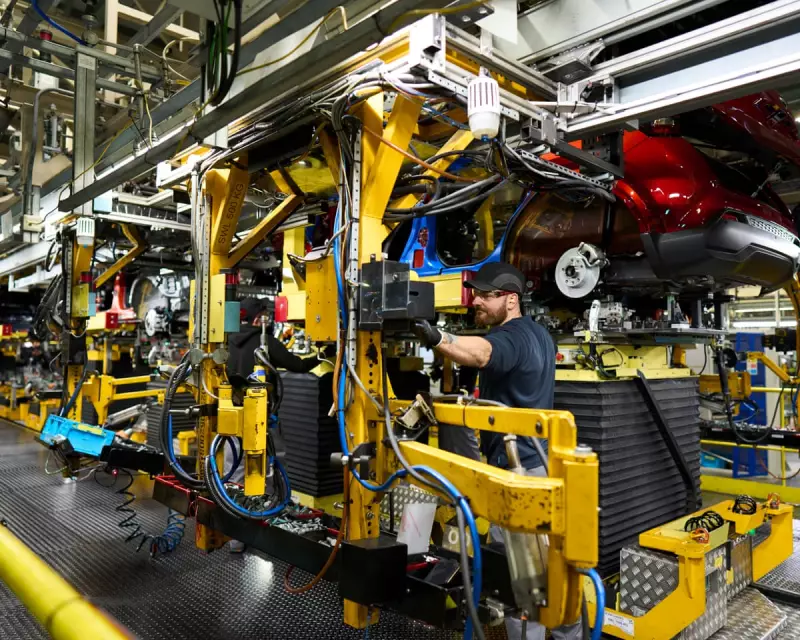
Nissan has officially commenced production of its third-generation Leaf electric vehicle at its Sunderland plant, the UK's largest car factory, following a major £450m investment in upgrades. The launch marks a significant moment for British automotive manufacturing, though it arrives amidst a global slowdown in the electric vehicle transition.
A Factory Future-Proofed for an Uncertain EV Market
At the heart of the Sunderland upgrade is a new, highly automated battery "marriage station." Here, robotic arms lift the crucial battery pack into the car body and secure it with 16 bolts in under a minute, maintaining the plant's high-volume flow. The investment was designed to provide flexibility, allowing the same production line to build the new Leaf alongside hybrid versions of the Qashqai and Juke.
Guy Reid, the plant's engineering general manager, stated the facility is now "future-proofed" for a full shift to electric vehicles. "When we introduce more electric vehicles, we don't have to modify this facility again," he explained. The plant has a theoretical capacity of 600,000 cars per year, though it produced only 282,000 in 2023.

Global Retreat from Aggressive EV Timelines
The launch coincides with a notable retreat from ambitious electrification deadlines across the industry. Just two years ago, Nissan pledged to sell only electric cars in Europe by 2030. However, the company's European boss, Massimiliano Messina, now refuses to commit to a date.
"If I might give a number, it will be wrong," Messina said when asked about an all-electric timeline for Europe. "I cannot give you a date by when. But I'm more confident that we talk about 2050." This shift mirrors a broader trend, with the EU recently watering down its 2035 ban on new petrol and diesel cars and the UK weakening its Zero Emission Vehicle mandate in April.
Part of Nissan's caution stems from internal challenges. The company is navigating its third turnaround plan following years of leadership turmoil after the arrest and dramatic escape of former chief Carlos Ghosn in 2018.
Government Support and Future Uncertainties
Securing the new Leaf for Sunderland was a major priority for the UK government. State aid disclosures reveal a £101m direct grant was awarded in 2022 for "a new all-electric vehicle," one of the largest subsidies since Brexit. Nissan itself invested £450m. This support likely helped shield the plant from recent global cutbacks, which saw Nissan announce the closure of seven factories elsewhere.
However, questions remain about filling the plant's capacity. One potential solution floated by Nissan's current CEO, Ivan Espinosa, involves building cars for its Chinese partner, Dongfeng. Messina confirmed the company is exploring "opportunities" but said there was "nothing concrete." For now, the focus is on regaining market share with new models, starting with the Leaf.
The batteries for the new Leaf are made next door at a new gigafactory operated by the Chinese-owned AESC. This facility has also scaled back, now capable of 15.8GWh per year—enough for about 300,000 cars—which is significantly less than initial plans for 38GWh.