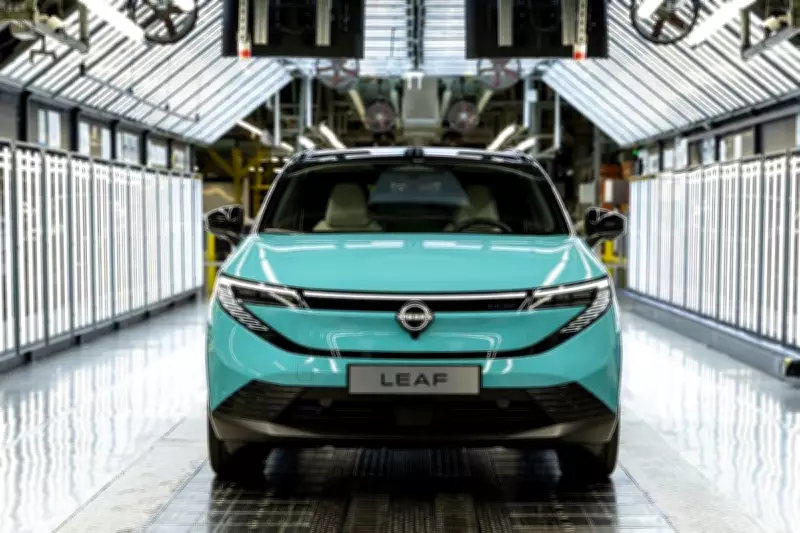
Nissan's chief executive has indicated the Japanese automotive giant would be willing to produce vehicles for Chinese manufacturers at its substantial Sunderland facility, marking a potential strategic shift in European automotive production.
Strategic Partnerships for European Market Access
During a presentation for the newly nominated World Car of the Year contender, the third-generation Nissan Leaf, CEO Ivan Espinosa addressed questions about potential platform sharing and manufacturing partnerships. When specifically asked whether Sunderland could produce vehicles based on the Leaf platform for Chinese brands seeking European market entry, Espinosa responded with notable openness.
"We're always open," stated Espinosa, referencing Nissan's existing collaboration with Mitsubishi in North America. "We remain of course open. We believe at least at this stage that creating more awareness of EVs is something that is necessary. And partnering and working with some other companies is something that helps bring more EVs to the market."

Economic Rationale Behind Manufacturing Openness
Espinosa elaborated on the commercial logic, highlighting how such partnerships could enhance Nissan's operational scale and business sustainability. "At the same time, of course it's no mystery – it helps us with our overall business by adding a bit more scale to the programmes," he explained. While confirming no immediate European agreements, the CEO emphasized "it's something that we are open to consider."
This potential move comes as Chinese automotive companies explore various strategies to establish European production bases, thereby circumventing potential import tariffs. Notable developments include BYD's forthcoming Hungarian factory and rumours about Chery potentially leveraging its Jaguar Land Rover relationship for UK production.
Sunderland's £450 Million EV Investment
Nissan's Sunderland plant represents a significant £450 million investment, currently producing the latest Nissan Leaf alongside adjacent battery manufacturing facilities. The original Leaf, launched in 2010, pioneered mass-market electric vehicles and won World Car of the Year in 2011.
Espinosa expressed hope that securing the award again would signal "Nissan is back, Nissan is a capable company, capable of delivering products that are very competitive and have a clear purpose." He described the Leaf's mission as creating "a no-compromise EV" to convince hesitant consumers to embrace electric mobility.
Shifting Business Priorities Amid Market Challenges
The announcement coincides with Nissan's strategic pivot from volume-driven growth to profitability-focused operations. Despite the Qashqai's continued popularity with its innovative e-Power hybrid system, Nissan experienced a concerning 10% UK sales decline in 2025, with a 2.1% European downturn in a marginally growing market.
"It's a difficult market everywhere," acknowledged Espinosa, outlining Nissan's revised approach. "One of the premises that we put into our Nissan plan was not to rely too much on the volume, but to have a decent business at the size that we have."
The CEO elaborated on this fundamental shift: "The goal for me is not to sell more cars, it's to make more money. It's really about how we can have a sustainable company with the size that we have... The priority is to have a healthy business."
Espinosa cited multiple industry pressures including rising regulatory costs, technological investments, and intensified competition from new market entrants as factors necessitating this strategic realignment toward organic, profitable growth rather than expansion at any cost.