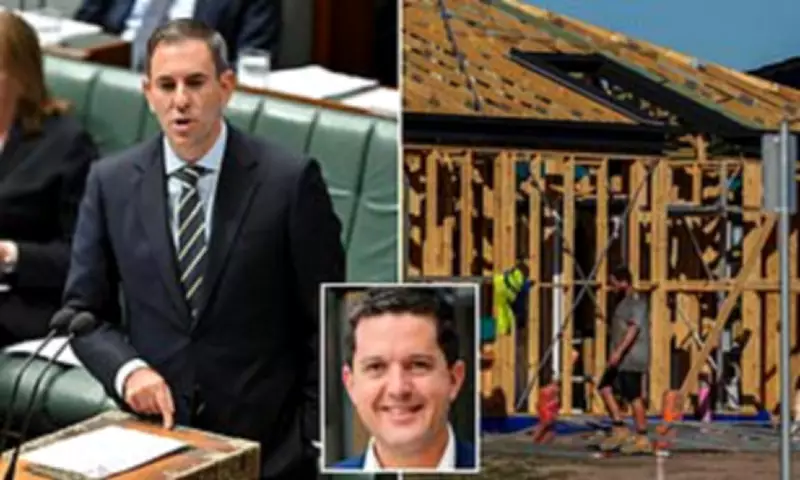
Australians eyeing property investments are facing a brutal new reality, finance experts have warned. If they buy the wrong home after July 2027, they could miss out on tax breaks worth almost $250,000 over a decade.
Under the Budget plan, which is not yet law, negative gearing would be limited to new builds from July 1, 2027. The current 50 per cent capital gains tax (CGT) discount would be replaced by an inflation-linked approach paired with a 30 per cent minimum tax on capital gains.
Treasurer defends crackdown
Treasurer Jim Chalmers has defended the government's contentious investor crackdown, arguing that decades-old settings have distorted the housing market. Existing investors would be protected under grandfathering, but buyers of established properties after Budget night would no longer be able to offset rental losses against wages, whereas new builds would be exempt from the changes.

Expert warns of pitfalls
UNSW finance professor Peter Swan said an investor who earns around $100,000 a year and buys an existing property worth $1 million could miss out on roughly $250,000 in concessions over a decade under the changes. But he cautioned would-be buyers not to blindly chase new-build tax perks.
'You would be a fool to do so if you think the present government will remain in power,' Professor Swan said. 'The moment your new property is built, it is no longer new. The government is then likely to change the rules once again to treat your new property like the old ones. Once again, negative gearing on your property could be introduced. The government has no credibility.'
Swan said investors still need to focus on fundamentals like location and capital growth, adding that the policy could reshape behaviour across the market. 'The budget measures seem to, and presumably are, designed to prevent investment in rental housing and thus sales of existing negatively geared rental housing,' he said. 'This will reduce the price growth in housing, or more likely, reverse it. All investors foolish enough to believe government promises will compete in the off-the-plan market.'
Market split warning
Strategic Property Group managing director Trent Fleskens said the changes would 'artificially split' the market by putting a premium on new builds while penalising established homes. 'It forces a wedge into the market where an asset's worth is dictated by its tax status rather than its utility or location,' Mr Fleskens said.
He warned there was a 'massive risk' investors would pile into off-the-plan apartments and house-and-land packages simply to chase concessions. 'Historically, whenever you see buyers piling into products purely for tax advantages, it ends in tears,' he added. 'We are going to see a repeat of the old mining town or spruiker cycles, where buyers rush into off-the-plan apartments and house-and-land packages solely to chase the concession. It creates an artificial bubble disconnected from genuine local demand.'
Mr Fleskens said the policy's 'fatal flaw' was that it could push investors into the same new-build market first-home buyers rely on. 'The Treasurer claims this protects first-home buyers, but by restricting tax concessions exclusively to new builds, the government is forcing cashed-up investors into direct competition with first-home buyers for the exact same entry-level house-and-land packages and apartments,' he said. 'It won't level the playing field; it will just supercharge price growth in the exact sector entry-level buyers rely on, effectively pricing them out of the new-build market too.'
CBA analysis
Commonwealth Bank senior economist Trent Saunders said the shake-up is likely to make established investment properties less attractive. As a result, he projected that house prices could be about 3 per cent lower than they otherwise would have been. But he said the CGT shift wouldn't always mean a bigger tax bill, because indexation taxes only the real gain after inflation, making outcomes dependent on inflation, house price growth and the investor's tax rate.

Saunders calculated that, with inflation at 2.5 per cent and a 10-year holding period, indexation becomes roughly equivalent to the old 50 per cent discount when annual house price growth is around 4.8 per cent. Below that, indexation can be more generous; above it, the previous discount tends to win. He also noted that investors who acquire new homes would have the option to choose either the current 50 per cent discount or the new indexation-minimum-tax treatment upon sale, further strengthening the incentive to purchase new builds.
'The effect depends on the relationship between inflation and house price growth, as well as the investor's marginal tax rate and the new 30 per cent minimum tax rate,' he said. 'If house prices rise only modestly above inflation, indexation can be more favourable than the previous 50 per cent discount. But if house prices rise strongly in real terms, the new system is less favourable.'