

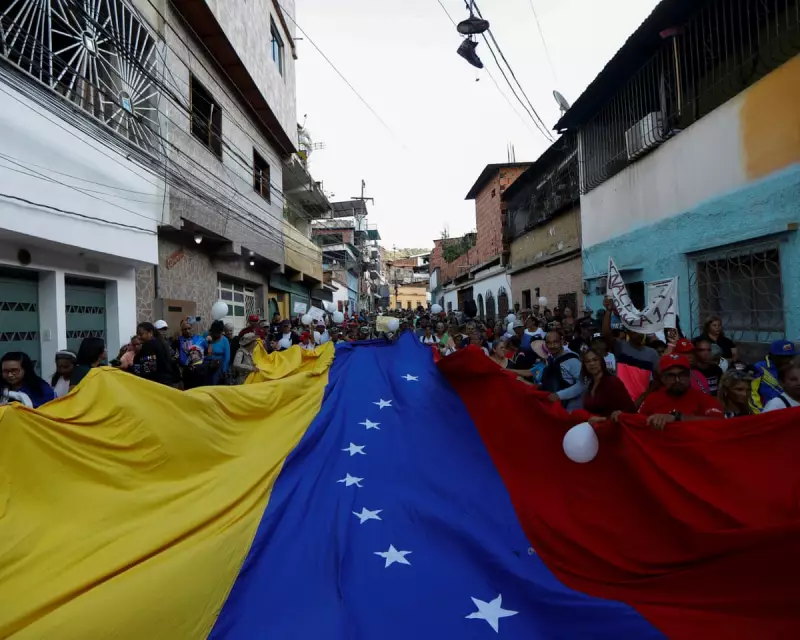
The United States has dramatically escalated its pressure on the government of Venezuelan President Nicolas Maduro, targeting the nation's vital oil industry with a sweeping new embargo. The move follows the recent US seizure of an oil tanker carrying Venezuelan crude, an act labelled "international piracy" by Caracas.
Trump's 'Total Blockade' and Military Buildup
In a late-night post on his Truth Social platform, former US President Donald Trump announced he was ordering a "total and complete blockade" on all sanctioned oil tankers entering or leaving Venezuela. While the exact enforcement mechanism remains unclear, the declaration signals a major intensification of US sanctions.
This follows the seizure of a Venezuelan oil tanker last week, a tactic Trump suggested could be repeated using the US Coast Guard. The White House has already moved thousands of troops and nearly a dozen warships, including an aircraft carrier, to the region. Trump boasted that Venezuela was "completely surrounded by the largest Armada ever assembled in the History of South America," warning it would "only get bigger."

Accusations and Geopolitical Tensions
The Trump administration has justified its actions by accusing Maduro's government of using proceeds from "stolen" oil to finance criminal activities, including drug trafficking and human smuggling. The US military has conducted strikes on boats allegedly carrying narcotics, resulting in at least 90 fatalities since September.
However, no public evidence has been provided linking these vessels to fentanyl or cocaine shipments bound for the US. Maduro has vehemently denied all accusations, countering that the US is using the "war on drugs" as a pretext to overthrow his government and seize Venezuela's vast oil reserves.
The political crisis is compounded by Maduro's controversial third term, which began in January following an election widely condemned as fraudulent, and the exodus of close to 8 million Venezuelans fleeing economic collapse.
Global Oil Market Reacts
The announcement of the blockade sent immediate ripples through global energy markets. Traders, fearing a significant disruption to supplies, pushed the price of Brent crude up by 1.5% to nearly $60 a barrel on Wednesday. This reversed a recent slide and underscored the market's sensitivity to geopolitical risk, even from a diminished producer.
Despite holding the world's largest oil reserves, Venezuela's output has crumbled to about 0.8% of global supply, exporting roughly 900,000 barrels per day, primarily to China. Oil revenue still finances over half of the government's budget, making it the regime's economic lifeline.
Analysts at Goldman Sachs suggest the blockade could tighten the market and raise prices in the short term. In the longer term, they note that any political upheaval leading to Western investment could eventually flood the market with increased Venezuelan crude.
The situation remains volatile, with US naval power encircling Venezuela and the Maduro government rallying supporters in protest, as seen in demonstrations where a giant Venezuelan flag was unfurled against what they view as American aggression.






