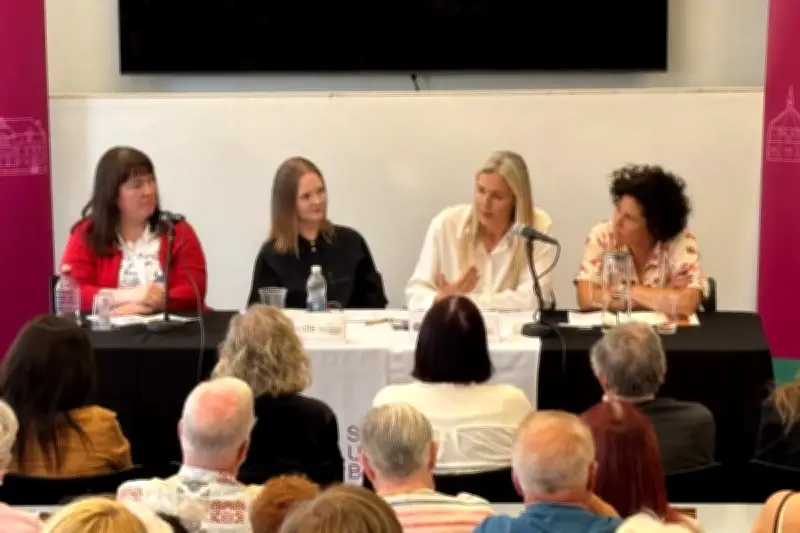
A panel discussion on Irish unity has warned that political unionism is in danger of losing the support of moderate unionists who feel increasingly apathetic. The event, titled 'Is Irish Unity Inevitable?', took place on Thursday as part of Féile an Phobail at St Mary's University College. Panelists included SDLP leader Claire Hanna, former UUP councillor Linzi McLaren, writer Claire Mitchell, and journalist Amanda Ferguson.
SDLP leader warns of push factors
Claire Hanna told attendees that she is seeing 'substantial' numbers of new members and engagers who are 'not from a traditional SDLP background', noting that identity is 'less binding' and people are 'excited to build something new'. She cautioned that alongside work needed to secure a yes vote in a Northern Ireland referendum on unity, effort is also needed on a parallel referendum in the Republic of Ireland.
'There is definitely a push factor from political unionism – hostility to Irishness, Irish culture, to ethnic diversity, LBGT issues, which absolutely switches people off,' she said. 'And there is a sense of them being a strategic disaster in terms of things like Brexit and the management of it, so people are open to persuasion.'
Ms Hanna warned against a 'flip of partition' and an attitude of 'we have the numbers now and you're stuck with it', instead advocating for co-designing a new Ireland. She said the Republic of Ireland has shown an 'incredible capacity for change' in terms of ethnic diversity and social change, adding the 'last big project is going to be embracing a tolerance of British identity and northern identity'.
Former UUP councillor speaks of abuse
Linzi McLaren said she has experienced abuse from some in the unionist community for engaging in the debate around a new Ireland, but described the potential she sees as 'so incredible that it is worth every second of the abuse I get'. 'I am certainly prepared to take it on the chin on behalf of those who are scared to speak up,' she added.
McLaren argued that what will determine a border poll will be 'demographics, but also the middle ground, unionists with a small u who feel they are politically homeless because political unionism doesn't represent them'. She said such unionists find political unionism 'too extreme', dislike loyalism, have no interest in bands or bonfires, and are horrified by race riots and burning of homes, but do not know who to vote for. 'It is at political unionism's peril to forget about those people because there are so many of us,' she said. 'Being a Protestant doesn't automatically make you a Unionist, there are lots of Protestants in that middle ground who would be more than happy to have the conversation about a new Ireland, and actually more than happy to call themselves a nationalist.'
Unionism as 'project of political conservatism'
Writer Claire Mitchell said a number of Protestants she knows are 'unity curious'. She described unionism as a 'project of political conservatism', and noted that having a close friend who is transgender makes her feel not part of it. 'The job of the unity movement is to create safe spaces where people can explore relationships without judgment,' she said.
Ms Mitchell also pointed to Brexit and the prospect of a government led by Nigel Farage as factors 'radicalising' unionists. 'If that is the government, I think people here will vote with their feet,' she said. 'It (the break-up of Britain) is in progress, it's under way, in regions of England, Scotland and Wales, everybody is experiencing the same kind of powerlessness, everybody wants to reclaim some democratic agency.'