

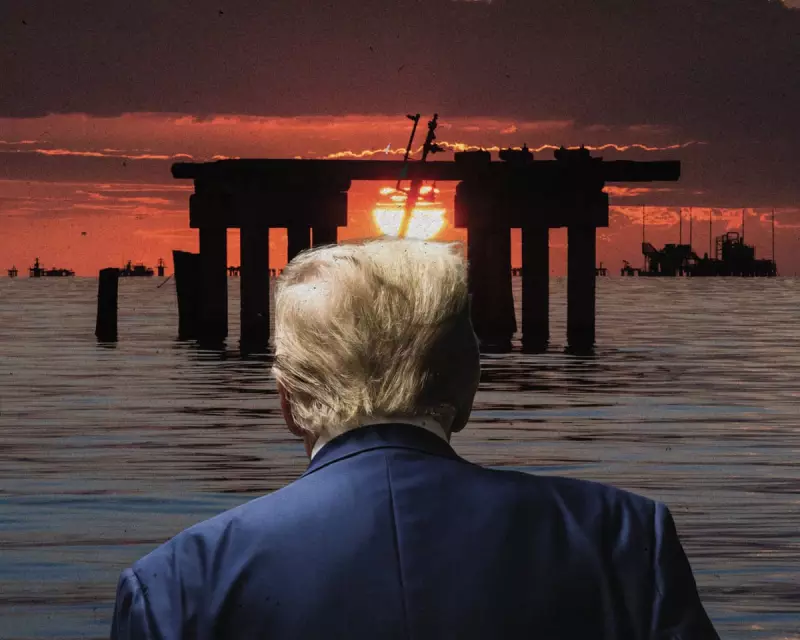
Former US President Donald Trump's vision of tapping into Venezuela's vast oil reserves is colliding with the hard realities of a saturated global market and significant political risk, making it an unattractive prospect for major energy firms.
A World Awash in Oil
The fundamental obstacle to Trump's Venezuelan ambitions is simple: the world is already flooded with crude. A primary driver of this surplus is the shale revolution in the United States itself. With prices languishing at levels not seen since 2021's pandemic recovery, the economic incentive to pursue costly new projects is weak.
This was starkly illustrated recently. Despite the US targeting Venezuela's president and street protests erupting in another major producer, Iran, the price of oil barely reacted. The commodity's resilience to geopolitical shocks underscores the current market's oversupply.

The High Cost of Venezuelan Crude
Venezuela's oil, while abundant in reserves, is particularly expensive and difficult to extract. According to analysis from Wood Mackenzie, the heavy crude from the Orinoco belt requires Brent prices of at least $80 per barrel to justify new investment. Currently, prices are hovering between $58 and $62.
Furthermore, years of underinvestment and mismanagement have crippled the country's infrastructure. In 2023, Venezuela produced just 880,000 barrels per day, a mere 1% of global output and only 4.3% of what the United States pumped domestically.
Political Peril for Investors
Beyond economics, the political risks are profound. As noted by Emily Meierding of the Naval Postgraduate School, "crude oil is not a quickly or easily lootable resource." Any contract signed with a Trump-backed entity or a puppet regime in Caracas would face extreme jeopardy.
The likelihood of a future government revoking such agreements is high, not to mention the physical threat of sabotage or bombing to facilities. This precarious environment led ExxonMobil's CEO, Darren Woods, to privately label Venezuela as "uninvestable" at present.
America's Declining Dependence
The strategic case for securing Venezuelan oil is also fading. The US economy has become dramatically more energy-efficient and less reliant on oil imports over the past two decades. Today, the US generates about three times more GDP per unit of energy consumed than it did at the turn of the century.
Oil's share in the national energy mix has also fallen, now accounting for 38% of use compared to 50% in the mid-1970s. The combination of efficiency gains and booming domestic shale production has sharply reduced dependence on foreign sources.
A History of Caution
Historical precedent suggests caution. Despite the US occupation of Iraq, the George W. Bush administration returned oil infrastructure to Iraqi government control rather than seizing it permanently. More recently, Western oil firms that rushed into post-invasion Iraq have largely withdrawn, frustrated by political turmoil and payment issues.
While the US has a long history of intervention in oil-rich nations—from Iran in 1953 to the Persian Gulf in the 1980s—the contemporary landscape is different. The economic and political calculus has shifted.
In conclusion, for American oil companies, the path of least resistance remains at home. Procuring oil from domestic shale fields is safer, easier, and ultimately cheaper than embarking on a high-risk, low-reward venture in Venezuela, regardless of presidential visions of buried treasure.






