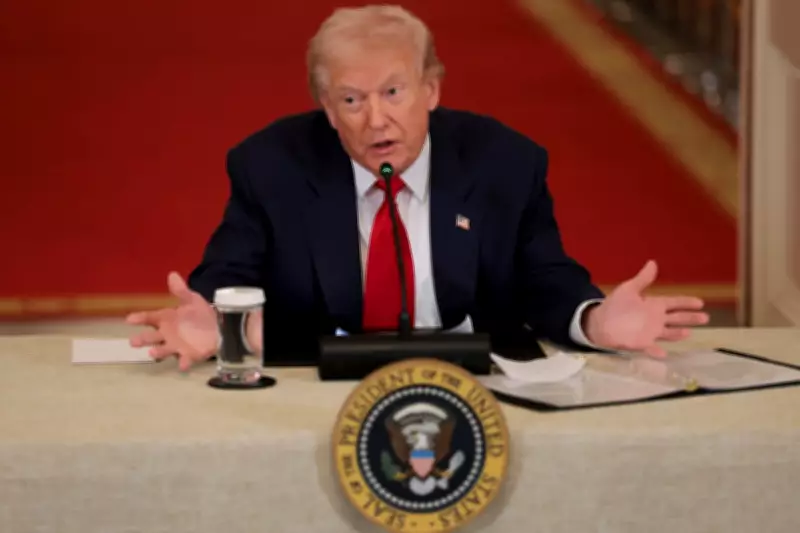
President Donald Trump has declared that escalating oil prices represent a "very small price to pay" for worldwide "safety and peace" as military conflict with Iran intensifies. The remarks come amid a significant surge in global oil markets, triggered by joint U.S. and Israeli strikes on Iran over a week ago.
Oil Markets Reach Critical Milestone
On Sunday, oil prices breached the $100-per-barrel threshold for the first time in more than three and a half years. The ongoing war in Iran has severely hampered production and shipping operations across the Middle East, creating sustained upward pressure on prices.
"Short term oil prices, which will drop rapidly when the destruction of the Iran nuclear threat is over, is a very small price to pay for U.S.A., and World, Safety and Peace," Trump wrote on his Truth Social platform.

Energy Secretary Acknowledges Consumer Pain
U.S. Energy Secretary Chris Wright has conceded that American drivers will likely experience elevated gasoline prices "for weeks" rather than months. While noting current prices remain $1.50 per gallon cheaper than during the Biden administration, Wright acknowledged the burden on households struggling with living costs.
"We want it back below $3 a gallon. And it will be again before too long," Wright stated during a CNN interview. When pressed for specifics, he clarified: "In the worst case, this is a weeks, this is not a months thing."
Market Reactions and Expert Predictions
The financial markets have responded dramatically to the geopolitical turmoil. Brent crude, the global benchmark, traded at $101.19 per barrel on Sunday, marking a 9.2 percent increase from Friday's closing price. Meanwhile, U.S.-produced West Texas Intermediate crude reached approximately $107.06 per barrel, representing a staggering 16 percent surge.
Multiple analysts have issued warnings about potential further increases. Patrick De Haan of GasBuddy estimates an 80 percent probability that the national average gasoline price will hit $4 per gallon within the next month. Currently, the U.S. average stands at $3.45 according to AAA data.
More dramatically, Goldman Sachs has projected oil prices could skyrocket to $150 per barrel by month's end. Qatar's energy minister has cautioned that the Iran conflict could trigger such dramatic price spikes that they might "bring down the economies of the world."
Supply Chain Disruptions Intensify
The conflict has created substantial disruptions to global oil infrastructure. Tanker traffic through the strategically vital Strait of Hormuz has declined sharply since hostilities began in late February. This narrow waterway, bordering southern Iran, typically facilitates approximately 20 percent of global oil shipments.
Additionally, Kuwait has significantly reduced production at multiple oil fields after exhausting available storage capacity for its crude oil. These supply constraints coincide with seasonal factors, as AAA notes that gasoline prices typically increase during spring months due to rising demand.
Political and Public Sentiment
Behind the scenes, the Trump administration faces mounting pressure to address energy affordability. According to Politico, industry executives report that Energy Secretary Wright and Interior Secretary Doug Burgum have been "screamed at" to find solutions for improving energy prices. The White House has dismissed these reports as "unverified gossip."
Public opinion appears divided on the administration's approach. A recent Marist poll indicates that 56 percent of Americans oppose U.S. military action in Iran. Simultaneously, affordability concerns remain paramount, with over half of voters describing healthcare, new vehicles, and weeklong vacations as financially unattainable according to a late February Ipsos survey.
Trump has maintained a seemingly unconcerned public stance regarding gasoline price increases. After initially acknowledging that pump prices would be higher "for a little while," he later told Reuters: "If they rise, they rise." This position underscores the administration's framing of energy market volatility as a temporary, necessary consequence of achieving broader geopolitical objectives.