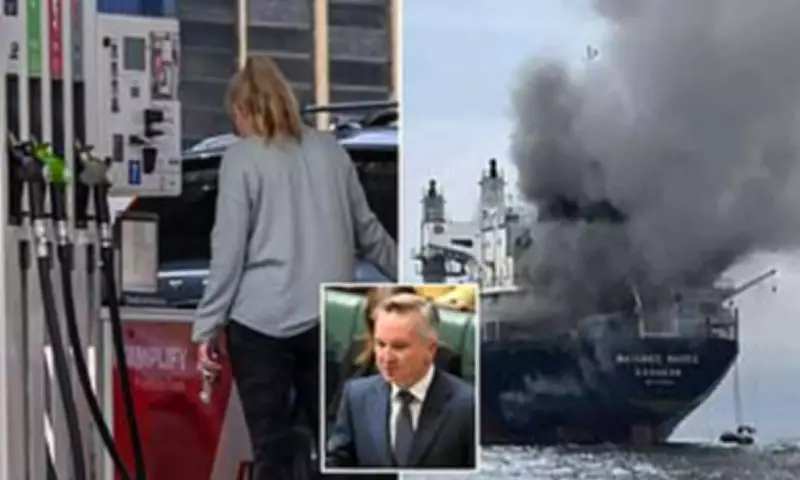
Australian Politicians Ordered to Stay Silent on Fuel Supply Crisis
A top defence analyst has revealed that Australian politicians were instructed to keep their mouths shut about the country's rapidly diminishing fuel supplies. This revelation comes amid growing concerns about national fuel security following recent US-Israeli strikes on Iran that have disrupted global oil shipments.
Global Shipping Chokepoint Closed
The military conflict has effectively closed the strategically vital Strait of Hormuz, which serves as the gateway for approximately 20 percent of global gas and oil shipping. Tankers have been left idle for more than a week, forcing producers to halt pumping operations while storage facilities work to clear existing supplies.
Compounding the crisis, Saudi Arabia's national oil company Aramco temporarily halted operations at its Ras Tanura refinery on the coast after it was struck by a drone attack. This disruption has sent shockwaves through global energy markets and raised urgent questions about fuel security worldwide.

Government Attempts to Calm Public Fears
Energy Minister Chris Bowen has attempted to extinguish growing public fears this week amid reports that Australians have started hoarding petrol in jerry cans. "Supply of diesel and petrol continues to arrive in Australia as expected and our backup reserves remain in place," he stated on Wednesday.
Bowen emphasized that while the international crisis is creating uncertainty globally, Australia remains well prepared. "Our strategic reserve is held under our government in Australia, not in Texas like it was under Angus Taylor," he added, drawing a distinction with previous policy approaches.
Whistleblower Reveals Political Silence
Former Deputy Chief of the Royal Australian Air Force, John Blackburn, has claimed that politicians across government were actively dissuaded from discussing Australia's fuel supply vulnerabilities. The retired fighter pilot, who authored a comprehensive report about Australia's liquid fuel security for the NRMA in 2014, expressed deep concern about the nation's dependence on overseas oil.
"We haven't made any progress. In fact, we've gone backwards," Blackburn told news.com.au on Thursday. "Back then we had seven refiners, we have two now. Twenty-five years ago, 40 percent of all our fuel came through Australian refineries and now it's less than 10 percent."
Blackburn revealed that while individual politicians recognized the seriousness of the situation, party leadership explicitly instructed them to remain silent. "Individuals knew, 'Hey, we needed to do something serious about this', but the leadership of the parties said 'It's not an election issue, keep quiet about it'."
Current Fuel Reserve Statistics
Minister for Industry and Innovation Tim Ayres has reinforced the Labor government's position that national fuel reserves have "not fundamentally changed" since the conflict began. He provided specific figures during an interview with ABC South Australia, detailing Australia's current fuel storage capacity.
"We have 36 days of petrol, so that's 1.56 billion litres of petrol. In jet fuel terms, 29 days or 802 million litres of jet fuel," Ayres explained. "Thirty-two days of diesel, about 2.97 billion litres of diesel are held either onshore or within our exclusive economic zone. Roughly 80 percent onshore."
Distribution Problems Compound Supply Issues
Gretta Barton, owner of Bartranz Petroleum which specializes in bulk fuel distribution across Queensland and New South Wales, told the Daily Mail that the current crisis represents more than just a supply issue. According to Barton, distribution problems are creating significant challenges, particularly as major oil companies have stopped supplying petrol to non-contract fuel distributors.
Many of these distributors supply agricultural communities that rely on consistent fuel access for farming operations. "If this continues another week a lot of people will be in a lot of trouble," Barton warned. "This has exposed Australia's vulnerability as far as refined product goes."
She added a sobering assessment: "Even without major oil companies profiteering there's clearly not enough fuel stored in our country that can be easily accessed."

The Daily Mail has contacted officials from both the Labor government and Opposition for further comment on these serious allegations about political silence regarding Australia's fuel security crisis.