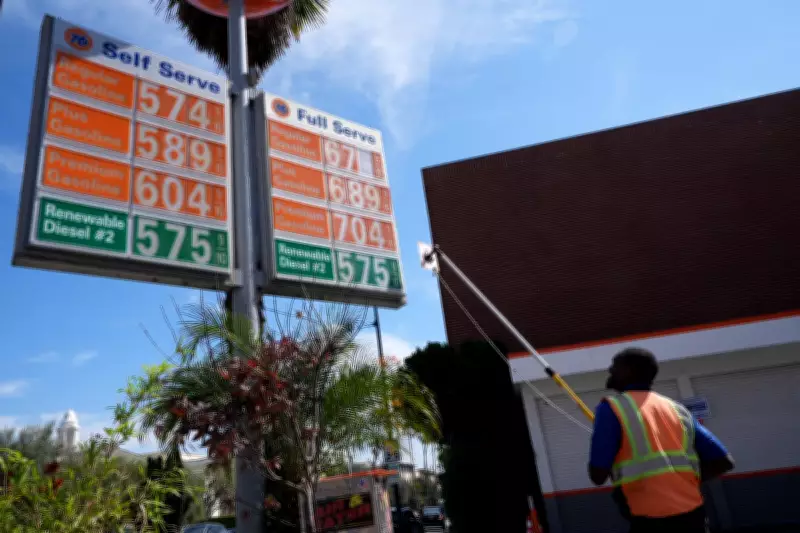
Oil and Gas Prices Skyrocket as Middle East Conflict Intensifies
The price of oil has surged dramatically, showing no signs of slowing its rapid ascent one week after major military attacks by the United States and Israel on Iran escalated into a full-scale war in the Middle East. This conflict has inflicted significant damage across the region, with nearly every country affected by missile or drone strikes.
Critical Shipping Routes Disrupted
The ongoing hostilities have left numerous oil tankers stranded in the Persian Gulf, unable to navigate safely through the strategically vital Strait of Hormuz. This narrow passage, bordered on its northern side by Iran, typically facilitates the transport of approximately 20 million barrels of oil daily. The disruption has been compounded by direct attacks on key oil and gas facilities throughout the Middle East, leading to severe interruptions in global energy supplies.
Price Surges Across Global Markets
By Friday, oil prices had surpassed $90 per barrel, with American crude settling at $90.90—a staggering 36% increase from the previous week. Meanwhile, Brent crude, the international benchmark, climbed 27% over the same period to reach $92.69. This dramatic price escalation is directly impacting consumers and businesses through higher costs for gasoline, diesel, and jet fuel.

In the United States, the average price for a gallon of regular gasoline rose to $3.32 on Friday, marking an 11% weekly increase according to AAA motor club data. Diesel fuel prices saw an even steeper rise, reaching $4.33 per gallon—a 15% jump from the previous week.
Global Impact and Consumer Reactions
The price shocks have been felt even more acutely in Europe and Asia, regions that depend more heavily on Middle Eastern energy supplies. According to Claudio Galimberti, chief economist at Rystad Energy, diesel prices have doubled in Europe, while jet fuel costs in Asia have risen by nearly 200%.
"It's crazy. It's not needed, especially at a time when people are already struggling," said Mark Doran, a driver filling his tank in Middlebury, Vermont. "I don't think there's been an end in sight to any Middle East conflict that's been started by us, so the fact that they say that there's going to be an end that quickly is not believable."
Escalating Conflict and Infrastructure Damage
Energy prices have climbed steadily throughout the week as Iran launched retaliatory attacks, including a drone strike on the U.S. Embassy in Saudi Arabia. The conflict has widened significantly, with Iran targeting a major refinery in Saudi Arabia and a liquefied natural gas facility in Qatar. These attacks have halted flows of refined products and taken approximately 20% of the world's LNG supply offline.
"We keep seeing news of vessels being hit or refineries or pipelines, so the list is very long," Galimberti noted. He estimated that roughly 9 million barrels of oil per day have been removed from the market due to damaged facilities or precautionary production shutdowns. "Right now, with all of this shut in, we are in a situation of extreme deficit."
U.S. Market Dynamics and Limitations
Although the United States is a net exporter of oil, this status does not insulate it from global price increases. Oil trades on international markets, meaning even domestically produced crude has risen in value due to Middle Eastern disruptions. Furthermore, American oil producers face significant limitations in responding to supply shortages.
"If you put more wells in the ground, there's about a six-month lag before you get that production uplift," explained Al Salazar, head of macro oil and gas research at Enverus. Additionally, most U.S. crude is light and sweet, while many coastal refineries are designed to process heavier, sour crude. This mismatch forces the U.S. to export some crude oil while importing refined products like gasoline.

Consumer Preparedness and Economic Concerns
Some Americans have taken proactive measures in anticipation of rising fuel costs. Jerry Dalpiaz of Covington, Louisiana began filling his vehicles and gas containers immediately after hearing about U.S. military operations against Iran. "I can weather the storm because I'm in good financial position, but I feel sorry for my fellow citizens who are living paycheck to paycheck," Dalpiaz said. "They need some relief and it doesn't seem to be coming anytime soon."
Government Response and Security Challenges
On Friday, President Donald Trump announced a plan to insure losses up to approximately $20 billion in the Gulf region, aiming to restore confidence in maritime trade and stabilize international commerce. However, energy experts remain skeptical about this approach.
"The problem is that in the oil trading, oil shipping world, people are worried about counterterrorism," said Amy Jaffe, director of the Energy, Climate Justice and Sustainability Lab at New York University. She emphasized concerns about automated drone speedboats, weapon-carrying drones, and maritime mines. "In order for the United States to create the atmosphere that undoes the current bottleneck at the Strait of Hormuz, there has to be some credible demonstration of solutions to the counter-terrorism problem."
Salazar questioned what effective security would look like if the Strait of Hormuz were reopened. "All it takes is one individual with a RPG to stand on the shore and take out a tanker, right?" he noted. "And this is forever, do you know what I mean?"
President Trump has stated that U.S. military operations against Iran are expected to last four to five weeks but acknowledged the capability to continue longer. On Friday, he appeared to rule out negotiations with Iran without what he termed "unconditional surrender."
"The more news we get, the more it seems like this is going to last a really long time," Salazar concluded, reflecting widespread uncertainty about the conflict's duration and its ongoing impact on global energy markets.