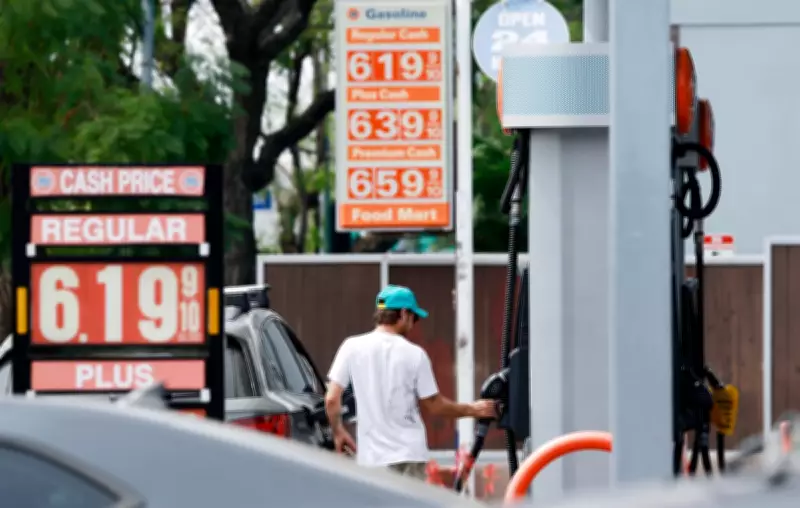
Los Angeles Drivers Adapt as Surging Gas Prices Challenge Car Culture
In Los Angeles, a city famed for its deep-seated love affair with the automobile, drivers are being forced to rethink their habits due to skyrocketing gas prices. With average costs nearing $5.90 per gallon and some stations charging a shocking $8, residents are employing innovative strategies to manage their budgets amidst the most expensive fuel in the United States.
The Impact on Daily Commutes and Creative Professionals
Jack Nooney, a musician and grocery deli employee, exemplifies the struggle. He drives nine miles daily from the San Fernando Valley to Santa Monica, a journey that often takes an hour in heavy traffic, burning significant fuel. Earning $20 per hour, Nooney notes that fuel expenses are consuming a larger portion of his tight finances. To cope, he shifts his manual transmission into neutral to coast downhill on the I-405, both southbound to work and northbound back home, and scouts for cheaper gas stations near his residence rather than in pricier Santa Monica.
For artists like Nooney, who form a vital part of Los Angeles' creative backbone, high gas prices add another layer of strain. When his band performs in West Hollywood, they carpool to save on fuel, as profit margins from shows are already slim. This adaptation highlights how economic pressures are reshaping the lifestyles of the city's independent talent.

Broader Economic and Global Factors Driving Prices
The surge in gas prices is directly linked to the Iran war, which the International Energy Agency reports has caused the largest supply disruption in global oil market history. Compounding this, California mandates a switch to a summer blend formula each spring, which is more environmentally friendly but costlier to produce, with consumers ultimately bearing the expense. These factors have created a perfect storm, pushing prices to unprecedented levels.
Strategies from Music Managers to Small Businesses
Chris Hardin, a music manager in Burbank, shares that one of his bands faced budget overruns on a month-long tour due to rapidly rising gas prices for their vehicles. With over two decades in the industry, Hardin calls this spike unprecedented. Personally, he rides his motorcycle to work multiple times a week to save fuel, only using his car for a 40-mile commute to teach at California Lutheran University, prioritizing safety over cost when classes end late.
For small businesses, the situation is particularly challenging. Jenise Blanc, co-owner of LA's Canyon Car Service with her husband Randy Chance, explains that as a small business reliant on LAX pickups and drop-offs, they cannot easily pass on fuel surcharges without risking customer alienation. While they utilize two electric cars in their fleet, most vehicles are fuel-dependent, forcing them to absorb increased costs. Blanc may consider raising rates by $5 to $10 if conditions do not improve, but for now, they are waiting and hoping for relief.
Long-Term Implications and Personal Adaptations
Nooney, a former Uber driver, recalls that even before the price hikes, making a living through ride-sharing was nearly impossible, requiring 12-hour days just to cover basic needs. His current job offers some stability, and he is seeking a transfer to a store closer to home. Meanwhile, he adopts further cost-cutting measures, such as packing lunch despite a 50% employee discount, emphasizing that in these times, saving wherever possible is essential.
As Los Angeles drivers navigate this new reality, their creative adaptations underscore a shifting relationship with car culture, driven by economic necessity and global events. The city's resilience is being tested, but for many, small changes are making a big difference in weathering the storm.