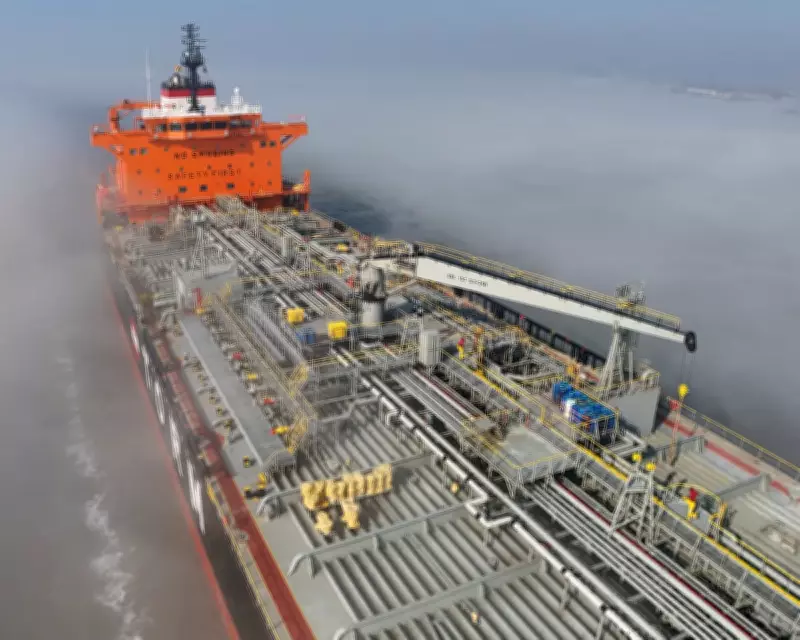
Global oil prices are poised for a dramatic surge, with Goldman Sachs issuing a stark warning that crude could breach the $100 per barrel mark within days and potentially skyrocket to $150 by the end of the month. This alarming forecast stems from severe supply disruptions in the critical Strait of Hormuz, triggered by the ongoing US-Israeli military conflict with Iran.
Supply Shock Exceeds Expectations
Oil exports via the Strait of Hormuz, a vital trade route connecting major producers to global markets, have plummeted more drastically than initially projected. Following the US-Israeli attack on Iran just over a week ago, Goldman Sachs had anticipated flows would drop to 15% of normal levels. However, Iran's effective blockade on tankers has reduced transit to a mere 10% of usual cargo volumes.
Historical Context and Economic Impact
The investment bank's analysis reveals this disruption is 17 times larger than the peak impact on Russian production in April 2022 after the invasion of Ukraine, which previously drove oil prices to $110 a barrel. In a note released on Friday night, Goldman Sachs stated, "Based on these new data, developments and the size of the shock, we now think that oil prices would likely exceed $100 next week if no signs of solutions emerge by then."

The bank further cautioned that oil prices, particularly for refined products, could surpass the peaks of 2008 and 2022 if flows through the Strait of Hormuz remain depressed throughout March. Historically, such spikes have led to severe consequences for the global economy, with the international benchmark briefly exceeding $120 in 2022 and reaching $145 in 2008.
Immediate Market Reactions
Oil prices have already surged, pushing above $90 a barrel late last week and recording the highest weekly gains since the Covid-19 pandemic six years ago. This included a sharp $10 increase on Friday alone. Over the weekend, US crude traded at more than $94 a barrel on brokerage IG's markets, indicating further rises when financial markets reopen.
Overall, oil prices have rocketed by more than 50% so far in 2026, having started the year at approximately $60 per barrel. Prices had been rising steadily in January and February before accelerating dramatically after the recent military actions against Iran.
Expert Analysis and Regional Tensions
Clayton Seigle, a senior fellow at the Center for Strategic and International Studies, noted, "The grace period given by the market to the Trump administration expired at the end of last week. A deficit of 20 million barrels per day is hitting global oil market balances with no sign of relief."
Seigle emphasized that President Trump's demand for unconditional surrender from Iran makes relief unlikely, adding that while observers initially thought his disregard for painful oil prices was a bluff, "it's now clear that it isn't."
Compounding Factors and Regional Shutdown Risks
Fears of a global oil shortfall intensified late last week when Qatar's energy minister predicted that if the war continues unabated, all Gulf energy exporters would be forced to shut down production within weeks, potentially driving oil to $150 a barrel.
Oil storage facilities in Saudi Arabia, the United Arab Emirates, and Kuwait are reaching their limits, meaning major oilfields may need to be shut down if crude cannot be exported via the Strait of Hormuz. This crisis has been exacerbated by Iran's Revolutionary Guards threatening to "set ablaze" any vessel using the trade route, which carries a fifth of the world's oil and liquefied natural gas.
Logistical Challenges and Insurance Concerns
Hundreds of tankers attempting to transit the strait have come to a complete halt. Seigle warned that Middle Eastern oil and gas exports will not resume "until shipowners, operators and insurers feel sufficiently safe from the threat environment posed by Iranian warships and aircraft, missiles, drones, speedboats and naval mines."
The White House has proposed countermeasures including rerouting Saudi crude via the Red Sea, drawing on emergency US crude reserves, or extending government-backed insurance to shipping companies. However, Seigle cautioned these measures would be insufficient to offset the loss of 20 million barrels of oil per day or anything approaching that volume.

As the situation continues to escalate without diplomatic resolution in sight, global markets face unprecedented pressure from what Goldman Sachs describes as one of the most severe oil supply shocks in recent history.